
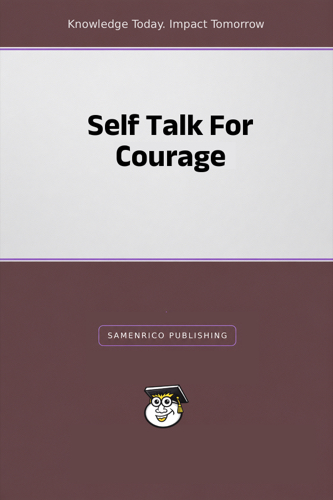
Self Talk For Courage eBook
Face fears with bravery affirming internal dialogu
by Fuchs Adelle
Face fears with bravery affirming internal dialogue before difficult tasks.
Formats
Free sample
Chapter 1: The Ancient Alarm--–- The first time I watched a client freeze mid-sentence, I thought something had gone terribly wrong. He was a surgeon—steady hands, decades of experience, a man who had held human hearts in his palms. But when he stood up to give a five-minute toast at his daughter's wedding, his mouth opened, nothing came out, and his face turned the color of a fire extinguisher. He later told me, "I thought I was having a stroke. My brain just...
stopped." He wasn't having a stroke. He was experiencing something far more common and far less understood: his ancient alarm system had hijacked his modern brain. That surgeon had held life in his hands without trembling, yet a wedding toast turned him into a statue. This is the paradox of courage, and it is the central puzzle this book exists to solve.Why do we freeze before a presentation but not before a car chase? Why can we navigate a marital crisis with clarity but stammer through a simple introduction at a networking event?
The answer lies not in your character, your confidence, or your competence. It lies in a small, almond-shaped cluster of neurons buried deep in your temporal lobe called the amygdala. And it is lying to you.This chapter dismantles the most damaging myth in all of self-help: that fear is a sign you are on the wrong path. That when your heart pounds and your palms sweat and your throat tightens, the universe is sending you a signal to stop, retreat, and wait until you feel ready. That myth has cost people promotions, relationships, dreams, and decades of regret.
It is time to kill it.You see, your brain's default self-talk—the voice that whispers "What if I fail?" "I'm not ready" "They'll think I'm stupid"—is not a character flaw. It is not a lack of confidence. It is not a sign that you need more preparation, more credentials, or more therapy. It is an evolutionary relic, a piece of ancient software running on modern hardware, and it is systematically misreading the world around you.The Brain's Operating System: Designed for Saber-Tooths, Not Spreadsheets To understand why you freeze before difficult tasks, you need to understand the architecture of fear. Your brain has two distinct operating systems, and they are constantly fighting for control.The first system is the Threat Response, driven by your amygdala.
This system evolved about 500 million years ago. Its job was simple: keep you alive long enough to reproduce. It scans the environment 24/7 for threats—not for bad presentations, not for awkward silences, not for criticism from your boss, but for actual, physical, mortal danger. A saber-toothed tiger in the bushes. A snake in the grass.
A rival tribe with spears.When the amygdala detects a threat, it triggers a cascade of physiological events that are nothing short of miraculous in their speed and ferocity. Your adrenal glands dump cortisol and adrenaline into your bloodstream. Your heart rate spikes to 140 beats per minute or more. Your breathing becomes shallow and rapid. Blood rushes away from your digestive system and your prefrontal cortex (the thinking part of your brain) and toward your large muscle groups.
Your peripheral vision narrows to a tunnel. Your hearing becomes hyper-focused on potential danger sounds. Your body is preparing to fight, flee, or freeze.Here is the critical insight that changes everything: your amygdala cannot tell the difference between a saber-toothed tiger and a quarterly review.To your ancient alarm system, a conference room full of executives looks exactly like a pack of predators. A blank page waiting for the first sentence of a novel looks like a dark cave with something moving inside it. A difficult conversation with your partner looks like a territorial dispute with a rival tribe.
The amygdala processes modern social and performance threats using the same neural circuitry it used to process physical predators. It is doing its job perfectly. The problem is that its job description is half a billion years out of date.The second system is the Challenge Response, driven by your prefrontal cortex. This system evolved much more recently—about 2 million years ago. Its job is executive function: planning, decision-making, impulse control, and what psychologists call "cognitive reappraisal," or the ability to reinterpret a situation.
When your prefrontal cortex is in charge, your heart rate stays in the 90–120 beats per minute range (elevated but manageable). Your breathing remains steady. Your vision widens. You feel focused, energized, and capable. You are not calm—calm is not the goal—but you are in control.The difference between these two responses is not the presence or absence of physiological arousal.
Both responses raise your heart rate. Both release adrenaline. Both change your breathing. The difference is the interpretation of that arousal. The threat response says: "You are in danger.
You will die. Run." The challenge response says: "You are activated. You are ready. Perform."Every moment of fear presents you with a choice between these two interpretations. And that choice is made not by your circumstances, but by your self-talk.The Fear as Data Framework: Your New Operating Manual This book introduces a single framework that will guide every chapter to come.
I call it the Fear as Data framework. It rests on three simple propositions:Proposition One: Fear is not a stop signal. It is a start signal.When you feel fear before a difficult task, the question is not "How do I make this feeling go away?" The question is "What is this feeling telling me to do?" Most people assume fear is a sign to stop, prepare more, wait, or retreat. But look at the evidence. When do you feel the most fear?
Before the biggest opportunities. Before the presentations that matter. Before the conversations you have been avoiding. Before the races, the performances, the creative leaps, the risks that could change your life. Fear is not a sign that you are on the wrong path.
It is a sign that you are standing at the threshold of something that matters.Proposition Two: Fear is data, not identity.Your fearful thoughts are not facts about who you are. They are data about what your amygdala has detected. When you think "I am going to fail," that is not a prophecy. That is data. Your amygdala has detected a high-stakes social situation and sent you an emergency alert.
The appropriate response is not to accept the alert as truth. The appropriate response is to read the alert, check the data, and decide whether it is accurate. Most of the time, it is not.Proposition Three: The intensity of your fear is a direct measure of the importance of the task.This is counterintuitive but empirically true. The more afraid you are, the more the task matters to you. Fear is not a sign of weakness.
It is a sign of investment. People who do not care do not feel fear before difficult tasks. They feel boredom. They feel apathy. They feel nothing.
Your fear is proof that you have something to lose, which is proof that you have something to gain. This insight alone changes…
This is the end of the free sample. Get the eBook to keep going. Buy now
About this book
Details
- Author
- Fuchs Adelle
- Publisher
- SamEnrico
- Language
- English
- Genre
- Non-Fiction, Self-Help, Courage
- Released
- 2026-06-09
- Pages (approx.)
- 152
- Available as
- eBook, Audiobook

Read better in the ZLOADR app
Your eBooks on your phone or tablet. Sign in with your SamEnrico account and start reading.
More by Fuchs Adelle
 Titanic Artifact Conservation HandbookFuchs Adelle$11.99
 Walking Meditation in AutumnFuchs Adelle$11.99
 Assertiveness for Flight AttendantsFuchs Adelle$11.99
 The Stoic's Fire: Marcus Aurelius and the Art of RulingFuchs Adelle$11.99
 Understanding Ophthalmoplegia Mental Retardation Lingua ScrotalisFuchs Adelle$17.99
 Bootcamp Curriculum vs CS SyllabusFuchs Adelle$12.99
 Healthcare and Pharma Pricing GuideFuchs Adelle$12.99
 IP Verification EngineerFuchs Adelle$11.99
 How to Become a Shaker-plate OperatorFuchs Adelle$11.99
You may also like
 Hong Kong Handover 1997Dunn Johnnie$11.99
 Zumba For Postnatal Recovery CourseNeal Christian$11.99
 Zumba for BeginnersLadner Nikia$11.99
 YouTube Comment Mining GuideHumes Pandora$12.99
 Worry Box MeditationCarlin Rudy$11.99
 Workplace Stress MeditationNguyen Lynn$11.99
 Workplace Stress and Sleep RepairHawley Ivory$11.99
 Workplace Perfectionism CureDelaney Jeffry$11.99
 Workplace Injustice Anger GuideWallen Isabelle$11.99
 Work Addiction and Burnout LinkGreenwood Ester$11.99
 Women in Yoga and WellnessBeattie Galina$11.99
 Women in Stand Up ComedyChun Evangeline$11.99