
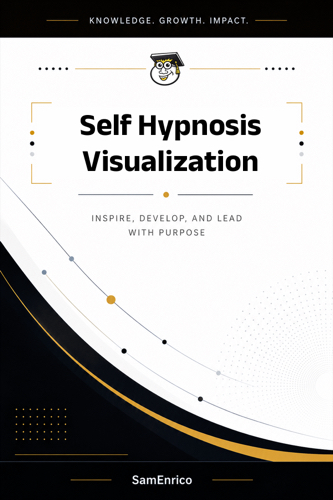
Self Hypnosis Visualization eBook
See and feel perfect performance in mind.
by Lay Alonso
See and feel perfect performance in mind.
Formats
Free sample
Chapter 1: The Silent Rehearsal--–- Every night, before you fall asleep, your brain does something remarkable. It takes the events of the day—the conversations, the successes, the embarrassments, the near-misses—and it replays them. Not randomly. Not chaotically. But with a specific purpose: to decide what to keep and what to discard.
Your brain is not a passive recorder of reality. It is an active sculptor, and the clay is your past experience. What you do not know—what most people never discover—is that you can take the chisel into your own hands. You can choose, deliberately and systematically, which performances to rehearse and which to erase. This is not self-help sloganeering.
This is neurobiology. This is the silent rehearsal that has been happening inside your skull every single night of your life, and the only question is whether you will direct it or let it direct you.The Myth of the Waking Mind Let us begin with a confession that most books on this topic are too timid to make: your conscious mind is not very good at changing you. It is excellent at planning, analyzing, and criticizing. It can make lists, set goals, and generate enthusiasm. But when it comes to actually rewiring the deep patterns of behavior—the way you breathe before a big speech, the hitch in your golf swing when you feel watched, the sudden blankness that overtakes your memory on stage—the conscious mind is often a spectator, not a driver.This is not a failure of willpower.
It is a feature of how your brain evolved. The conscious mind is relatively new in evolutionary terms, layered on top of older, more powerful systems that process information far faster than you can think. By the time your conscious mind notices that your hands are sweating, your subconscious has already decided you are afraid. By the time you tell yourself “I am confident,” your body has already received a different instruction.Consider a simple experiment. Try to fall asleep on command.
Try to digest your lunch by thinking about it. Try to regulate your own heartbeat with a logical argument. You cannot, because these systems are not under conscious control. They are under subconscious control. And here is the insight that changes everything: the same is true of your performance under pressure.
The way you move, speak, react, and recover in high-stakes moments is not directed by your conscious will in real time. It is directed by a much faster system—one that has been programmed by every rehearsal you have ever done, whether you knew you were rehearsing or not.Most people spend their entire lives programming this system by accident. Every time you replay a mistake in your head, you are rehearsing it. Every time you imagine an audience laughing at you, you are rehearsing that outcome. Every time you tell yourself “I always choke in the final minute,” you are writing code.
The tragedy is not that you cannot change. The tragedy is that you have been changing yourself all along, in the wrong direction, without realizing you had the power to choose.The Discovery That Changed Everything In the 1970s, a Russian psychologist named Nikolai Bernstein made a discovery that would have been revolutionary if the Cold War had not buried it in Soviet journals for a decade. Bernstein was studying how athletes learn complex movements. He noticed something strange: when an athlete physically practiced a skill, their brain did not simply record the successful attempts. It also recorded the failures, the near-misses, and the compensatory adjustments.
Physical practice was efficient, but it was not clean. The brain could not distinguish between a perfect repetition and a flawed one.Bernstein then designed a different experiment. He had athletes mentally rehearse a movement without moving a single muscle. They sat in a chair, closed their eyes, and imagined performing the skill perfectly, over and over. When he measured their neuromuscular activity, he found that the same neural pathways activated as during physical practice.
But there was a crucial difference: mental rehearsal produced only the perfect pattern. There were no failed repetitions. There were no compensatory adjustments. The brain was learning from a pure signal.This discovery—that mental rehearsal produces cleaner learning than physical practice—has been replicated hundreds of times. In one of the most famous studies, researchers at the Cleveland Clinic divided volunteers into three groups.
One group physically practiced a five-finger piano exercise. One group mentally rehearsed the same exercise while keeping their hands still. A third group did nothing. After five days, the physical practice group showed a 30% improvement. The mental rehearsal group showed a 23% improvement.
The control group showed no improvement. Think about that: sitting in a chair, doing nothing but imagining, produced nearly the same neural change as hours of physical practice.But there is an even more important finding buried in that study. When the researchers looked at the brain scans, they saw that the mental rehearsal group had developed stronger neural connections in the motor cortex than the physical practice group. Why? Because physical practice includes fatigue, small errors, and the friction of reality.
Mental rehearsal includes only the ideal. It is, quite literally, perfect practice.Why Your Brain Cannot Tell the Difference To understand why this works, you need to understand a fundamental property of your nervous system: it is not a truth detector. It is a pattern completer. Your brain does not ask “Did this actually happen?” before it lays down a neural pathway. It asks “Did this happen vividly and repeatedly?” If the answer is yes, the brain treats the event as real.This is not a bug.
It is a survival mechanism. Your ancestors did not have time to verify whether the rustling in the bushes was actually a predator before their body responded. Their brain completed the pattern—rustling equals danger—and they ran first, asked questions later. The same mechanism allows you to flinch at a movie monster even though you know it is not real. Your conscious mind knows the difference.
Your subconscious does not.This is the crack in the doorway through which you can step. If your subconscious cannot distinguish between a vividly imagined action and a real one, then you can practice any skill you want without ever leaving your chair. You can rehearse the perfect speech, the flawless performance, the calm response under pressure—and your brain will lay down the same neural pathways as if you had actually done it.But there is a catch, and it is a serious one. The image must be vivid. It must be repeated.
And it must be associated with the right emotional state. Vague, half-hearted visualization—the kind where you sort of see yourself succeeding while also sort of worrying about failing—does not work. That is not perfect practice. That is mixed practice, and your brain will learn the mixture.The Hidden Variable No One Tells You About Every book on visualization mentions the importance of vivid imagery. Few of them tell you the single most important variable: state.
The same image rehearsed in a state of relaxed concentration produces a completely different neural outcome than the same image…
This is the end of the free sample. Get the eBook to keep going. Buy now
About this book
Details
- Author
- Lay Alonso
- Publisher
- SamEnrico
- Language
- English
- Genre
- Non-Fiction, Self-Help, Visualization
- Released
- 2026-06-09
- Pages (approx.)
- 129
- Available as
- eBook, Audiobook

Read better in the ZLOADR app
Your eBooks on your phone or tablet. Sign in with your SamEnrico account and start reading.
More by Lay Alonso
 Child Loss And Social LifeLay Alonso$11.99
 Paint Chip Trace EvidenceLay Alonso$11.99
 Financial Burnout Recovery GuideLay Alonso$11.99
 The Micronutrient Hope GuideLay Alonso$11.99
 Single Parent Infant LossLay Alonso$11.99
 Anki Web Mobile GuideLay Alonso$11.99
 Agostinho Neto Angola MPLALay Alonso$11.99
 The Vanishing of El Presidio: Argentina's Forgotten Prison UprisingLay Alonso$11.99
 Hippocrates and the Birth of Medicine: The Western Healing RevolutionLay Alonso$11.99
 Lowchen: Little LionLay Alonso$11.99
 How to Produce FlockingLay Alonso$11.99
 How to Produce a Scouring PadLay Alonso$11.99
You may also like
 White Room InductionHostetler Vasiliki$11.99
 The Gambling Free Identity VisualizationFinn Clement$11.99
 Spending Visualization ExerciseCantwell Michaele$11.99
 Guided Imagery for RestGuillen Stevie$11.99
 Financial Visualization PracticeIsbell Gerri$11.99
 Emotional Regulation VisualizationFelix Lanell$11.99
 Anger Visualization TechniquesYounger Verona$11.99
 Visualization Sleep MeditationStull Dodie$11.99
 Visualization for ConfidenceMilliken Bok$11.99
 Road Rage Visualization GuideStratton Latrina$11.99
 The Affirmation Visualization ComboHopper Nyla$11.99
 Teen Visualization Self EsteemClick Jere$11.99