
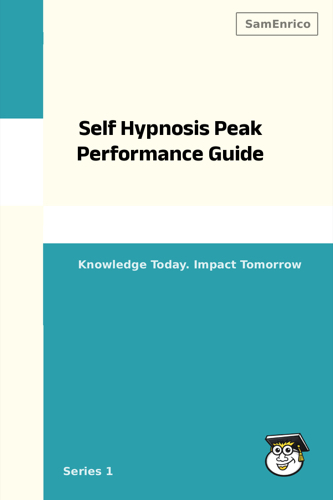
Non-FictionSelf-Help / Sports Psychology
Self Hypnosis Peak Performance Guide eBook
Teaches athletes to enter focused trance states fo
Teaches athletes to enter focused trance states for enhanced strength, speed, and endurance.
Formats
Free sample
Chapter 1: The Natural Trance--–- You have already been hypnotized thousands of times in your life. You just did not call it that.Think back to the last time you drove home from work and realized you had no memory of the last ten miles. Your hands were on the wheel. Your foot was on the pedal. You stopped at red lights.
You signaled before turns. You did everything correctly. But your conscious mind was somewhere else—planning dinner, replaying a conversation, worrying about tomorrow.That is hypnosis. That is trance. That is your brain doing what it does naturally, without instruction, without a pocket watch, without anyone swinging a pendulum in front of your face.Highway hypnosis is not a mysterious phenomenon.
It is not a sign of fatigue or distraction. It is your brain’s default mode of operating efficiently. Your conscious mind can only process about 120 bits of information per second. Your unconscious mind processes millions. When you drive a familiar route, your conscious mind hands the wheel to your unconscious because the unconscious is faster, smoother, and more reliable.This chapter will reframe everything you think you know about hypnosis.
You will learn that trance is not weird. It is not dangerous. It is not about losing control. It is about focused attention. And most importantly, you will learn that athletes already have a massive advantage when it comes to self-hypnosis—because you have already been in trance during your best performances.The Ninety Percent Myth and the Real Truth Let me clear something up immediately.
You may have heard that humans spend ninety percent of their waking hours in trance. Or that ninety percent of athletic performance is mental. These numbers are repeated so often in pop psychology and self-help that they have taken on the authority of fact.They are not facts. They are approximations. They are rhetorical devices.
And they have caused more confusion than clarity.Here is the real truth. Researchers who study spontaneous trance states—highway hypnosis, daydreaming, flow, absorption in movies or music—estimate that these states occupy a significant portion of waking life. Not a specific percentage, because the percentage varies dramatically by individual, activity, and environment. A person driving the same route for the tenth year in a row will experience more highway hypnosis than a delivery driver navigating new streets every day. A person who loves their job will experience more flow than someone who watches the clock.The specific number does not matter.
What matters is this: trance is normal. Trance is natural. Trance happens to everyone, every day, often without their awareness.The same is true for mental factors in athletic performance. Once an athlete has achieved a baseline level of physical fitness, the difference between good and great is often determined by mental factors—focus, confidence, emotional control, the ability to enter flow. This has been documented by sport psychologists like Dr.
Jim Loehr (1994) and Dr. Michael Gervais. But the exact percentage varies by sport, by athlete, and by situation. A weightlifter may need more mental control for a one-rep max than a marathon runner needs for the middle miles of a race.Do not get stuck on the number. Get stuck on the principle: your mind is the most under-trained asset in your athletic arsenal.
And self-hypnosis is the most direct path to training it.What Trance Is (And What It Is Not)Let me give you a working definition of trance that will serve you for the rest of this book.Trance is a state of focused attention with reduced peripheral awareness.That is it. That is the whole definition.When you are in trance, your attention narrows. Instead of being aware of everything around you—the temperature of the room, the texture of your clothing, the sound of traffic, the weight of your body, the thoughts about tomorrow—your awareness contracts to a single point. The highway. The movie.
The conversation. The barbell in your hands.This narrowing of attention is not a loss of control. It is a gain of focus. You are not becoming less conscious. You are becoming more conscious of one thing and less conscious of everything else.Consider the difference between a cheap camera and a professional camera.
A cheap camera keeps everything in focus—the foreground, the middle ground, the background. A professional camera allows you to focus on a single subject while blurring the background. The professional camera is not broken. It is not losing information. It is prioritizing information.Trance is the professional camera.
Trance prioritizes. Trance filters. Trance removes the noise so you can hear the signal.What trance is not: Trance is not sleep. In sleep, you lose consciousness. In trance, you are more conscious, not less.
Trance is not mind control. No one can make you do anything against your will in trance. Stage hypnosis works because the volunteers are willing participants who want to perform. Trance is not dangerous. Trance is a natural neurological state that your brain enters multiple times per day without any negative effects.The fear of hypnosis comes from stage shows and Hollywood movies.
Svengali. The Manchurian Candidate. Zombies. None of that is real. Hypnosis cannot make you cluck like a chicken unless you want to cluck like a chicken.
Hypnosis cannot make you reveal secrets you want to keep. Hypnosis cannot make you violate your moral code.All hypnosis is self-hypnosis. The hypnotist is just a guide. You are the one entering trance. You are the one in control.
You are the one who decides whether to accept a suggestion.The Athlete's Unfair Advantage Here is something that most self-hypnosis books do not tell you. Athletes are already better at trance than the general population. You have an unfair advantage. You just have not been using it.Consider what athletes do every day. You visualize.
Before a race, a lift, a match, you see yourself performing. You run the movie in your head. You feel the movement. You hear the crowd. That is a trance-adjacent state.
Visualization narrows your attention to a single imagined scene. It reduces awareness of your actual environment. It is, for all practical purposes, a self-induced trance.Consider your pre-performance routine. The deep breath before the starting pistol. The ritual of chalking your hands before a heavy deadlift.
The bounce of the basketball before a free throw. These routines are anchors—physical triggers that shift your brain into performance mode. Anchoring is a core technique of self-hypnosis. You have already been doing it.Consider your best performances. That race where everything felt easy.
That lift where the weight felt light. That match where you could not miss. You were in flow. You were in the zone. You were in trance.
Your conscious mind stepped aside. Your unconscious took over. You stopped trying and started doing.You have already touched the edge of trance during your best performances. This book is about learning to enter that state on command, every time, no matter the circumstances.The general population has to learn trance from scratch. They have to practice relaxation.
They have to learn to quiet their minds. They have to build the skill of focused attention.You already have these…
This is the end of the free sample. Get the eBook to keep going. Buy now
About this book
Details
- Author
- Faison Karleen
- Publisher
- SamEnrico
- Language
- English
- Genre
- Non-Fiction, Self-Help / Sports Psychology
- Released
- 2026-06-07
- Pages (approx.)
- 120
- Available as
- eBook, Audiobook

Read better in the ZLOADR app
Your eBooks on your phone or tablet. Sign in with your SamEnrico account and start reading.
More by Faison Karleen
 Senior Memory Loss EsteemFaison Karleen$11.99
 Sibling Loss Support GuideFaison Karleen$11.99
 World of Warcraft Raid AddictionFaison Karleen$11.99
 The Forbidden Scrolls: How a Secret Team Saved China's Ancient Art TreasuresFaison Karleen$11.99
 Reservation System ManagerFaison Karleen$11.99
 How to Produce Multipurpose AdhesiveFaison Karleen$11.99
 How to Start a Bird Skin Production From Ranching Operation Business (Beginners Guide)Faison Karleen$11.99
You may also like
 Hong Kong Handover 1997Dunn Johnnie$11.99
 Zumba For Postnatal Recovery CourseNeal Christian$11.99
 Zumba for BeginnersLadner Nikia$11.99
 YouTube Comment Mining GuideHumes Pandora$12.99
 Worry Box MeditationCarlin Rudy$11.99
 Workplace Stress MeditationNguyen Lynn$11.99
 Workplace Stress and Sleep RepairHawley Ivory$11.99
 Workplace Perfectionism CureDelaney Jeffry$11.99
 Workplace Injustice Anger GuideWallen Isabelle$11.99
 Work Addiction and Burnout LinkGreenwood Ester$11.99
 Women in Yoga and WellnessBeattie Galina$11.99
 Women in Stand Up ComedyChun Evangeline$11.99