
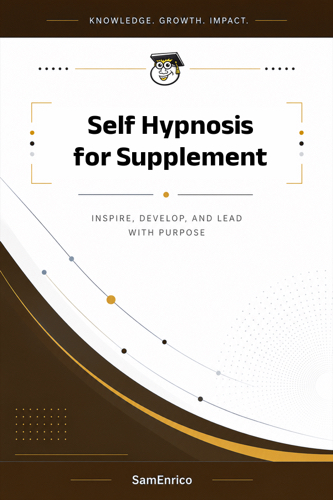
Non-FictionSelf-HelpSupplements
Self Hypnosis for Supplement eBook
Enhance placebo effect of sports supplements.
by Cobb Vincent
Enhance placebo effect of sports supplements.
Formats
Free sample
Chapter 1: The $60 Billion Ghost--–- The first time I watched an athlete drink a sugar solution and then deadlift 50 pounds more than their recorded max, I thought I was witnessing fraud. The second time, I thought I was witnessing magic. The third time, I realized I was witnessing neuroscience.The athlete in question was a regional-level powerlifter named Sarah. She had plateaued at a 315-pound deadlift for eleven months. Her coach, a frustrated but clever sport psychologist, handed her a white paper cup filled with tap water and a single dissolved sugar cube.
He told her it was a "new German-engineered osmotic stimulant" that had been shown to increase intra-muscular hydration by 22% in clinical trials. He used words like "phosphocreatine saturation" and "neural drive amplification." Sarah believed him completely.Thirty minutes later, she pulled 365 pounds off the floor.That is a 50-pound personal record, achieved on nothing more than table sugar and trust. The coach later confessed the deception. Sarah’s response was not anger but confusion. "But I felt it," she said.
"I felt the energy. I felt my muscles fill up. It wasn't fake."She was right. It wasn't fake. The feeling was real.
The cause was not the sugar cube—it was her brain’s interpretation of the sugar cube. And that distinction, more than any single insight in this book, is the key to unlocking the 47% of your supplements that you have been throwing away.This chapter is called The $60 Billion Ghost because the supplement industry is built on a ghost—a hidden variable that no bottle, no powder, and no pill can capture. That variable is belief. And belief, as you are about to learn, is not a soft, fuzzy, motivational concept. It is a hard, measurable, neurochemical event that determines whether the creatine you just paid forty dollars for becomes a performance rocket or an expensive urine sample.The Dirty Secret of the Supplement Aisle Walk into any supplement store—GNC, Vitamin Shoppe, or the grimly lit online marketplace of Amazon—and you will see a cathedral of promises.
Tubs with names like "Annihilation," "God of Rage," and "Nuclear Pre" line the shelves. The labels feature exploding molecules, lightning bolts, and muscular torsos airbrushed to anatomical impossibility. Each product claims to be "clinically shown" or "university tested" or "the most advanced formula in history."Here is the truth that no supplement company will ever put on a label: approximately 30 to 50 percent of any supplement's observable effect comes from the user's expectation that it will work. This is not speculation. It is the consensus of decades of placebo-controlled research across sports science, nutrition, and performance psychology.Consider the most famous study in the history of sports placebo research.
In 2007, a team of Italian scientists led by Dr. Fabrizio Benedetti—arguably the world's leading authority on placebo effects—gave a group of trained cyclists a substance they were told was a powerful new performance-enhancing drug. In reality, it was saline solution. Nothing more than salt water. The cyclists were told to ride to exhaustion on a stationary bike.
The saline group rode significantly longer and reported lower perceived exertion than a control group who received nothing. Their brains had released endorphins and dopamine because they believed a drug was helping them. The belief was the drug.Now let that sink in. A salt water injection, given to world-class athletes, improved their endurance. Not because salt water is a performance enhancer—it is not—but because their brains, anticipating improvement, manufactured the very chemistry of improvement.This is not a flaw in human cognition.
It is a feature. It is the result of three hundred million years of evolutionary fine-tuning, in which the brain learned to prepare the body for what it predicted was coming. When you believe a substance will give you energy, your brain releases glucose into the bloodstream and catecholamines into the synapses. When you believe a substance will reduce pain, your brain floods the periaqueductal gray with endogenous opioids. When you believe a substance will make you stronger, your brain lowers the gain on the neural signals that create the sensation of fatigue.The ghost in the machine is not a ghost at all.
It is a neurochemical factory, and you have been leaving it on idle.The Performance Triad: Endorphins, Dopamine, Adrenaline To understand how belief becomes biology, you need to meet the three molecules that will appear throughout this book. I call them the Performance Triad because they work together, like three musicians in a jazz trio, to create the state we call "peak performance."Endorphins are your body's internal painkillers. They are structurally similar to morphine and heroin, but produced entirely within your own nervous system. When endorphins bind to opioid receptors in your brain and spinal cord, they block pain signals and produce a state of mild euphoria. This is the molecule responsible for the "runner's high" and for the uncanny ability of athletes to ignore discomfort during competition.
The placebo effect is exceptionally good at triggering endorphin release because the brain, anticipating pain relief, pre-emptively deploys its own analgesics.Dopamine is the molecule of motivation and reward. It does not cause pleasure directly—that is a common misconception—but rather causes anticipation of pleasure. Dopamine is what makes you lean forward, reach for the barbell, and want to try one more rep when your body is screaming to stop. It is the chemical signature of "I can do this." Placebo studies using PET scans have shown that simply believing you have received a performance-enhancing substance increases dopamine release in the striatum, a brain region critical for movement initiation and effort allocation.Adrenaline (also known as epinephrine) is the molecule of physical arousal. It increases heart rate, dilates airways, shunts blood to working muscles, and releases stored glucose from the liver.
This is the "fight or flight" molecule, but in the context of sports, it is the "lift or sprint" molecule. Adrenaline is what allows a mother to lift a car off her trapped child—and what allows a powerlifter to grind through a sticking point. Crucially, adrenaline release is strongly modulated by expectation. If your brain predicts a physical challenge, it releases adrenaline pre-emptively. If your brain predicts that a supplement will help you meet that challenge, the adrenaline release is amplified.These three molecules do not work in isolation.
They form a cascade. Dopamine gets you moving. Adrenaline fuels the movement. Endorphins keep you moving despite discomfort. And the placebo effect—the belief that you have taken something that works—can trigger all three simultaneously.This is why the sugar cube deadlift is not magic.
It is neurochemistry, unlocked by expectation.The Nocebo Effect: The Dark Twin If belief can heal, belief can also harm. The Nocebo Effect is the placebo's evil twin: negative expectations produce negative outcomes. When an athlete believes a supplement will cause jitters, nausea, or a crash, their brain can manufacture those exact symptoms from an inert substance.There is a famous case in the medical literature of a man who participated in a clinical trial for an antidepressant. He swallowed twenty-nine placebo pills in a suicide attempt—pills he believed were lethal. His blood pressure…
This is the end of the free sample. Get the eBook to keep going. Buy now
About this book
Details
- Author
- Cobb Vincent
- Publisher
- SamEnrico
- Language
- English
- Genre
- Non-Fiction, Self-Help, Supplements
- Released
- 2026-06-09
- Pages (approx.)
- 154
- Available as
- eBook, Audiobook

Read better in the ZLOADR app
Your eBooks on your phone or tablet. Sign in with your SamEnrico account and start reading.
More by Cobb Vincent
 Child Loss And Phone NumberCobb Vincent$11.99
 Coroner Death Investigation StressCobb Vincent$11.99
 Self Hypnosis for Fear of CommitmentCobb Vincent$11.99
 The DBT Emotion JournalCobb Vincent$11.99
 Herd Immunity Explained WorkbookCobb Vincent$11.99
 Script Writing for HypnosisCobb Vincent$11.99
 Alcohol Recovery for LawyersCobb Vincent$11.99
 The Timbuktu Codebreakers: Cracking the Cosmos with NumbersCobb Vincent$11.99
 The Unseen War: How a Tiny Swiss Town Took Over the Global Watch IndustryCobb Vincent$11.99
 Sealyham Terrier: Rare TerrierCobb Vincent$11.99
 How to Produce Security and Protection ProductsCobb Vincent$11.99
 Transportation Climate Risk GuideCobb Vincent$12.99
You may also like
 Hong Kong Handover 1997Dunn Johnnie$11.99
 Zumba For Postnatal Recovery CourseNeal Christian$11.99
 Zumba for BeginnersLadner Nikia$11.99
 YouTube Comment Mining GuideHumes Pandora$12.99
 Worry Box MeditationCarlin Rudy$11.99
 Workplace Stress MeditationNguyen Lynn$11.99
 Workplace Stress and Sleep RepairHawley Ivory$11.99
 Workplace Perfectionism CureDelaney Jeffry$11.99
 Workplace Injustice Anger GuideWallen Isabelle$11.99
 Work Addiction and Burnout LinkGreenwood Ester$11.99
 Women in Yoga and WellnessBeattie Galina$11.99
 Women in Stand Up ComedyChun Evangeline$11.99