
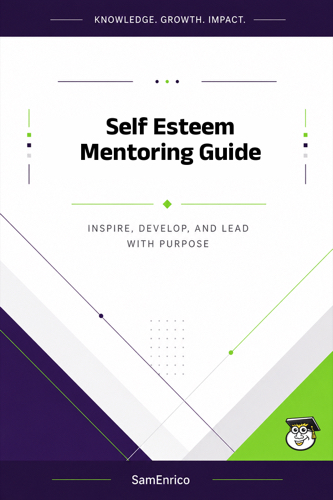
Self Esteem Mentoring Guide eBook
Find or become confidence building mentor.
by Larue Alva
Find or become confidence building mentor.
Formats
Free sample
Chapter 1: The Rescue Reflex--It begins with a clenched jaw and a racing heart. You are watching someone you care about struggle. They are failing, flailing, or frozen. Every fiber of your being screams: Fix it. Say something.
Do it for them. And because you are a good person, you do. You step in. You solve the problem. You offer the answer before they finish the question.
You feel useful. They feel relieved. And both of you have just taken one step further away from their self-esteem.This is the Rescue Reflex. It is the single most destructive force in modern mentoring—and the hardest habit to break because it feels exactly like love.I learned this lesson in the worst possible way: by destroying someone I was trying to save.My younger brother, let us call him David, was twenty-three years old when he dropped out of community college for the third time. He was brilliant, funny, and utterly convinced he was a failure.
Every conversation with him was a confession of inadequacy. "I cannot do anything right." "Everyone is ahead of me." "What is the point?"I was twenty-eight, full of self-help books and unearned confidence. I decided I would fix him.For eighteen months, I was the perfect rescuer. When he could not write a resume, I wrote it for him. When he was too anxious to call a potential employer, I dialed the number and handed him the phone.
When he failed an interview, I spent two hours explaining what he should have said differently. When he felt hopeless, I delivered a TED Talk disguised as a pep talk. "You are amazing," I said. "You can do anything." "I believe in you."He did not get better. He got worse.Every time I solved a problem for him, he retreated further.
He stopped trying entirely. Why would he try? I was doing it for him. The worst moment came six months after I finally stopped. He called me, not to thank me, but to say something I have never forgotten: "You made me feel like I could not survive without you.
And for a while, I believed it."I had not built his self-esteem. I had stolen it.This chapter is about why the Rescue Reflex is so seductive, how to recognize it in yourself, and what to do instead. Because if you cannot master this first lesson, nothing else in this book will matter. You will become a crutch, not a scaffold. And the people you try to help will collapse the moment you walk away.The Seduction of Rescue The Rescue Reflex is not a character flaw.
It is a biological and social instinct. Neuroscience research shows that helping someone in distress activates the same reward pathways in the brain as eating chocolate or receiving a compliment. Your nucleus accumbens lights up. You feel good. You want to do it again.This is called the "warm glow" of giving, and it is dangerous in mentoring because it rewards the mentor, not the mentee.
You walk away feeling heroic. They walk away feeling incapable. And neither of you knows the transaction happened.The Rescue Reflex takes three specific forms. I call them the Three Rescue Traps.Trap One: Unsolicited Advice-Giving This is the most common and the most subtle. The mentee describes a problem.
Before they finish their second sentence, you have already formulated a solution. You interrupt. "Here is what you should do." Your intentions are pure. You want to save them time, pain, and uncertainty.But here is what you actually communicate: Your process of thinking is too slow. Your ability to solve problems is insufficient.
Let me do the thinking for you.Unsolicited advice is not generosity. It is a form of intellectual theft. You are stealing the mentee's opportunity to struggle, to fail, to revise, and to discover their own capability. Every time you give an answer they did not ask for, you delay their self-efficacy by one more conversation.The fix is simple and brutal: Do not speak until they ask for a tool. And when they ask, you offer options, not commands.
"I have seen three approaches work in similar situations. Would you like to hear them, or would you prefer to keep brainstorming on your own?"Trap Two: Emotional Takeover This trap springs when the mentee expresses a painful emotion. They say "I am so angry" or "I feel humiliated" or "I cannot stop crying." Your discomfort rises. You need the emotion to stop—not for their sake, but for yours. So you say, "Do not cry, let me call them," or "It is not that bad," or "Here is why you should not feel that way."You have just emotionally taken over.
You have replaced their experience with your solution. You have sent the message: Your feelings are too big for you to handle. Let me handle them for you.This is the most insidious trap because it masquerades as empathy. But genuine empathy sits with the emotion. It does not try to eliminate it.
The mentor's job is not to make the mentee feel better. The mentor's job is to help the mentee tolerate feeling bad long enough to learn something.The fix: Name the emotion, validate its presence, and then get curious. "You sound furious. That makes sense given what happened. What is the smallest thing you want to do with that anger?"Trap Three: Perfectionistic Hovering This trap catches mentors who care the most.
You check in daily. You ask for screenshots of their work. You review their emails before they send them. You offer "just a few small suggestions" that turn into a complete rewrite. You are not helping.
You are hovering.Perfectionistic hovering communicates: Your work is not good enough for me to trust you alone. I need to supervise you to prevent failure.But failure is not the enemy of self-esteem. Failure is the raw material of self-esteem. People do not build confidence by succeeding. They build confidence by failing, surviving, and learning that failure did not kill them.
When you hover, you rob them of that exact experience.The fix: Set a boundary around your involvement. "I will review one draft per week. You will send it to me 48 hours before we meet. Between meetings, you are on your own. I will not respond to emergency texts unless someone is bleeding."The Kryptonite Effect: Why Rescue Backfires Rescue behaviors do not just fail to help.
They actively harm. I call this the Kryptonite Effect because the rescuer believes they are giving strength, but they are actually draining it.Here is the mechanism. Self-esteem is not a feeling. It is a conclusion the brain draws from evidence. The brain asks: Have I handled difficult situations before?
Have I solved problems on my own? Have I survived failure and tried again? If the answer is yes, the brain concludes: "I am capable." If the answer is no, the brain concludes: "I need someone else."Rescue removes the evidence. Every time you solve a problem for a mentee, you delete the data point they need to conclude "I am capable." You replace it with a…
This is the end of the free sample. Get the eBook to keep going. Buy now
About this book
Details
- Author
- Larue Alva
- Publisher
- SamEnrico
- Language
- English
- Genre
- Non-Fiction, Self-Help, Mentoring
- Released
- 2026-06-07
- Pages (approx.)
- 141
- Available as
- eBook, Audiobook

Read better in the ZLOADR app
Your eBooks on your phone or tablet. Sign in with your SamEnrico account and start reading.
More by Larue Alva
 Five AM Club Morning RoutineLarue Alva$11.99
 Alcoholism Spiritual AwakeningLarue Alva$11.99
 Zapier Memory WorkflowsLarue Alva$11.99
 Affirmations For ForgivenessLarue Alva$11.99
 Caregiver Support Groups GuideLarue Alva$11.99
 Weekly Review for LawyersLarue Alva$11.99
 Meditation for Plantar FasciitisLarue Alva$11.99
 The Last Shovel of EldoradoLarue Alva$11.99
 Velvet & Dynamite: The Untold Story of the 1970s Jet-Set HeistsLarue Alva$11.99
 How to Become a Cosmetologist ApprenticeLarue Alva$11.99
 How to Produce Recorder PartsLarue Alva$11.99
 A Collector's Handbook to the AC 70Larue Alva$11.99
You may also like
 Hong Kong Handover 1997Dunn Johnnie$11.99
 Zumba For Postnatal Recovery CourseNeal Christian$11.99
 Zumba for BeginnersLadner Nikia$11.99
 YouTube Comment Mining GuideHumes Pandora$12.99
 Worry Box MeditationCarlin Rudy$11.99
 Workplace Stress MeditationNguyen Lynn$11.99
 Workplace Stress and Sleep RepairHawley Ivory$11.99
 Workplace Perfectionism CureDelaney Jeffry$11.99
 Workplace Injustice Anger GuideWallen Isabelle$11.99
 Work Addiction and Burnout LinkGreenwood Ester$11.99
 Women in Yoga and WellnessBeattie Galina$11.99
 Women in Stand Up ComedyChun Evangeline$11.99