
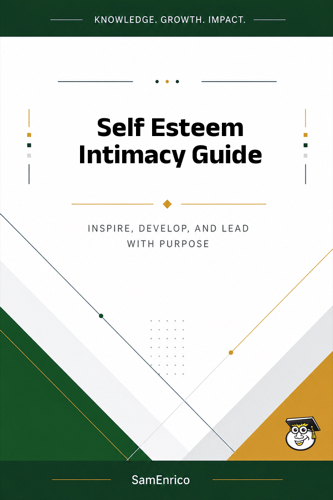
Self Esteem Intimacy Guide eBook
Increase emotional and physical closeness without
Increase emotional and physical closeness without fear of judgment.
Formats
Free sample
Chapter 1: The Judgment Trap--–- You are about to discover something that will change every relationship you have for the rest of your life. But first, you need to hear a story that might make you uncomfortable. It is the story of how you learned to hide.Imagine a four-year-old girl named Maya. She is standing in the kitchen, her hands covered in flour, a bowl of cake batter tipped over on the floor. She wanted to surprise her mother by baking a birthday cake.
Instead, she has created a mess. Her mother walks in. The mother has had a long day. She is tired, overwhelmed, and not particularly patient in this moment. She looks at the floor, looks at Maya, and sighs heavily.
“Why can’t you just sit still? Why do you always make such a mess?” Maya’s face crumples. She wasn’t trying to be bad. She was trying to be loving. But in that instant, her brain files away a piece of data: Authentic expression leads to punishment.Now imagine that same girl, now eight years old, crying in her bedroom after a friend excluded her at school.
Her father comes to the door. Instead of sitting with her, he says, “Stop crying. It’s not a big deal. Toughen up.” Maya learns another lesson: Big emotions are not welcome. She learns to swallow her tears, to smile when she is hurting, to become what her parents can tolerate rather than who she actually is.By the time Maya is fifteen, she has become a master performer.
She is the “easy” friend, the “good” daughter, the girl who never causes trouble. But inside, she feels invisible. She has learned the most dangerous lesson of all: If people really knew me, they would leave.This is not a story about bad parents. Most parents are doing their best with the tools they have. This is a story about how human beings learn to hide.
And it is the story of every person who has ever struggled with intimacy.You learned to hide long before you ever had a romantic partner. You learned that being yourself is risky. You learned that judgment hurts. And so you built a mask.The Paradox at the Heart of Love Here is the central paradox of this entire book: You are wired for connection, but terrified of being fully known.Neuroscience tells us that human beings are fundamentally social creatures. Our brains are designed to seek attachment.
We need touch, eye contact, and emotional resonance to survive. Babies who are not held die. Adults who are chronically lonely suffer higher rates of heart disease, depression, and early mortality. Connection is not a luxury. It is a biological imperative.And yet.The very same nervous system that craves closeness also fears it.
Because to be known is to be vulnerable. And to be vulnerable is to risk being judged, rejected, or abandoned. So you walk through life with a constant, low-grade war inside you: Come closer. No, stay away. I want to be seen.
But not like that.This war is what I call The Judgment Trap.The Judgment Trap is the space between who you really are and who you pretend to be. It is the distance between your inner world—with all its messy, contradictory, sometimes shameful thoughts and feelings—and the curated version of yourself that you show to the people you love most. Every time you choose the curated version, you fall deeper into the trap. Every time you hide, the walls grow thicker. And every time the walls grow thicker, you feel more alone.The tragedy is that you are not hiding because you are weak or broken.
You are hiding because you learned, somewhere along the way, that hiding works. It kept you safe. It kept you loved. It helped you survive.But survival strategies are not intimacy strategies. What keeps you safe in a dysfunctional environment will keep you lonely in a loving one.The Anatomy of Hiding: Why "Being Known" Feels Dangerous To understand why you hide, you have to understand how the brain learns.
And the brain learns through repetition and prediction.Every time you expressed a genuine emotion as a child—excitement, sadness, anger, fear, even joy—and received a response that was punishing, dismissive, or overwhelming, your brain logged that event. It was not a logical decision. It was a survival calculation happening below the level of conscious thought. The calculation went something like this: I expressed X. I received Y punishment/discomfort.
Therefore, expressing X leads to pain. Do not express X again.Over time, the brain generalizes. It stops distinguishing between different emotions, different contexts, different people. It simply learns: Authenticity is dangerous.This is not a moral failing. This is neuroscience.The problem is that what kept you safe in childhood becomes a prison in adulthood.
The partner who loves you is not your critical parent. The friend who wants to know you is not the classmate who bullied you. But your nervous system does not know the difference. It operates on ancient data. It reacts to a tender conversation the same way it would react to a predator.So when your partner asks, “What are you really feeling?” your heart races.
Your palms sweat. Your throat tightens. And you say, “Nothing. I’m fine.” You are not lying to be cruel. You are lying because your body has already decided that the truth is too dangerous.This is the Judgment Trap.
And almost everyone you know is caught in it.The Difference Between Performing and Sharing One of the most important distinctions in this entire book is the difference between performing for your partner and sharing with your partner. These two activities look similar on the surface, but they produce radically different results.Performing means showing your partner the version of yourself that you believe will earn approval. You say what you think they want to hear. You hide your flaws. You curate your emotions.
You present a “best self” that is polished, agreeable, and safe. Performance may earn you admiration. It may earn you praise. It may even earn you love—but it will never earn you intimacy.Why? Because intimacy requires the risk of rejection.
And performance is designed to eliminate that risk.Think about it. When you are performing, you are not actually in the room. You are watching yourself from the outside, asking, “Am I doing this right? Do they still like me? Should I say something funnier?
Nicer? Smarter?” You are not connecting. You are auditioning.Sharing, by contrast, means revealing your real internal state—even when it is unflattering. Sharing means saying, “I am scared to tell you this.” It means admitting, “I felt jealous when you talked to your ex.” It means letting your partner see your insecurity, your messiness, your confusion, your grief. Sharing is terrifying because it can be rejected.
But it is also the only path to being truly known.Here is the truth that changes everything: You cannot be loved for who you are if you refuse to show who you are.Performance may feel safer in the…
This is the end of the free sample. Get the eBook to keep going. Buy now
About this book
Details
- Author
- Ritchie Miles
- Publisher
- SamEnrico
- Language
- English
- Genre
- Non-Fiction, Self-Help, Intimacy
- Released
- 2026-06-09
- Pages (approx.)
- 120
- Available as
- eBook, Audiobook

Read better in the ZLOADR app
Your eBooks on your phone or tablet. Sign in with your SamEnrico account and start reading.
More by Ritchie Miles
 The Remote Email Time GuideRitchie Miles$11.99
 Detox For Dual Diagnosis GuideRitchie Miles$11.99
 Personal Brand for ConsultantsRitchie Miles$11.99
 Flight Response RecoveryRitchie Miles$11.99
 Emotional Regulation TechniquesRitchie Miles$11.99
 Lawyers Professional LiabilityRitchie Miles$11.99
 Spatial Working Memory DrillsRitchie Miles$11.99
 The Phantom Coachman: The Victorian Highwayman Who Exposed Prison HorrorsRitchie Miles$11.99
 The Great Melbourne Zoo Escape: Tracking the Tiger That Outsmarted PoliceRitchie Miles$11.99
 A Collector's Handbook to the Aston Martin DBSRitchie Miles$11.99
 How to Trade Soybean MealRitchie Miles$11.99
 JEE Focus and Concentration GuideRitchie Miles$12.99
You may also like
 Hong Kong Handover 1997Dunn Johnnie$11.99
 Zumba For Postnatal Recovery CourseNeal Christian$11.99
 Zumba for BeginnersLadner Nikia$11.99
 YouTube Comment Mining GuideHumes Pandora$12.99
 Worry Box MeditationCarlin Rudy$11.99
 Workplace Stress MeditationNguyen Lynn$11.99
 Workplace Stress and Sleep RepairHawley Ivory$11.99
 Workplace Perfectionism CureDelaney Jeffry$11.99
 Workplace Injustice Anger GuideWallen Isabelle$11.99
 Work Addiction and Burnout LinkGreenwood Ester$11.99
 Women in Yoga and WellnessBeattie Galina$11.99
 Women in Stand Up ComedyChun Evangeline$11.99