
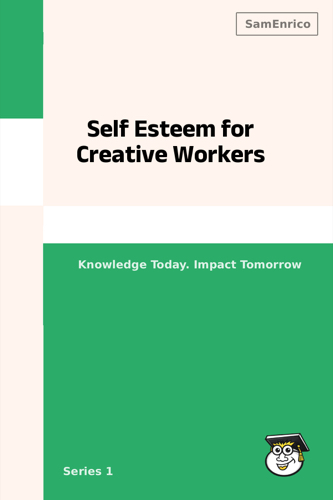
Non-FictionSelf-Help / Creative Industries
Self Esteem for Creative Workers eBook
Separates self-worth from creative rejection and b
by Altman Jules
Separates self-worth from creative rejection and builds rejection resilience.
Formats
Free sample
Chapter 1: The Portfolio of Selves--The email arrived at 11:47 on a Tuesday. I remember the exact minute because I was mid-bite into a mediocre turkey sandwich, and I nearly choked when I saw the sender's name. It was the gallery. The one I had been courting for eighteen months. The one that, in my mind, would validate everything – every late night, every rejection, every whispered doubt from my family about "that creative thing you're doing."I opened it.
Three sentences. Form letter polite. They had gone with another artist.For the next seventy-two hours, I did not sleep more than four hours total. I fought with my partner about nothing. I cancelled drinks with a friend.
I stared at my studio wall and felt absolutely nothing except a low, humming certainty that I was a fraud. Not a person who had experienced a setback. A fraud. A permanent, unlovable, untalented fraud.Here is the strange thing: I knew, intellectually, that this was an overreaction. I had read the books.
I understood that rejection was part of the game. I had even given advice to other artists about not taking things personally. But knowing and feeling are separated by a chasm that no amount of self-help wisdom can bridge on its own.What I did not understand then – and what this entire book exists to correct – is that the reason that rejection hit me like a wrecking ball was not because I was weak or overly sensitive. It was because I had made a catastrophic error in how I had built my identity. I had placed my entire sense of self into a single drawer of the filing cabinet called "artist." And when that drawer was rejected, the whole cabinet toppled over.This chapter is about why that happens and what to do about it.
It is not a pep talk. It is a diagnosis.The Hybrid Creature Let us begin with a question that most books on creativity are too polite to ask: who exactly are you?If you are reading this book, chances are you are not a pure "artist" in the romantic nineteenth-century sense – living in a garret, painting for posterity, unconcerned with commerce. And you are not a pure "businessperson" – clocking in, collecting a paycheck, leaving work at work. You are something newer and stranger. You are a hybrid.Call yourself what you will: freelancer, solo-preneur, gig-economy worker, influencer, creative entrepreneur, side-hustler.
The label matters less than the underlying structure. You have a creative skill – writing, designing, filming, illustrating, composing, consulting – and you have turned that skill into a source of income. Your identity and your livelihood are the same asset.This is the first and most important fact about your psychological reality. When a corporate employee's project fails, they can say "the project failed" and go home to their family, their garden, their bowling league, their identity as a parent or a spouse or a volunteer. The failure is contained.
It lives in one drawer.When your project fails, you hear "you failed." Because there is no institutional buffer between you and your output. You are the product. You are the brand. You are the R&D department, the marketing team, the CEO, and the janitor all at once. And when the product gets rejected, every one of those hats falls off at the same time.This is what I call the Hybrid Vulnerability.
It is the central psychological challenge of creative work in the twenty-first century. And it is the problem that this book was written to solve.Identity Fusion: The Mechanism Beneath the Pain There is a term from social psychology that explains what happened to me with that Tuesday email. It is called identity fusion. It describes what happens when a particular role or identity becomes so central to your self-definition that any threat to that role triggers an existential crisis.Identity fusion is not the same as commitment or passion. You can be deeply committed to your creative work without fusing your entire self to it.
Fusion is what happens when the boundary blurs. When you can no longer tell where the work ends and you begin. When a rejection of the work feels indistinguishable from a rejection of your right to exist.Research on identity fusion has mostly focused on extreme cases – soldiers fused with their units, fans fused with their sports teams, activists fused with their causes. In those contexts, fusion predicts remarkable sacrifice but also remarkable fragility. A fused soldier will risk his life for his unit.
He will also experience clinical depression if the unit is disbanded.Creative workers are unusually susceptible to identity fusion for three reasons.First, the romantic mythology of the artist. We have inherited a cultural story that says real artists are born, not made; that creativity is a mystical gift; that the artist's identity is total, all-consuming, and incompatible with ordinary life. This story is mostly nonsense, but it lives in our bones. It tells us that if we are not creating, we are not fully alive – and if our work is rejected, we are not fully real.Second, the economic precarity of creative work. When your identity and your income are the same thing, the stakes are higher.
A rejection is not just an insult to your ego. It is a threat to your ability to pay rent, buy groceries, and maintain your lifestyle. The body does not distinguish between a threat to self-esteem and a threat to survival. Both trigger the same stress response.Third, the absence of institutional buffers. The corporate employee has a job title that is separate from their name.
They are "a marketing manager at Acme Corp." The company absorbs some of the weight of failure. The freelancer has only their name. "Jane Smith, Designer." When Jane Smith loses a client, there is no Acme Corp to cushion the fall.These three forces – mythology, precarity, and institutional loneliness – conspire to fuse your identity to your work. And once fused, every rejection becomes an amputation.The Cost of Fusion Let me be specific about what this fusion costs you. I am not talking about abstract psychological concepts.
I am talking about measurable, observable, lived experience.Cost one: You stop taking risks. If your entire self is riding on every project, you cannot afford to fail. So you play it safe. You make the work you already know how to make. You stick to the style that has been approved before.
You do not experiment, because experimentation might produce something "bad," and "bad" feels like a verdict on your soul. Fusion is the enemy of artistic growth.Cost two: You cannot hear feedback. When someone critiques your work, a fused identity hears an attack on your person. Your defenses go up. You argue, you explain, you justify, you deflect.
You cannot distinguish between "this paragraph is unclear" and "you are unclear as a human being." The result is that you learn nothing from feedback except to fear it.Cost three: You burn out. Fusion demands total investment. Every project becomes a life-or-death struggle. There is no off switch. You work late, you obsess, you ruminate, you refresh your email forty times…
This is the end of the free sample. Get the eBook to keep going. Buy now
About this book
Details
- Author
- Altman Jules
- Publisher
- SamEnrico
- Language
- English
- Genre
- Non-Fiction, Self-Help / Creative Industries
- Released
- 2026-06-06
- Pages (approx.)
- 147
- Available as
- eBook, Audiobook

Read better in the ZLOADR app
Your eBooks on your phone or tablet. Sign in with your SamEnrico account and start reading.
More by Altman Jules
 The Elder Parent TalkAltman Jules$11.99
 Ideal Vector Mapping GuideAltman Jules$11.99
 Disability Job Loss GuideAltman Jules$11.99
 Music Man Harold HillAltman Jules$11.99
 Kushite Pharaohs of EgyptAltman Jules$11.99
 Gratitude for AtheistsAltman Jules$11.99
 Creative Confidence for FilmmakersAltman Jules$11.99
 The Silent Champions: The Forgotten Paralympians of the RenaissanceAltman Jules$11.99
 Neon Labyrinth: The Forgotten Subway of TokyoAltman Jules$11.99
 How to Become a Hair StylistAltman Jules$11.99
 How to Produce Other Security and Protection ProductsAltman Jules$11.99
 How to Produce Composting EquipmentAltman Jules$11.99
You may also like
 Hong Kong Handover 1997Dunn Johnnie$11.99
 Zumba For Postnatal Recovery CourseNeal Christian$11.99
 Zumba for BeginnersLadner Nikia$11.99
 YouTube Comment Mining GuideHumes Pandora$12.99
 Worry Box MeditationCarlin Rudy$11.99
 Workplace Stress MeditationNguyen Lynn$11.99
 Workplace Stress and Sleep RepairHawley Ivory$11.99
 Workplace Perfectionism CureDelaney Jeffry$11.99
 Workplace Injustice Anger GuideWallen Isabelle$11.99
 Work Addiction and Burnout LinkGreenwood Ester$11.99
 Women in Yoga and WellnessBeattie Galina$11.99
 Women in Stand Up ComedyChun Evangeline$11.99