
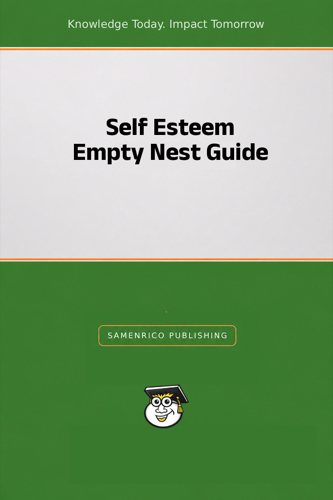
Self Esteem Empty Nest Guide eBook
Rediscover each other after children leave using t
Rediscover each other after children leave using this relationship renewal workbook.
Formats
Free sample
Chapter 1: The Ghost in the Hallway--The hallway outside your bedroom used to be a war zone. Backpacks dropped like bombs. Wet umbrellas leaned against the wall like fallen soldiers. Shoes—so many shoes—formed a chaotic archipelago from the front door to the stairs. You stepped over them, around them, sometimes tripped on them, but you never truly noticed them because they were simply the landscape of your life.
The noise was constant: doors slamming, music thumping, arguments erupting over who used the last of the conditioner, the refrigerator door opening and closing like a heartbeat.And then one day, it stopped.Not dramatically. Not with a final scene scored by orchestral music. Just… quietly. The last box was loaded into the last car. The last "I'll call you tonight" was promised.
The last set of headlights disappeared down the driveway. You closed the door, turned around, and the hallway was clean. Empty. Silent.And instead of feeling relief, you felt something worse. You felt the ghost.Here is the truth that no one tells you about the empty nest: the house is not empty because your child left.
The house is empty because your purpose left. And that purpose was not your child as a person—it was your role as a parent. The two are not the same thing, and confusing them is what makes the silence so unbearable.This chapter is about identifying the ghost. Not exorcising it yet—that comes later. First, you have to name what you actually lost.
Because most empty nesters spend months, sometimes years, grieving the wrong thing. They say, "I miss my daughter," and they do. But that is not the pain that keeps them up at 3:00 AM, staring at the ceiling next to a spouse who feels like a stranger. The deeper pain is the loss of the shared job description that held your marriage together like mortar between bricks.The Identity Diffusion That No One Warned You About Psychologists have a term for what happens when someone loses a primary role without having a replacement ready. They call it identity diffusion.
It was originally used to describe adolescents who haven't figured out who they are yet, but it applies just as perfectly to parents who have spent eighteen or twenty or twenty-five years defining themselves as "Sarah's mom" or "Michael's dad."Here is what identity diffusion feels like in practice. You are at a dinner party. Someone asks, "So, what do you do?" For the last two decades, you had an answer. It might have been "I'm a teacher" or "I'm a marketing director" or "I stay home with the kids." But underneath that professional identity was a deeper, more private identity that you carried everywhere: I am someone who is needed. Your children needed you to pack lunches, drive carpools, kiss skinned knees, edit college essays, and worry about their futures.
That need gave your days structure and your hours meaning. Even on the hard days—especially on the hard days—you knew why you got out of bed.Now the need is gone. Not reduced. Gone.And no one has handed you a replacement job description.This chapter opens with a metaphor that will frame everything that follows: the hallway outside your bedroom now feels haunted, but the ghost is not your child. The ghost is the purpose your child gave you.
Most empty nest books focus on missing the child's laughter, their presence, their specific personhood. That grief is real, and it deserves acknowledgment. But this book argues that couples are actually grieving something else entirely: the loss of their shared job description. You were not just a parent. You were a crisis manager.
A logistics coordinator. A co-CEO of a chaotic, beautiful, exhausting family enterprise. And that enterprise has just been dissolved.The Difference Between Missing a Person and Missing a Purpose Before we go any further, I need you to understand something crucial. This is not a book that tells you to stop loving your children or to pretend their absence doesn't matter. That would be cruel and impossible.
You will miss your child. You should miss your child. That is the sign of a healthy attachment and a life well-lived.But there is a difference between missing a person and missing the function that person served in your identity.Missing your child sounds like this: "I miss the sound of her laugh." "I miss the way he used to tell me about his day right before bed." "I wish I could see her face across the dinner table one more time." That grief is about a specific human being you love. It is bittersweet, but it is not disorienting. You can hold that grief in one hand and still function with the other.Missing your purpose as a parent sounds different.
It sounds like this: "I don't know what I'm supposed to do with my afternoons anymore." "No one needs me for anything, and I can't figure out why that feels so terrible." "My spouse and I sat on the couch for two hours last night and said maybe twelve words to each other." "I feel like I'm invisible in my own house."That second set of statements is not about your child. It is about you. About your sense of worth, your daily structure, your reason for getting out of bed. And that is the grief that this book is designed to address.Here is the paradox that trips up most empty nesters: you can love your child completely and still feel relief that they are gone. You can be proud of their independence and still feel lost without the chaos.
You can want them to succeed and still resent the silence they left behind. All of these things are true at the same time. The human heart is not a binary switch. It is a kaleidoscope.The Crisis Manager vs. The Partner For the last eighteen or more years, your marriage operated like a well-oiled machine.
Or, more accurately, like a hectic triage center. You and your spouse were Crisis Managers. Your job was to identify problems (homework not done, fever of 102, college applications due, car broke down) and solve them as quickly as possible. You divided and conquered. You communicated in shorthand.
You were not romantic partners most of the time—you were colleagues in the exhausting, beautiful project of raising human beings.And here is the thing about being colleagues: you do not need to like each other to be effective. You just need to be competent. Many empty nest couples discover, to their horror, that they have built a highly efficient parenting partnership but have absolutely no idea how to be partners in the absence of children. They sit down to dinner across from each other and realize they have nothing to talk about that isn't logistics. They try to have a date night and end up talking about the kids anyway because that is their only shared vocabulary.The distinction between Crisis Managers and Partners is the foundational reframe of this entire book.Crisis Managers operate in emergency mode.
They are reactive, efficient, and focused on the next problem. They do not ask each other about dreams or fears…
This is the end of the free sample. Get the eBook to keep going. Buy now
About this book
Details
- Author
- Booker Deandre
- Publisher
- SamEnrico
- Language
- English
- Genre
- Non-Fiction, Self-Help, Empty Nest
- Released
- 2026-06-09
- Pages (approx.)
- 153
- Available as
- eBook, Audiobook

Read better in the ZLOADR app
Your eBooks on your phone or tablet. Sign in with your SamEnrico account and start reading.
More by Booker Deandre
 Commute Energy ManagementBooker Deandre$11.99
 Last Mile Delivery Exception Management GuideBooker Deandre$11.99
 Stigma Reduction Campaign GuideBooker Deandre$11.99
 The Great Bitcoin Heist: How a Shadow War Sabotaged a Crypto EmpireBooker Deandre$11.99
 Nefertem's Golden Whisper: The Lotus Sorcerer of the NileBooker Deandre$11.99
 How to Start a Bridgelayer (tracked Military) Business (Beginners Guide)Booker Deandre$11.99
 Understanding Herrmann–opitz Arthrogryposis SyndromeBooker Deandre$17.99
 Defensive DrivingBooker Deandre$11.99
 Five-Year Artificial Intelligence OutlookBooker Deandre$12.99
 Thundafund Africa Crowdfunding ManualBooker Deandre$12.99
You may also like
 Empty Nest Stress GuideBertrand Domitila$11.99
 DBT for Empty NestEdge Brianne$11.99
 The Empty Nest AnxietyDonnelly Renna$11.99
 Self Esteem for Empty Nest CouplesHardwick Dreama$11.99
 Empty Nest Stress Couples GuideWolford Lindsy$11.99
 The Empty Nest Relationship Renewal GuideSmalley Temeka$11.99
 Empty Nest DivorceBroussard Kitty$11.99
 Loneliness After Empty NestBunting Mary$11.99
 Empty Nest Relationship GuideHolden Kory$11.99
 The Empty Nest Anger GuideBetz Rod$11.99
 Purpose For Empty NestersSoutherland Danyel$11.99
 Empty Nest Purpose Rediscovery CourseWelsh Jama$11.99