
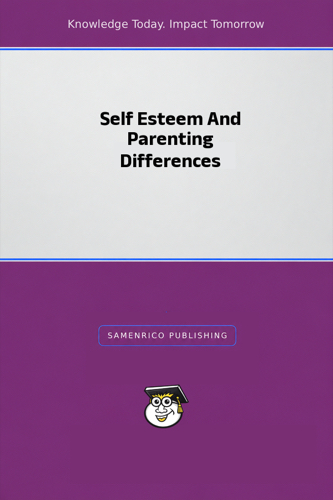
Self Esteem And Parenting Differences eBook
Stand by your parenting choices without partner cr
by Clay Sandie
Stand by your parenting choices without partner criticism eroding self worth.
Formats
Free sample
Chapter 1: Two Blueprints--Every parent enters a partnership carrying an invisible inheritance. You did not choose it. You probably cannot name it. But it governs every single decision you make about your child, and it is the hidden source of almost every fight you will ever have about parenting.This inheritance is what I call your parenting blueprint – the internal, mostly unconscious set of rules, assumptions, and instincts about what it means to be a good parent. You absorbed this blueprint from your own childhood, from the way your parents raised you.
You absorbed it from every movie you have ever watched, every magazine cover you have ever scanned in a grocery store checkout line, every passive-aggressive comment from your mother-in-law, and every sanctimonious Instagram reel from a parenting influencer who seems to have a spotless house, perfectly behaved children, and the patience of a Buddhist monk.Your partner has a different one.Not a worse one. Not a better one. A different one.And neither of you has ever sat down and said, "Here is my blueprint. Show me yours. Let us compare where they conflict before we have a screaming match about jackets at 7:45 on a Tuesday morning."This chapter is about making the invisible visible.
It is about understanding why criticism from your partner feels like an attack on your very identity as a parent. And it is about the single most important reframe you will ever learn: the problem is not that you are failing. The problem is that you are navigating two different rulebooks written in two different languages – and no one ever gave you a translator.The Myth of the "Natural" Parent Let me tell you about a woman I will call Maya. Maya is a first-time mother to a two-year-old named Leo. She works full-time, handles all the pediatrician appointments, remembers when the diaper subscription needs renewing, and has a mental calendar of every snack Leo will accept and every texture he will refuse.
Her partner, David, is a loving father who works long hours and genuinely wants to help. But when David comes home and sees Leo running around in a thin shirt on a chilly evening, he says, "Are you sure he does not need a jacket?"Maya feels her jaw tighten. Her chest gets hot. She hears not a question about weather but a judgment about her competence. You are not paying attention.
You are not a good mother. You are failing.David, meanwhile, is genuinely confused. He asked about a jacket. Why is she upset?This scene plays out in thousands of homes every single day. And it is not about jackets.
It is about the Myth of the Natural Parent – the deeply ingrained cultural fiction that one parent (usually the mother) is biologically or instinctively better equipped to parent than the other.Where does this myth come from? Everywhere.It comes from biology. For decades, we have been told that maternal instinct is real, powerful, and uniquely female – that mothers just know what a baby needs in a way that fathers never can. But here is the truth that research has repeatedly shown: there is no evidence for a uniquely female "parenting instinct" that men lack. What looks like instinct is actually experience, attention, and the accumulation of thousands of small observations.
The parent who changes the most diapers learns the difference between a hungry cry and a tired cry. The parent who handles the most bedtimes learns exactly how many stories are too many. That is not instinct. That is practice.The myth comes from media. How many movies have you seen where the mother is the emotional center of the family – the one who remembers birthdays, plans holidays, and somehow intuits that a child is sad before the child even knows it?
Now count how many movies feature a father who is bumbling, clueless, or merely "helping out." The cultural message is relentless: mothers are the real parents. Fathers are assistants at best.The myth comes from social circles. When a mother struggles, other mothers offer advice, resources, and sometimes judgment. When a father struggles, people say, "At least he is trying." The bar for maternal competence is set at perfection. The bar for paternal competence is set at showing up.And here is the cruelest part of the myth: it traps both parents.
Mothers are crushed under the weight of impossible expectations. Fathers are robbed of the chance to be seen as fully capable parents. Everyone loses.The Self-Esteem Trap Now let me explain why your partner's simple question about jackets makes you feel like a failure. I call this the Self-Esteem Trap.Here is how it works. Society has told you – explicitly and implicitly – that good parents just know.
They know when a child is getting sick before the fever appears. They know the exact right amount of screen time. They know which discipline method will work for which child on which day. They know, they just know, because they are natural parents.If you believe this myth – and almost all of us do, at least a little – then any moment of uncertainty becomes a crisis. If you do not know whether your child needs a jacket, maybe you are not a natural parent.
If you have to think about bedtime, maybe you are failing. If your partner questions a decision, maybe they have spotted the flaw that proves you are not good enough.The trap is this: you have been trained to believe that asking questions is a sign of incompetence.Think about that for a moment. In every other domain of life, asking questions is a sign of intelligence. A doctor who asks for a second opinion is thorough, not incompetent. A pilot who checks the weather twice is careful, not clueless.
But in parenting, we have created a culture where uncertainty is shameful.So when your partner asks, "Are you sure they need jackets?" your brain does not hear a question. It hears an accusation. It hears proof that you have been found out – that you are not the natural, instinctive, flawless parent you were supposed to be.The truth is much simpler and far less painful. You are not failing. You are making a decision based on your blueprint – your internal rules about temperature, comfort, risk, and independence.
Your partner is asking a question based on their blueprint – their different rules about the same things. Neither blueprint is objectively correct. They are just different.But because you have been trained to believe that good parents never have to ask, their question feels like a verdict.Where Blueprints Come From Let me give you a more concrete picture of where your blueprint actually comes from. It is not magic. It is not instinct.
It is a lifetime of accumulated data.Your childhood. The single biggest influence on your parenting blueprint is how you were parented. If your parents were strict about bedtime, you will either replicate that strictness or rebel against it. If your parents never made you wear a jacket unless it was snowing, you will have a different sense of what "cold enough" means. If your parents hovered, you may be…
This is the end of the free sample. Get the eBook to keep going. Buy now
About this book
Details
- Author
- Clay Sandie
- Publisher
- SamEnrico
- Language
- English
- Genre
- Non-Fiction, Self-Help, Co Parenting
- Released
- 2026-06-09
- Pages (approx.)
- 141
- Available as
- eBook, Audiobook

Read better in the ZLOADR app
Your eBooks on your phone or tablet. Sign in with your SamEnrico account and start reading.
More by Clay Sandie
 Self Care For New ParentsClay Sandie$11.99
 The MBSR for Insomnia AdvancedClay Sandie$11.99
 Behavioral Addiction Smartphone AppsClay Sandie$11.99
 The Secret Codebreakers of Cold War America: How the NSA's Hidden Academy Shaped the Digital AgeClay Sandie$11.99
 Tangaroa's Wrath and the Birth of the First CanoeClay Sandie$11.99
 Understanding Heparin-induced ThrombopeniaClay Sandie$17.99
 How to Become a Display MakerClay Sandie$11.99
 Eurasia Study Hub PrimerClay Sandie$12.99
 E-Commerce Electronics OutlookClay Sandie$12.99
 Snapshot PhotographyClay Sandie$11.99
You may also like
 Parenting Disagreement RageCerda Reggie$11.99
 Co Parenting Stress Relief GuideCreel Kathie$11.99
 Co Parenting Anger Management GuideSandoval Pat$11.99
 Co Parenting After DivorceHobson Inga$11.99
 Parental Anger Spouse Support GuideGatewood Tayna$11.99
 Discussing Parenting Differences GuideAsher Boyce$11.99
 Co Parenting Stress ReductionDerr Samual$11.99
 Co Parenting Stress Management GuideCobbs Juli$11.99
 Co Parenting Conflict ResolutionBarrow Norene$11.99
 The Co Parenting Communication GuideSisk Dona$11.99
 Co Parenting Stress GuideGarber Arlyne$11.99
 Co Parenting CommunicationLacroix Sook$11.99