
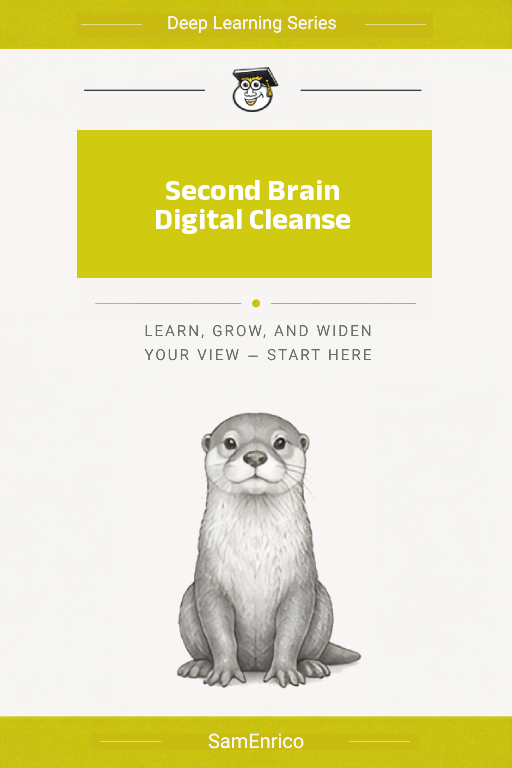
Second Brain Digital Cleanse eBook
Declutter note taking apps, bookmarks, and saved f
Declutter note taking apps, bookmarks, and saved folders to reduce digital overwhelm for knowledge workers.
Formats
Free sample
Chapter 1: The Invisible Hoard--–- It begins not with a crash, but with a sigh.You know the sigh. It comes at the end of a long workday, when you've answered emails, attended meetings, and clicked through documents. You close your laptop, lean back in your chair, and feel… nothing. Not accomplishment. Not relief.
Just a vague, gnawing exhaustion that you can't quite explain. You did things today. You were busy. And yet, somewhere beneath the surface, you know you didn't do the things that mattered most.This is the signature emotional state of the modern knowledge worker: busy but not productive, exhausted but not fulfilled, surrounded by digital tools but never quite in control of them.You tell yourself the problem is time management. If only you had better systems.
If only you could wake up earlier or find the perfect productivity app. You've tried them all—Notion, Evernote, Obsidian, Roam, Todoist, Pocket, Instapaper. You've watched the You Tube tutorials, read the blog posts, bought the courses. Each new tool promised to be the one that would finally organize your digital life. And each time, after a few weeks of enthusiastic use, your system collapsed under its own weight.
Not because the tools failed, but because you buried them.You buried them under thousands of notes you'll never read, bookmarks you'll never open, and saved articles you'll never revisit.This is not a productivity problem. This is a hoarding problem. And until you recognize it as such, no system, no app, and no morning routine will save you.The Cognitive Tax You Never Asked to Pay Let me ask you a question. When was the last time you scrolled through your note-taking app and felt genuine excitement rather than low-grade dread? When was the last time you opened your bookmarks folder and thought, "Ah yes, here is exactly what I need," rather than, "Oh god, why did I save all of this?"If you're like most knowledge workers, the answer is somewhere between "never" and "I can't remember."Here is what you have done to yourself, without realizing it.
Every time you encountered an interesting article, a useful PDF, or a promising video, you performed a tiny ritual. You clicked a button. You hit "save to Pocket." You dragged a link into a folder. You copied a quote into a note. In the moment, this felt productive.
You were curating! You were building a personal library! You were investing in your future self!But here is the truth that no productivity influencer will tell you: that little click was not an investment. It was a debt.Every saved item makes a silent promise to your brain. It says, "You will read this later.
You will use this later. This matters." And because your brain believes these promises—because your brain is wired to treat future plans as almost as satisfying as current accomplishments—it files each saved item as an unfulfilled obligation. A tiny, unpaid invoice. A small, nagging voice that whispers, "You still haven't gotten to that article about deep work. You still haven't organized those meeting notes.
You still haven't processed that PDF."Now multiply that whisper by one thousand. Or five thousand. Or, in the case of some readers I've worked with, by fifty thousand.That whisper becomes a roar. That roar becomes a constant, low-level hum of anxiety that follows you from your inbox to your browser to your note-taking app and back again. You are never fully present because you are always vaguely aware of the pile.
The pile of unread, unprocessed, unsorted digital stuff that sits in your tools like a ghost at the feast.Psychologists have a name for this phenomenon. They call it the Zeigarnik Effect: the tendency of the human mind to remember uncompleted or interrupted tasks better than completed ones. Every saved article you haven't read is an open loop. Every unsorted note is an unresolved obligation. Every unopened bookmark is a broken promise to yourself.You are not lazy.
You are not disorganized. You are drowning in open loops.The Snake Graph: How We Got Here To understand how you arrived at this moment—exhausted, overwhelmed, and staring at a digital mess you don't know how to clean—you need to look at a graph. Paul Leonardi, a professor at UC Santa Barbara and author of Digital Exhaustion, spent years studying the relationship between digital tool adoption and worker well-being. What he found is both obvious and terrifying.Between 2002 and 2024, the number of digital tools used by the average knowledge worker increased by over 400%. The number of notifications received per day increased by over 500%.
The volume of information saved for "later" increased by over 1,000%. And over that same period, self-reported measures of cognitive well-being—focus, satisfaction, sense of accomplishment—declined steadily.Leonardi calls this the "snake graph." It looks like a snake swallowing its own tail. As digital tools expand to help us manage information, they generate more information, which requires more tools, which generates more information, until the system collapses under its own weight.You are living inside that graph right now. You are the snake, and you are swallowing your own tail.The problem is not that you are bad at using digital tools. The problem is that digital tools have become too good at one specific thing: capturing your attention without ever giving it back.
Saving is frictionless. Deleting is hard. The entire architecture of the modern internet is designed to encourage accumulation and discourage discernment. Every app wants you to save more, bookmark more, clip more, because every saved item is a tiny vote for continued engagement. The app wins when you save.
You lose when you never return.This is not a personal failing. It is a structural trap. And the first step out of the trap is recognizing that you are inside it.The Container That Never Overflows Think for a moment about your physical closet. It has limits, doesn't it? You can only hang so many shirts before the rod bends.
You can only stack so many boxes before the shelf collapses. When your physical closet gets full, you know it. You see it. You trip over it. The mess becomes impossible to ignore, and at some point—usually after a minor crisis like a missing shoe or a collapsing pile of sweaters—you clean it.Your digital tools have no such limits.
Your note-taking app will happily store a million notes. Your bookmark manager will never tell you it's full. Your saved folder will never collapse under the weight of its own contents. This is not a feature. It is a bug disguised as a convenience.I call this Digital Object Permanence, and it is the single most destructive property of the tools you use every day.
Physical objects have weight, volume, and visibility. Digital objects have none of these things. A note you wrote five years ago takes up exactly as much virtual space as a note you wrote five minutes ago. A bookmark you will never open looks exactly like a bookmark you open every day. The pile is invisible, so your brain pretends it doesn't exist.But your…
This is the end of the free sample. Get the eBook to keep going. Buy now
About this book
Details
- Author
- Randolph Alphonso
- Publisher
- SamEnrico
- Language
- English
- Genre
- Non-Fiction, Mental Wealth, Information Management
- Released
- 2026-06-01
- Pages (approx.)
- 107
- Available as
- eBook, Audiobook

Read better in the ZLOADR app
Your eBooks on your phone or tablet. Sign in with your SamEnrico account and start reading.
More by Randolph Alphonso
 HGH Therapy Side EffectsRandolph Alphonso$11.99
 Talking About InfidelityRandolph Alphonso$11.99
 Weight Loss Patience PlanRandolph Alphonso$11.99
 Failure Pharmacological HelpRandolph Alphonso$11.99
 Anger Responsibility Pie ChartRandolph Alphonso$11.99
 Forgiving a SiblingRandolph Alphonso$11.99
 HIIT for Joint HealthRandolph Alphonso$11.99
 Financial Control Freak ReleaseRandolph Alphonso$11.99
 The Golden Voices of Timbuktu: Africa's Forgotten Opera LegendsRandolph Alphonso$11.99
 Tangaroa's Deep Resonance: The Birth of Oceanic SoundRandolph Alphonso$11.99
 Pumpkin: Winter Squash HarvestingRandolph Alphonso$11.99
 How to Start a Manhole or Access Covers Made of Plastic Business (Beginners Guide)Randolph Alphonso$11.99