
Non-FictionInformativeEducational
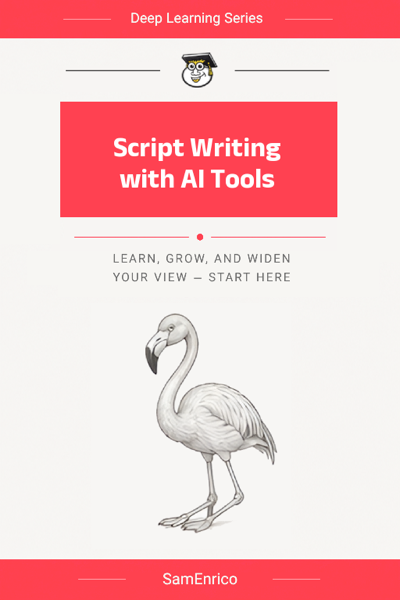
Script Writing with AI Tools eBook
A Coursebook on Script Writing with AI Tools
by Aleman Lacy
A Coursebook on Script Writing with AI Tools
Formats
Free sample
Chapter 1: The Augmented Writer...–- The blinking cursor on the blank page. Every screenwriter knows it. The weight of expectation. The whisper of doubt. The deadline looming.
For decades, writers have faced this moment alone, armed with nothing but instinct, experience, and caffeine. But something has changed. A new collaborator has entered the room—not a replacement for the writer’s voice, but a catalyst for it. Meet the augmented writer: a creative professional who uses artificial intelligence as a creative assistant, not as an autopilot, to generate ideas faster, break through blocks, and spend more time on the work that only a human can do. This chapter introduces the paradigm shift facing modern screenwriters and establishes the foundational principle that governs everything that follows: the writer remains the author.
AI remains the instrument. The story still belongs to you.1.1 The Paradigm Shift: From Typewriter to AI Assistant The history of screenwriting tools is a history of creative liberation. The typewriter freed writers from the illegibility of handwriting. The word processor freed writers from the tyranny of white-out and retyping entire pages. Scriptwriting software like Final Draft and Movie Magic standardized formatting, allowing writers to focus on story instead of margin settings.
Each new tool was met with skepticism. Each new tool was eventually adopted. Each new tool made the writer more productive without making the writer obsolete.Artificial intelligence continues this trajectory, but with a difference. Unlike a typewriter or a word processor, AI can generate original content. It can suggest dialogue, propose plot twists, and restructure scenes.
This generative capability has sparked fear—fear that AI will replace human writers, that the unique voice of the individual artist will be flattened into algorithmic mediocrity, that the craft of screenwriting will be reduced to prompt engineering.These fears are understandable but misplaced. The evidence from cognitive science and professional practice suggests otherwise. Creative ideation—the ability to generate novel, surprising, and meaningful combinations of ideas—remains a fundamentally human capability. Emotional truth—the resonance that comes from lived experience and genuine empathy—cannot be algorithmically manufactured. Authentic voice—the distinctive signature of an individual writer’s perspective—emerges from a lifetime of observation, not from training data.This chapter establishes the augmented writer framework that will guide the entire book.
The augmented writer is not someone who lets AI write for them. The augmented writer is someone who uses AI as a creative assistant, much like a composer uses an orchestra or a painter uses a brush. The AI generates options. The writer selects, refines, and infuses with meaning. The AI handles volume and speed.
The writer handles judgment and soul.1.2 The Four Pillars of AI-Augmented Screenwriting The integration of generative AI into audiovisual screenwriting affects four fundamental aspects of the craft. Understanding these four pillars will help you identify where AI can be most useful and where your human judgment remains irreplaceable.Pillar One: Process Management AI excels at speeding up the mechanical aspects of writing. Generating twenty loglines in sixty seconds. Restructuring a beat sheet across multiple frameworks. Formatting a script to industry standards.
Tracking character names and scene locations across a hundred pages. These tasks are essential but time-consuming. AI handles them in seconds, freeing you to focus on creative decisions.This is not about taking shortcuts. It is about allocating your creative energy to the work that only you can do. A composer does not build the orchestra’s instruments.
A painter does not manufacture the pigments. A screenwriter should not spend hours on tasks that AI can complete instantly.Pillar Two: Idea Generation The blank page is the screenwriter’s greatest adversary. AI offers a way to overcome initial inertia by generating volume and variety. Stuck on a logline? Ask AI for twenty variations.
Unsure how a scene might play out? Generate five alternative versions. Need a character backstory? Let AI suggest possibilities, then select and deepen the most promising.The key word is suggest. AI generates raw material.
The writer does the selecting, refining, and embedding into the larger narrative. This is not outsourcing creativity. It is augmenting it—using speed to overcome inertia, then applying human judgment to find the diamond in the rough.Pillar Three: Narrative and Stylistic Techniques AI can analyze narrative structures, identify pacing problems, and suggest stylistic variations. It can help you master genre conventions, subvert them intentionally, or blend genres in novel ways. It can identify weak transitions, repetitive dialogue patterns, and underdeveloped subplots.But AI cannot feel the rhythm of a scene.
It cannot know which joke lands and which falls flat. It cannot sense when a character’s motivation rings false. These judgments require emotional intelligence, cultural context, and lived experience—qualities that remain uniquely human.Pillar Four: Evaluation and Communication AI can provide developmental feedback on your drafts, identifying potential plot holes, inconsistent character behavior, and structural weaknesses. It can help you articulate your creative vision for producers, directors, and collaborators. It can generate coverage and pitch materials.But AI is not a substitute for human readers.
The most valuable feedback still comes from trusted peers who bring their own perspectives, experiences, and emotional responses. Use AI as a first pass, not a final judge.1.3 The Augmented Writer Framework: A Clear Hierarchy Throughout this book, you will encounter the term augmented writer. It is important to understand exactly what this means—and what it does not mean.What the augmented writer is: A creative professional who strategically deploys AI tools to handle volume, speed, and exploration, while retaining ultimate creative authority over selection, refinement, and emotional truth. The augmented writer works with AI, not for AI, and not through AI.What the augmented writer is not: A writer who outsources creative decisions to algorithms. A writer who presents AI-generated material as their own without substantial creative contribution.
A writer who uses AI as a crutch rather than a catalyst.The hierarchy is clear and will be referenced throughout this book:You are the author. Every creative decision—what to include, what to cut, what to emphasize, what to subvert—belongs to you. AI suggestions are raw material, not commands.AI is the creative assistant. It generates options, identifies patterns, and handles mechanical tasks. It does not have taste, judgment, or emotional intelligence.
It does not know what is funny, sad, or surprising.Collaboration is directional. You direct the AI. The AI does not direct you. You ask. It answers.
You refine. It adapts. You remain in control of the creative process at every stage.This hierarchy resolves the apparent contradiction in calling AI a "collaborator" while also calling it a "tool." The term collaborator is aspirational—it means AI works alongside you, not that it has equal creative standing. Throughout this book, when we say "partner," we mean "sophisticated tool that requires human direction."1.4 Addressing the Fear: Will AI Replace Human Writers?The question is asked in writers’ rooms, coffee shops, and online forums. Will AI replace human screenwriters?
The short answer is no. The longer answer requires examining what AI can and cannot do.What AI can do: Generate grammatically correct sentences. Mimic stylistic patterns from its training data. Complete prompts with plausible continuations.…
This is the end of the free sample. Get the eBook to keep going. Buy now
About this book
Details
- Author
- Aleman Lacy
- Publisher
- SamEnrico
- Language
- English
- Genre
- Non-Fiction, Informative, Educational
- Released
- 2026-05-06
- Pages (approx.)
- 114
- Available as
- eBook, Audiobook

Read better in the ZLOADR app
Your eBooks on your phone or tablet. Sign in with your SamEnrico account and start reading.
More by Aleman Lacy
 Self Esteem for Retail EmployeesAleman Lacy$11.99
 Obligation Extraction AI PlaybookAleman Lacy$11.99
 Physics Equation PalaceAleman Lacy$11.99
 Emotional Dysregulation ADHDAleman Lacy$11.99
 Anger Management for Depression at WorkAleman Lacy$11.99
 The Nostril Sensation GuideAleman Lacy$11.99
 Pressure Cooker Diver MemoirAleman Lacy$11.99
 Egyptian Furniture GuideAleman Lacy$11.99
 Return To Work BurnoutAleman Lacy$11.99
 Dust Bowl Diaries: The Unsung Heroes of the Great PlainsAleman Lacy$11.99
 The Silk Road's Shadow: The Rise and Fall of the Dark Web's Drug EmpireAleman Lacy$11.99
 Frozen Fire: The Arctic Volcano Hunters of the Early 1900sAleman Lacy$11.99
You may also like
 Hong Kong Handover 1997Dunn Johnnie$11.99
 Zumba For Postnatal Recovery CourseNeal Christian$11.99
 Zumba for BeginnersLadner Nikia$11.99
 YouTube Comment Mining GuideHumes Pandora$12.99
 Worry Box MeditationCarlin Rudy$11.99
 Workplace Stress MeditationNguyen Lynn$11.99
 Workplace Stress and Sleep RepairHawley Ivory$11.99
 Workplace Perfectionism CureDelaney Jeffry$11.99
 Workplace Injustice Anger GuideWallen Isabelle$11.99
 Work Addiction and Burnout LinkGreenwood Ester$11.99
 Women in Yoga and WellnessBeattie Galina$11.99
 Women in Stand Up ComedyChun Evangeline$11.99