
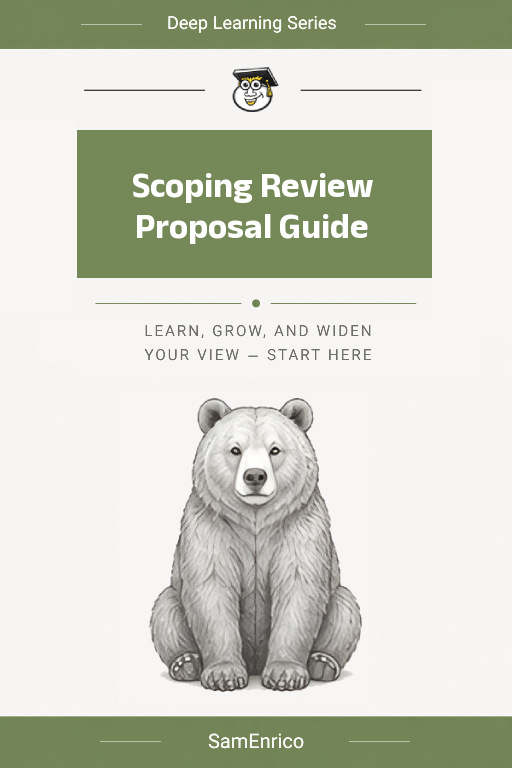
Non-FictionStudent's ShortcutEvidence Synthesis
Scoping Review Proposal Guide eBook
Propose scoping reviews as standalone grad researc
Propose scoping reviews as standalone grad research projects. Map literature, identify evidence clusters, and justify scoping over systematic review approach.
Formats
Free sample
Chapter 1: The Cartographer's Pivot-- Every graduate student remembers the moment their comfortable understanding of a literature review collapsed. For some, it happens during a committee meeting when a professor asks, "But how is your review different from a dissertation chapter?" For others, it comes while reading a methods paper that casually mentions "PRISMA flow diagrams" and "risk of bias assessments" as if these were common knowledge. And for many, it arrives in the middle of the night, staring at a spreadsheet of 3,000 article titles, realizing that summarizing each one individually would take longer than writing the actual thesis.That moment of collapse is not a failure. It is an invitation.The traditional graduate education model treats the literature review as a rite of passage—something you endure before getting to the "real" research. You read broadly, take notes, organize by theme, and produce a chapter that demonstrates your familiarity with the field.
Your advisor reads it, nods, and says, "Good foundation. Now what's your research question?" The review itself is never the destination. It is the bus you take to get there.But what if the review could be the destination? What if mapping what is known—not judging it, not aggregating it, but simply charting its contours—was a contribution worthy of a thesis, a publication, and a career?This book argues that it is. And the key to unlocking that argument is what I call the cartographer's pivot: the shift from asking "What works?" to asking "What is the shape of what we know?"The Two Traps That Catch Every Graduate Student Before we can understand why the scoping review is revolutionary, we must understand the traps that literature-based graduate projects fall into.
I have seen these traps consume months of student time, derail dissertations, and produce work that satisfies no one—not the student, not the committee, not the field.Trap One: The Kitchen Sink The kitchen sink literature review is the most common failure mode in the humanities and social sciences. Here is how it happens. You choose a topic—say, "resilience in healthcare workers during crises." You search Google Scholar and your university library database. You find 500 relevant articles. You read the abstracts, then the full texts of the most cited ones.
You take notes on index cards or in a Word document. You organize these notes thematically: definitions of resilience, measures of resilience, factors that predict resilience, interventions that build resilience.So far, so good.Then you start writing. You write a paragraph summarizing one definition, then another paragraph summarizing a different definition. You write a paragraph about the Connor-Davidson Resilience Scale, then a paragraph about the Brief Resilience Scale, then a paragraph about the Resilience Scale for Adults. You write ten paragraphs about predictive factors, then fifteen paragraphs about interventions.By page forty, you realize something terrible: you are summarizing, not synthesizing.
You have produced an annotated bibliography in prose form. You have shown the committee that you can read, but you have not shown them that you can think. Your contribution is "I read a lot of papers," which is not a contribution at all.The kitchen sink trap is seductive because it feels like progress. Each new paragraph is another paper summarized. Each new citation is evidence of diligence.
But the trap closes when your advisor asks, "What is your argument?" and you realize you do not have one. You have description, not analysis. You have aggregation, not interpretation.Trap Two: The Empty Systematic Review The empty systematic review is the mirror image of the kitchen sink, and it is most common in fields that have adopted evidence-based medicine methodologies without adopting the underlying assumptions. Here is how this trap happens. You learn about systematic reviews in a methods course.
You hear that they are the "gold standard" for evidence synthesis. You decide to conduct one for your thesis.You formulate a PICO question: "In healthcare workers (Population), does a mindfulness-based intervention (Intervention) compared to no intervention (Comparison) reduce burnout (Outcome)?" You register your protocol on PROSPERO. You design a comprehensive search strategy. You run the search across five databases.And you find... twelve studies.
Of these, three are randomized controlled trials. Two use different mindfulness protocols. One measures burnout with the Maslach Burnout Inventory, another with the Oldenburg Burnout Inventory, and the third with a single-item measure. Two have high risk of bias. The third is underpowered.
You cannot perform a meta-analysis because the outcome measures are incomparable.You have spent six months on a systematic review that has nothing to synthesize. You followed every rule, checked every box, and produced... an empty set. Your contribution is "There is insufficient evidence to draw conclusions," which, while true, is not a thesis.The empty systematic review trap is cruel because it punishes you for following the rules. The problem is not your execution.
The problem is the fit between your question and your method. Systematic reviews assume a mature evidence base with comparable studies. When those assumptions fail—as they often do in emerging fields, interdisciplinary topics, and policy-relevant questions—the systematic review becomes an engine for producing frustration.The Third Path Between the kitchen sink (rigorless) and the empty systematic review (rigorous but empty) lies a third path: the standalone scoping review.The scoping review is not a compromise between the two traps. It is a fundamentally different approach that asks a fundamentally different question. Where the systematic review asks "What works?" (requiring homogeneity of intervention, comparison, and outcome), the scoping review asks "What is known, and how is it studied?" (embracing heterogeneity of method, definition, and theory).This difference is not minor.
It changes everything: your research question, your search strategy, your data extraction, your analysis, and your contribution. Let me show you how.Using the resilience in healthcare workers example, a scoping review would ask: "How has resilience been studied among healthcare workers during public health emergencies?" This question does not assume an intervention. It does not require a comparison group. It does not demand a single outcome measure. Instead, it invites exploration.Your scoping review would map:Which populations of healthcare workers have been studied (nurses?
physicians? paramedics? support staff?)Which definitions of resilience are in use (trait? state? process?
outcome?)Which measurement instruments exist (validated scales? qualitative interviews? physiological measures?)Which study designs predominate (cross-sectional surveys? longitudinal cohorts? qualitative case studies?)Which geographic regions are represented (high-income countries?
low- and middle-income countries?)Which theoretical frameworks guide the research (psychological? ecological? systems-based?)Which gaps exist (no studies of resilience during simultaneous crises? no interventions tested with paramedics?)Each of these findings is a contribution. If you discover that 90% of studies use the Connor-Davidson Resilience Scale with nurses in high-income countries, you have identified a conceptual cluster (a dominant measurement tool) and a dead zone (other populations, other regions).
If you discover that definitions of resilience range from "personality trait" to "dynamic process involving individual and environment," you have identified a conceptual fragmentation that future research must address.These are not negative findings. They are positive discoveries about the shape of the evidence base. They are exactly what a dissertation committee, a journal editor, and a funding agency want…
This is the end of the free sample. Get the eBook to keep going. Buy now
About this book
Details
- Author
- Mcclintock Santana
- Publisher
- SamEnrico
- Language
- English
- Genre
- Non-Fiction, Student's Shortcut, Evidence Synthesis
- Released
- 2026-06-01
- Pages (approx.)
- 149
- Available as
- eBook, Audiobook

Read better in the ZLOADR app
Your eBooks on your phone or tablet. Sign in with your SamEnrico account and start reading.
More by Mcclintock Santana
 The Dry Cleaning GuideMcclintock Santana$11.99
 Restaurant Nonverbal GuideMcclintock Santana$11.99
 Harvard Extension School Transfer CreditsMcclintock Santana$11.99
 Burnout and Therapy SeekingMcclintock Santana$11.99
 Rana Pratap's Last Stand: The Siege of Chittorgarh (1568)Mcclintock Santana$11.99
 Real Estate Valuation AnalystMcclintock Santana$11.99
 How to Produce Bicycle DerailleursMcclintock Santana$11.99
 How to Start a Noils (woollen Industry) Business (Beginners Guide)Mcclintock Santana$11.99
You may also like
 Hong Kong Handover 1997Dunn Johnnie$11.99
 Zumba For Postnatal Recovery CourseNeal Christian$11.99
 Zumba for BeginnersLadner Nikia$11.99
 YouTube Comment Mining GuideHumes Pandora$12.99
 Worry Box MeditationCarlin Rudy$11.99
 Workplace Stress MeditationNguyen Lynn$11.99
 Workplace Stress and Sleep RepairHawley Ivory$11.99
 Workplace Perfectionism CureDelaney Jeffry$11.99
 Workplace Injustice Anger GuideWallen Isabelle$11.99
 Work Addiction and Burnout LinkGreenwood Ester$11.99
 Women in Yoga and WellnessBeattie Galina$11.99
 Women in Stand Up ComedyChun Evangeline$11.99