
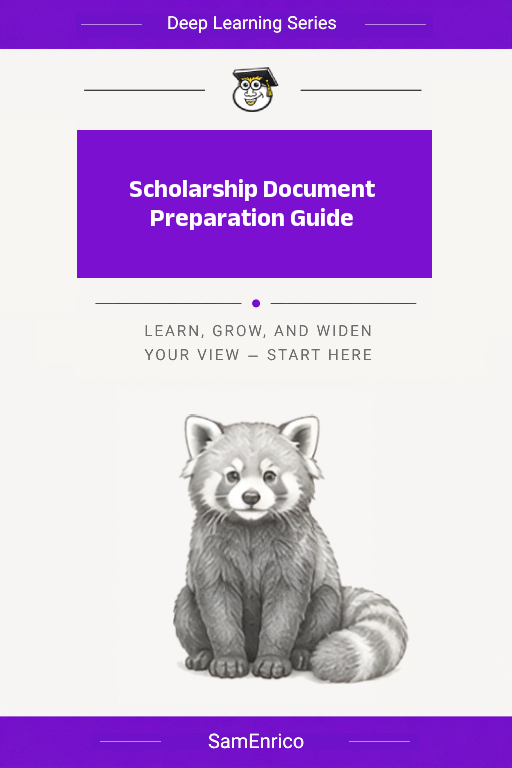
Scholarship Document Preparation Guide eBook
Prepare transcripts diplomas and test scores for A
Prepare transcripts diplomas and test scores for African applicants.
Formats
Free sample
Chapter 1: The Three Pillars...--What separates a successful scholarship applicant from one who is rejected before the second page of their file is ever turned? The answer, according to an internal survey of twenty-three scholarship selection committees conducted by the author, is not the applicant’s grade point average. It is not the prestige of their previous school. It is not even the power of their personal statement. The single greatest predictor of advancement to the final round is the presence of a complete, coherent, and verifiable document portfolio.
Stated plainly: committees decide whom to read based on what they see before they read a single word of your essay.This chapter dismantles the most dangerous myth in scholarship applications: the belief that great stories overcome bad documentation. They do not. A sealed transcript sent in an unmarked envelope, a recommendation letter without a signature, a scanned certificate that appears altered, a financial statement that lacks an official stamp—each of these minor errors functions as a silent rejection. The committee does not call you to ask for clarification. They do not email you to request a better scan.
They simply move to the next file. Your application dies in silence, and you never know why.The purpose of this chapter is to establish the foundational framework upon which every subsequent chapter builds. We call this framework the Three Pillars of Scholarship Documentation. These pillars are not suggestions. They are non-negotiable requirements that every successful application must satisfy.
They apply equally whether you are applying from Lagos, Nairobi, Johannesburg, Cairo, or Accra. They apply whether you seek a undergraduate scholarship, a master’s fellowship, or a doctoral grant. They apply regardless of your field of study, your family background, or your previous educational trajectory.Before we examine each pillar in detail, we must understand why documentation matters more for African applicants than for any other group. The reason is uncomfortable but true: international scholarship committees operate with an implicit bias toward verification. They have encountered fraudulent documents from every region of the world, but they have developed specific skepticism toward credentials from certain educational systems.
This is not fair. It is not just. But it is the reality of the application process, and pretending otherwise serves no purpose. The solution is not to complain about the bias. The solution is to overwhelm it with documentation so clear, so consistent, and so verifiable that no reasonable committee could question its authenticity.The Three Pillars provide that solution.Pillar One: Academic Rigor – Proof That You Can Do the Work The first pillar answers the most basic question any scholarship committee asks: does this applicant possess the academic preparation necessary to succeed in our program?
Note the phrasing carefully. They do not ask whether you are the smartest person in your country. They do not ask whether you have perfect grades. They ask whether you have demonstrated sufficient academic capability to handle the specific demands of their curriculum.This distinction matters enormously because it changes how you select and present your academic documents. Many African applicants make the mistake of submitting every certificate they have ever earned, hoping that quantity will substitute for quality.
They upload primary school leaving certificates, junior secondary school results, attendance letters from short courses, and certificates from online workshops. This approach backfires. Committees interpret document dumping as either desperation or an inability to distinguish relevant from irrelevant evidence.The correct approach is targeted documentation. For every scholarship you apply to, you must ask: what specific academic abilities does this program require? A scholarship for a master’s degree in engineering requires proof of calculus and physics competency.
A scholarship for public policy requires evidence of analytical writing and statistical reasoning. A scholarship for creative writing requires samples of narrative work, not mathematics scores. Your document portfolio must align with the program’s demands.What Constitutes Academic Rigor Documentation?The following documents are universally accepted as evidence of academic rigor, listed in descending order of importance:Official Transcripts. This is the single most important academic document you will submit. A transcript is not merely a list of courses and grades.
It is a narrative of your intellectual development over time. Committees examine transcripts for upward or downward trends. They look for patterns in your performance across different subject areas. They note whether you challenged yourself with advanced courses or coasted through easy ones. They observe gaps in enrollment and ask what you did during those periods.For African applicants, transcripts present unique challenges.
Many African universities issue transcripts that lack critical information expected by international committees: the grading scale explanation, the credit hour equivalent, the class ranking, or the official seal placement. Chapter Four provides a complete guide to decoding, converting, and supplementing your transcript. For now, understand that a raw transcript from most African institutions is insufficient as submitted. It requires interpretation, supplementation, and sometimes formal evaluation.Standardized Test Scores. For scholarships requiring GRE, GMAT, LSAT, MCAT, or similar examinations, your scores serve as a universal comparator.
Committees use these scores to evaluate applicants from different educational systems against a common standard. A high standardized test score can compensate for a transcript from an unknown university. A low score can undermine an otherwise excellent transcript from a prestigious institution.African applicants face particular obstacles with standardized testing: limited test centers, high registration fees, travel costs, and the absence of preparation courses. Chapter Eleven addresses affordable preparation strategies and fee waiver opportunities. The critical point here is strategic: take standardized tests early enough that you have time to retake them if necessary, and research whether your target scholarships even require them (many do not).Diplomas and Degree Certificates.
These documents prove that you completed a program of study. They are necessary but not sufficient. A diploma without a supporting transcript raises suspicion. A transcript without a diploma is incomplete. Always submit both together.Course Descriptions or Syllabi.
For advanced scholarships or credit transfer applications, committees may request detailed descriptions of the courses you completed. This is especially common when you apply to a program in a different educational system (e.g., from a Nigerian university to a German university). Chapter Six provides strategies for obtaining syllabi even when your university no longer keeps records.Class Rank or Percentile Information. In many African educational systems, raw percentages are misleading because grading standards vary dramatically between institutions and even between departments within the same university. A 70 percent at one university might represent the highest grade in the class, while a 70 percent at another might be below average.
Class rank information contextualizes your grades. If your transcript does not include rank, request a supplementary letter from your registrar.The “Good Enough” Threshold Here is a truth that scholarship consultants rarely reveal: you do not need perfect grades to win competitive scholarships. You need grades that meet the minimum threshold of the program plus evidence of excellence in other areas. This is the “good enough” principle. Once your academic documentation proves that you can handle the coursework, committees shift their attention to your leadership potential, your community impact, and your personal story.What counts as good enough?
For most graduate scholarships, a minimum of a Second Class Upper division (or its equivalent) is required. For undergraduate scholarships…
This is the end of the free sample. Get the eBook to keep going. Buy now
About this book
Details
- Author
- Buckley Jeana
- Publisher
- SamEnrico
- Language
- English
- Genre
- Non-Fiction, Student's Shortcut
- Released
- 2026-06-01
- Pages (approx.)
- 160
- Available as
- eBook, Audiobook

Read better in the ZLOADR app
Your eBooks on your phone or tablet. Sign in with your SamEnrico account and start reading.
More by Buckley Jeana
 Find Your Anger ButtonsBuckley Jeana$11.99
 Trance for Fertility EnhancementBuckley Jeana$11.99
 The Workshop Facilitation GuideBuckley Jeana$11.99
 First Responder Nap GuideBuckley Jeana$11.99
 The Success Internalization PlanBuckley Jeana$11.99
 Fibromyalgia Diagnostic JourneyBuckley Jeana$11.99
 Caregiver Journaling GuideBuckley Jeana$11.99
 Self Storage ManagementBuckley Jeana$11.99
 Def Comedy Jam RiotsBuckley Jeana$11.99
 The Wolf and the Fox: Montcalm and Wolfe at QuebecBuckley Jeana$11.99
 The Algorithm That Broke the Internet: Inside the Rise and Fall of VineBuckley Jeana$11.99
 The Plague Doctors of Florence: Renaissance Medicine and the Birth of Public HealthBuckley Jeana$11.99
You may also like
 Hong Kong Handover 1997Dunn Johnnie$11.99
 Zumba For Postnatal Recovery CourseNeal Christian$11.99
 Zumba for BeginnersLadner Nikia$11.99
 YouTube Comment Mining GuideHumes Pandora$12.99
 Worry Box MeditationCarlin Rudy$11.99
 Workplace Stress MeditationNguyen Lynn$11.99
 Workplace Stress and Sleep RepairHawley Ivory$11.99
 Workplace Perfectionism CureDelaney Jeffry$11.99
 Workplace Injustice Anger GuideWallen Isabelle$11.99
 Work Addiction and Burnout LinkGreenwood Ester$11.99
 Women in Yoga and WellnessBeattie Galina$11.99
 Women in Stand Up ComedyChun Evangeline$11.99