
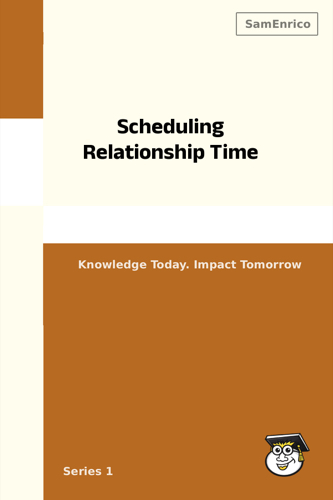
Scheduling Relationship Time eBook
Block calendar for intimacy like you would for wor
Block calendar for intimacy like you would for work meetings.
Formats
Free sample
Chapter 1: The Pantry Breakdown--–- I found myself crying on the floor of my own pantry at 11:47 on a Tuesday night. Not because of anything tragic—no one had died, no one was sick, no marriage was ending in a dramatic blaze of infidelity or financial ruin. I was crying because I had just realized, with the kind of stomach-dropping clarity that only comes in the dark with a box of stale crackers in your lap, that I could not remember the last time my wife had actually touched me. Not a peck on the cheek as she rushed out the door. Not a hand on my shoulder while we watched the same Netflix show we had been "watching" for three weeks.
A real touch. The kind that says I see you. I want you. You are not just the person who pays the bills and takes out the trash.I knew because I had checked my calendar.That is not a sentence I am proud to write. But it is the truth.
I scrolled back through weeks of appointments, deadlines, kid activities, dentist visits, and grocery pickups. I found a date night we had scheduled six weeks earlier. It was a Thursday. I had blocked 7:00 PM to 10:00 PM and given it the optimistic title "Date Night – Our Turn." We canceled it for a work deadline—mine. We rescheduled for the following Saturday.
Canceled for a sick child—hers. We rescheduled again for the following Tuesday. Canceled because we were both exhausted and honestly could not remember what we were supposed to talk about. The third time, we just... stopped trying.
Neither of us said, "We are canceling this permanently." We just stopped putting it back on the calendar. And I had not noticed. For six weeks, I had not noticed that my marriage had become a logistics partnership.That is The Drift.The Invisible Current That Sinks Most Marriages The Drift is the single most destructive force in long-term relationships, and almost no one talks about it. It is not infidelity. It is not addiction.
It is not financial ruin or abuse or any of the dramatic, cinematic reasons marriages fail. The Drift is quiet. It is the slow, imperceptible slide from lovers into roommates. It happens when you stop scheduling each other because you assume you will "find time." It happens when you prioritize everything else—work, kids, chores, phone scrolling, television—and tell yourself that intimacy will just happen when the conditions are perfect. The conditions are never perfect.I have now worked with hundreds of couples as a relationship coach, and I have seen The Drift in every single one of them.
It shows up in three distinct ways, each one feeding the others like a toxic ecosystem.The first manifestation is what I call the "Can we talk?" ambush. This is when one partner tries to have a serious conversation—about money, about chores, about the kids, about something that has been bothering them—during what was supposed to be relaxing time. You sit down to watch a movie, and your partner says, "Hey, can we talk about the credit card bill?" You climb into bed, and your partner says, "I've been thinking about your mother's visit." The ambush kills intimacy not because the topics are unimportant, but because they are uncontained. You never get a break from logistics. Every moment becomes a potential negotiation.
And over time, you stop wanting to be in the same room because you never know when another conversation is coming.The second manifestation is time leaks. These are the hours that disappear into activities that neither partner truly values but both default to because they are easy. Phone scrolling. Television bingeing. Endless social media.
The average American spends nearly three hours per day on their phone. The average couple spends two and a half hours per day watching television together but only fifteen to thirty minutes talking to each other. I am not anti-television. I am not anti-phone. But I am asking you to look at those numbers and tell me with a straight face that you have "no time" for your partner.
You have time. You are just spending it elsewhere.The third manifestation is the long-term consequence of The Drift: empty-nest strangers. This is the couple who spends twenty years raising children, managing careers, and keeping the household running—never once protecting their own connection—and then wakes up the day after the last child leaves for college to discover they have nothing to say to each other. They have become excellent business partners and terrible romantic partners. The research is brutal on this point: marital satisfaction often hits its lowest point not during the newborn stage, as many assume, but during the launching stage, when the children leave home.
Why? Because the children were the only thing holding the marriage together. Once they are gone, the couple looks across the table and sees a stranger.I was well on my way to becoming an empty-nest stranger. My children were young then, but I could see my future. I was crying in the pantry because I had looked at my calendar and realized that my wife and I had become two ships passing in the night.
We were efficient. We were polite. We were not connected.The Spontaneity Myth That night, I did something that felt deeply wrong. I opened my calendar and scheduled a date. Not a vague "we should do something sometime." I opened my calendar and typed: "Tuesday, 7:00 PM – 9:00 PM: Date Night.
No phones. No kids. No work talk." I set a notification for twenty-four hours in advance. I sent my wife a calendar invitation. And then I waited for her to think I had lost my mind.She did not think I had lost my mind.
She looked at the invitation, looked at me, and said, "Is everything okay?" I told her about the pantry. I told her about the six weeks. I told her I missed her. And she started crying too, because she had been feeling the exact same thing but had not known how to say it without sounding needy or accusing.That date night was awkward. We had forgotten how to have a conversation that was not about logistics.
We sat across from each other at a restaurant and realized we had no idea what the other person was reading, thinking, or wanting. But we stayed the full two hours. And at the end, we scheduled another one. And then another. And then we scheduled a weekly logistics meeting so that the "can we talk?" ambush would stop hijacking our date nights.
And then we scheduled sex. Yes, we typed it into the calendar. And yes, it worked.Here is what I learned, and what this entire book is built upon: the belief that intimacy should be spontaneous is a myth that is destroying your relationship.I know that is a strong statement. I know it goes against every romantic comedy, every love song, every cultural script we have been fed since adolescence. We are told that real love is effortless.
That if you have to schedule it, it is not authentic. That planning a date night or—God forbid—scheduling sex means…
This is the end of the free sample. Get the eBook to keep going. Buy now
About this book
Details
- Author
- Shelley Julene
- Publisher
- SamEnrico
- Language
- English
- Genre
- Non-Fiction, Self-Help
- Released
- 2026-06-08
- Pages (approx.)
- 145
- Available as
- eBook, Audiobook

Read better in the ZLOADR app
Your eBooks on your phone or tablet. Sign in with your SamEnrico account and start reading.
More by Shelley Julene
 Email Draft Folder Weekly ReviewShelley Julene$11.99
 The Personal Brand Networking GuideShelley Julene$11.99
 Menopause And Caffeine GuideShelley Julene$11.99
 First Time Home Buyers After FiftyShelley Julene$11.99
 Self Validation HypnosisShelley Julene$11.99
 Layoff Survival Recovery GuideShelley Julene$11.99
 Deep Work For Remote TeamsShelley Julene$11.99
 The First Frame: How a Colonial Outpost Brought Cinema to the WorldShelley Julene$11.99
 Brushstrokes Across the Battlefield: The Secret Art of War Correspondent Li WeiShelley Julene$11.99
 Mastering Tallage: Medieval Lord's TaxShelley Julene$11.99
 How to Become a Hatch TenderShelley Julene$11.99
 Ghanaian Export Payment HandbookShelley Julene$12.99
You may also like
 Hong Kong Handover 1997Dunn Johnnie$11.99
 Zumba For Postnatal Recovery CourseNeal Christian$11.99
 Zumba for BeginnersLadner Nikia$11.99
 YouTube Comment Mining GuideHumes Pandora$12.99
 Worry Box MeditationCarlin Rudy$11.99
 Workplace Stress MeditationNguyen Lynn$11.99
 Workplace Stress and Sleep RepairHawley Ivory$11.99
 Workplace Perfectionism CureDelaney Jeffry$11.99
 Workplace Injustice Anger GuideWallen Isabelle$11.99
 Work Addiction and Burnout LinkGreenwood Ester$11.99
 Women in Yoga and WellnessBeattie Galina$11.99
 Women in Stand Up ComedyChun Evangeline$11.99