
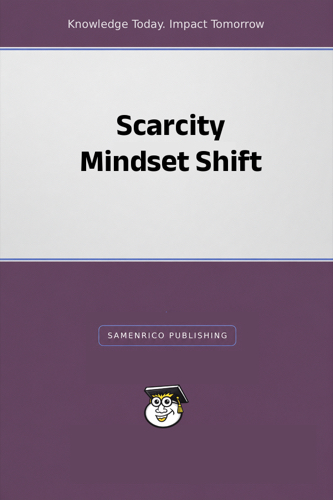
Scarcity Mindset Shift eBook
Transform lack mentality into generative creative
Transform lack mentality into generative creative force.
Formats
Free sample
Chapter 1: The Bandwidth Tax--It begins with a farmer in Tamil Nadu, India, named Karthik. Twice a year, before the harvest, Karthik has no money. He borrows from the village lender at 20% interest to buy seeds and fertilizer. He worries constantly. He cannot sleep.
His children ask for school supplies he cannot afford. Then the harvest comes. He sells his crops, pays back the lender, and for a few months, he has enough. Not wealth, but enough.Researchers followed Karthik and hundreds of farmers like him through this cycle. They gave the farmers a battery of cognitive tests twice: once before the harvest (when money was scarce) and once after (when money was plentiful).
The same farmers. The same intelligence. The only difference was whether they were poor or not-poor at that moment.The results were staggering. Before the harvest, the farmers scored an average of 13 IQ points lower than after the harvest. Thirteen points.
That is the difference between average and superior intelligence. That is the difference, researchers noted, between being rested and losing an entire night of sleep. The farmers were not less intelligent during the lean season. They were cognitively impaired by scarcity itself.This is the Bandwidth Tax. And it is the first thing you must understand before you can shift your scarcity mindset.The Weight of Not Enough Let us name what you have felt but perhaps could not articulate.
That fog that descends when you check your bank account and the number is lower than you hoped. That inability to think clearly when a bill arrives you cannot pay. That frantic, spinning feeling when a deadline is tomorrow and you have not started. That shortness with your children or partner when you are worried about money, time, or both.That is not weakness. That is not a character flaw.
That is the bandwidth tax being levied on your cognitive functioning.The term comes from the work of behavioral economists Sendhil Mullainathan and Eldar Shafir, who spent a decade studying how scarcity changes the mind. Their central finding, published in the book Scarcity: Why Having Too Little Means So Much, is that scarcity captures the mind automatically and involuntarily. You do not choose to obsess about your overdue rent. You do not choose to lie awake at 3 AM calculating how you will pay for the car repair. The scarcity does that to you.
It hijacks your attention.This hijacking is not entirely stupid from an evolutionary perspective. Your brain is designed to prioritize threats. A lion on the savanna should capture your full attention. A missing meal should make you focus on finding food. The problem is that modern scarcity does not come in neat, solvable episodes.
It comes in endless, overlapping, chronic waves. You pay one bill, and three more arrive. You finish one project, and two more appear. The tunnel never closes.And while you are in that tunnel, focused on the immediate lack, you are not thinking about next week, next month, or next year. You are not planning.
You are not being creative. You are not solving the structural problems that created the scarcity in the first place. You are just surviving.The Scarcity Trap: How Tunneling Creates More Lack Here is the cruelest irony of the bandwidth tax. The tunnel that scarcity creates – that narrow, desperate focus on the immediate – leads you to make decisions that create more scarcity. Mullainathan and Shafir call this the Scarcity Trap.
It is a feedback loop that will appear throughout this book, and understanding it is the first step to escaping it.The trap works like this:Step One: You experience scarcity – of money, time, social connection, or any resource.Step Two: Your mind tunnels. You focus intensely on solving the immediate lack. This focus is useful in the moment. It helps you juggle due dates, squeeze out a last-minute report, or patch together a social obligation.Step Three: While tunneling, you neglect everything else. You borrow from the future to solve the present.
You take a high-interest loan to pay this month's rent. You skip career training to finish today's urgent task. You ignore your health to meet a deadline.Step Four: The borrowing creates more scarcity. The loan must be repaid with interest. The skipped training means you are less qualified for a better job.
The ignored health becomes a medical bill. The trap deepens.Step Five: Return to Step One.This is not a metaphor. Researchers have documented the Scarcity Trap in laboratory experiments, field studies, and large-scale data sets. For example, when people are given a series of tasks with tight deadlines, they focus on the task due soonest and neglect tasks due later – even if the later tasks are more important. They then scramble, fail, and fall further behind.
The same pattern appears in financial behavior. People behind on bills take high-interest payday loans, which make them more behind. People short on time agree to overlapping commitments, which make them more short on time.The trap is self-perpetuating. And it is exhausting.The Three Faces of Scarcity Before we go further, we must make a distinction that will shape the entire rest of this book. Not all scarcity is the same.
In fact, there are three fundamentally different experiences of "not enough," and each requires a different response. Confusing them is why many self-help books fail and why many well-intentioned efforts to "shift your mindset" backfire.Face One: Involuntary Resource Scarcity This is the scarcity that Karthik the farmer experiences before the harvest. It is externally imposed. You did not choose it. You cannot think your way out of it.
You have ten dollars for food, not because you decided to challenge yourself, but because the money is not there.Involuntary resource scarcity is real. It is painful. And it taxes bandwidth exactly as described above. If this is your primary experience of scarcity – if you are struggling to afford housing, food, medical care, or basic safety – this book will not ask you to "reframe" your way out of structural poverty. (See the Appendix for resources and guidance.) However, even within involuntary scarcity, there are tools in Part II and Part III that can help you protect what little bandwidth you have.Face Two: Felt Scarcity This is the scarcity of the upper-middle-class professional who earns $90,000 but feels perpetually broke.
It is the scarcity of the parent who has a loving partner but feels desperately lonely. It is the scarcity of the executive who has a full calendar but feels like they have no time.Felt scarcity is driven by comparison, by ego, by internalized standards of "enough" that shift upward as fast as you climb. It is real in the sense that the anxiety is real – the sleepless nights, the constant stress, the sense of falling behind. But it is not the same as involuntary scarcity. You have resources.
The problem is that your mind does not register them as sufficient.Felt scarcity is the primary target of this book's psychological transformation, especially Chapters 3 and 10. If your Scarcity Score from Chapter 0 showed high felt scarcity with low involuntary scarcity, you are in the right place.Face Three: Voluntary…
This is the end of the free sample. Get the eBook to keep going. Buy now
About this book
Details
- Author
- Bunker Edgardo
- Publisher
- SamEnrico
- Language
- English
- Genre
- Non-Fiction, Self-Help, Mindset
- Released
- 2026-06-07
- Pages (approx.)
- 134
- Available as
- eBook, Audiobook

Read better in the ZLOADR app
Your eBooks on your phone or tablet. Sign in with your SamEnrico account and start reading.
More by Bunker Edgardo
 The Inversion Table Therapy GuideBunker Edgardo$11.99
 HRT For Women With Raynaud's GuideBunker Edgardo$11.99
 Alerzo Trade Sale GuideBunker Edgardo$11.99
 Longevity Biotech GuideBunker Edgardo$11.99
 The Victorian Coin Fraud: Britain's First Financial ScandalBunker Edgardo$11.99
 How to Start a Tire Cord and Tire Fabric Mills BusinessBunker Edgardo$11.99
 Currency Conversion Strategy GuideBunker Edgardo$12.99
 London Pop Up for Beauty BrandsBunker Edgardo$12.99
 Touch FootballBunker Edgardo$11.99
 Understanding Persistent Sexual Arousal SyndromeBunker Edgardo$17.99
You may also like
 Hong Kong Handover 1997Dunn Johnnie$11.99
 Zumba For Postnatal Recovery CourseNeal Christian$11.99
 Zumba for BeginnersLadner Nikia$11.99
 YouTube Comment Mining GuideHumes Pandora$12.99
 Worry Box MeditationCarlin Rudy$11.99
 Workplace Stress MeditationNguyen Lynn$11.99
 Workplace Stress and Sleep RepairHawley Ivory$11.99
 Workplace Perfectionism CureDelaney Jeffry$11.99
 Workplace Injustice Anger GuideWallen Isabelle$11.99
 Work Addiction and Burnout LinkGreenwood Ester$11.99
 Women in Yoga and WellnessBeattie Galina$11.99
 Women in Stand Up ComedyChun Evangeline$11.99