
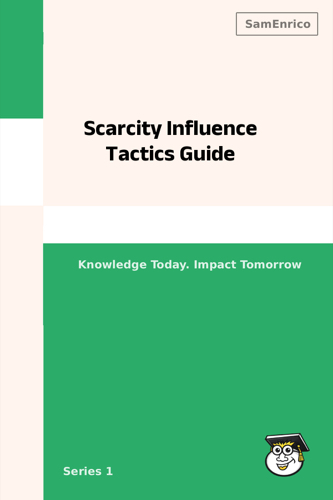
Scarcity Influence Tactics Guide eBook
Creates urgency with limited time and limited quan
by Dumas Glady
Creates urgency with limited time and limited quantity psychological triggers.
Formats
Free sample
Chapter 1: The Primal Trigger--–- You are walking through a crowded mall when you see a sign in a store window: "Closing Down Sale – Everything 50% Off – Final Week." You have never shopped at this store before. You do not need anything they sell. Yet something pulls you through the door. You browse the racks, pick up items you would normally ignore, and find yourself reaching for your wallet. What happened?
The primal trigger fired. The prospect of losing access to a limited opportunity activated a response that bypassed your rational brain and engaged a drive to acquire before it is too late.This reaction is not a quirk of modern consumer behavior. It is an evolutionary adaptation that helped our ancestors survive. When food was scarce, those who recognized the value of limited resources and acted quickly were more likely to survive and reproduce. Those who hesitated, who assumed there would always be more, often starved.
This evolutionary pressure wired scarcity sensitivity into the human brain over thousands of generations. Today, we no longer face the same survival threats. But our brains have not caught up. When we see a "Limited Time Offer" or "Only 3 Left in Stock," the same neural circuits that once drove our ancestors to gather scarce food activate. We feel urgency.
We feel the fear of missing out. We act.This chapter establishes the evolutionary and psychological foundations of scarcity as a persuasive force. You will learn why scarcity works, the two core psychological mechanisms that make it so effective, and the research that proves its power. You will also learn the critical difference between ethical scarcity that builds trust and manipulative scarcity that destroys it. This foundation will inform every tactic in the chapters that follow.The Evolutionary Roots of Scarcity Sensitivity To understand why scarcity works, you must first understand where the instinct comes from.
The human brain evolved in an environment of scarcity. For most of human history, food, water, shelter, and mates were limited resources. Those who recognized scarcity and acted quickly to secure resources survived. Those who did not, died. Over time, this selective pressure created a brain that is exquisitely sensitive to cues of scarcity and limitation.This sensitivity is not conscious.
You do not decide to feel urgency when you see a limited-time offer. The feeling arises automatically, below the level of rational thought. This is why scarcity works even when you know it is working. You can be fully aware that a marketer is using a scarcity tactic, and still feel the pull to act. The conscious mind knows the tactic is being used.
The ancient brain does not care.Consider the Tickle-Me-Elmo craze of 1996. A $30 doll sold for over $7,000 on the secondary market. Parents camped outside stores overnight. Fights broke out over the last dolls. What made this $30 doll worth $7,000?
Only scarcity. The doll itself was unchanged. Its objective value had not increased. But its perceived value skyrocketed because it was hard to get. The same phenomenon occurs every year with holiday toys, concert tickets, sneaker releases, and limited-edition products.
Scarcity creates value where none objectively exists.The Two Psychological Mechanisms: Loss Aversion and Reactance Scarcity works through two core psychological mechanisms: loss aversion and reactance theory. Understanding these mechanisms is essential to using scarcity ethically and effectively.Loss Aversion: The Fear of Losing Loss aversion, first identified by behavioral economists Daniel Kahneman and Amos Tversky, is the finding that losses hurt about twice as much as equivalent gains feel good. Losing $100 causes approximately twice the emotional impact of finding $100. This asymmetry is built into the human brain. It is not a logical calculation but a hardwired emotional response.Scarcity tactics exploit loss aversion by framing the decision not as a choice to gain something, but as a choice to avoid losing something.
"Buy now before it's gone" is more powerful than "Buy now because it's available." The former triggers the fear of loss; the latter triggers only the hope of gain. Fear is a stronger motivator than hope. Loss aversion explains why limited-time offers, low stock alerts, and expiring discounts are so effective. The customer is not deciding whether to gain a product. They are deciding whether to lose the opportunity to get it.This mechanism operates automatically.
You do not need to calculate the probability of loss or the value of the product. The mere possibility of loss triggers an aversive emotional state, and purchasing removes that state. The customer buys not because they want the product, but because they want the feeling of loss to go away. This is why scarcity can drive purchases of products customers do not need and would not otherwise buy.Reactance Theory: Wanting What Is Restricted Reactance theory, developed by psychologist Jack Brehm, explains why people respond strongly to restrictions on their freedom. When something becomes less available, our psychological reactance system activates, and we want it more simply because it is being taken away.
This is why teenagers rebel against curfews. This is why adults line up for hours for limited-edition products. This is why "sold out" signs actually increase desire for future releases.Reactance is a response to perceived restriction of freedom. When a product is described as "limited edition" or "only for members," the restriction signals that access is not automatic. The customer must take action to overcome the restriction.
The restriction itself becomes motivating. The product is desirable not despite the restriction, but because of it.Reactance explains why exclusive access scarcity is so powerful. When customers are told they need an invitation to join, or that a product is only for VIP members, the restriction increases desire. The customer wants what they cannot easily have. This is why invitation-only launches, members-only sales, and early access programs generate such high engagement.
The restriction creates value.Loss aversion and reactance work together. Scarcity creates the perception that something is being restricted (reactance), which makes us want it more. That wanting is amplified by the fear of losing the opportunity forever (loss aversion). The combination produces urgency that rational persuasion alone cannot match.The Research Behind Scarcity The power of scarcity is not theoretical. It has been demonstrated repeatedly in controlled studies across decades of research.The Cookie Jar Experiment In one classic experiment, researchers asked participants to rate the quality of chocolate chip cookies.
One group received a jar with ten cookies. Another group received a jar with only two cookies. Participants rated the cookies from the nearly empty jar as significantly more desirable, even though the cookies were identical. The scarcity of the cookies changed their perceived value. This experiment demonstrates that scarcity operates independently of objective quality.
The cookies did not taste different. They were not made with better ingredients. But the perception of scarcity made them seem better.The Exclusive Information Study In another study, researchers told participants that they could only access certain information if they were willing to receive follow-up communications. When the information was described as "exclusive" or "limited to a small group," compliance rates increased dramatically compared to when the same information was described as widely available. The restriction itself increased desire.
Participants wanted the information more when they were told they might not be able to get it.The Commodity Theory Foundation…
This is the end of the free sample. Get the eBook to keep going. Buy now
About this book
Details
- Author
- Dumas Glady
- Publisher
- SamEnrico
- Language
- English
- Genre
- Non-Fiction, Self-Help, Marketing
- Released
- 2026-06-10
- Pages (approx.)
- 132
- Available as
- eBook, Audiobook

Read better in the ZLOADR app
Your eBooks on your phone or tablet. Sign in with your SamEnrico account and start reading.
More by Dumas Glady
 Neighborhood Watch CaptainDumas Glady$11.99
 Major Depressive Disorder Seasonal PatternDumas Glady$11.99
 Purpose for ParentsDumas Glady$11.99
 Aging Out and HomelessnessDumas Glady$11.99
 Oodgeroo NoonuccalDumas Glady$11.99
 Getting Things Done Weekly ReviewDumas Glady$11.99
 The Alchemist’s Feast: How a Medieval Cookbook Forged a KingdomDumas Glady$11.99
 The Forgotten Pioneers: Japan's First Olympic Dreamers and the Birth of Modern SportDumas Glady$11.99
 How to Start a Air Cargo Agents Business (Beginners Guide)Dumas Glady$11.99
 How to Produce Weapon Scope and Sight AccessoriesDumas Glady$11.99
 How to Produce a Machine ToolDumas Glady$11.99
 Procurement Specialist Career GuideDumas Glady$12.99
You may also like
 Hong Kong Handover 1997Dunn Johnnie$11.99
 Zumba For Postnatal Recovery CourseNeal Christian$11.99
 Zumba for BeginnersLadner Nikia$11.99
 YouTube Comment Mining GuideHumes Pandora$12.99
 Worry Box MeditationCarlin Rudy$11.99
 Workplace Stress MeditationNguyen Lynn$11.99
 Workplace Stress and Sleep RepairHawley Ivory$11.99
 Workplace Perfectionism CureDelaney Jeffry$11.99
 Workplace Injustice Anger GuideWallen Isabelle$11.99
 Work Addiction and Burnout LinkGreenwood Ester$11.99
 Women in Yoga and WellnessBeattie Galina$11.99
 Women in Stand Up ComedyChun Evangeline$11.99