
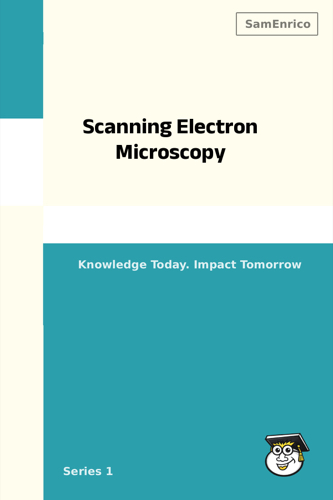
Non-FictionTrue CrimeElectron Microscopy
Scanning Electron Microscopy Audiobook
SEM with EDX for elemental analysis of trace evide
by Janes Sunday
SEM with EDX for elemental analysis of trace evidence.
Formats
Free sample
Chapter 1: The Silent Witness...--The murder weapon was a 9mm semiautomatic pistol, recovered three days later from a storm drain. The suspect’s hands had been washed. His clothing had been bagged and sat in an evidence locker for two weeks. By the time the forensic analyst pressed a small aluminum stub covered in carbon tape against the cuff of the suspect’s jacket, everyone expected nothing. The gunshot residue, if it had ever existed, was surely gone.What the analyst found, under the beam of a scanning electron microscope, changed the trajectory of the case.
Scattered across the sticky surface of that tape were fifty-seven particles smaller than a single grain of baking flour. Each was spherical, smooth, and unlike anything found in ordinary dust. When the electron beam struck them, they emitted X-rays—fingerprints of lead, antimony, and barium. Those three elements, together in a single particle of that specific shape, meant only one thing: the suspect had discharged a firearm, or stood within inches of one when it fired. The silent witness, invisible to the human eye, had spoken.This is the power of scanning electron microscopy combined with energy-dispersive X-ray spectroscopy.
It is not merely an instrument. It is a forensic truth-teller, capable of finding the unfindable, measuring the unmeasurable, and presenting the invisible in vivid, courtroom-ready detail. This chapter establishes why SEM-EDX has become the indispensable workhorse of modern trace evidence analysis, how it compares to other analytical techniques, and what you must know to use it effectively in a forensic laboratory.The Revolution That Began in the 1970s Before the scanning electron microscope found its way into crime laboratories, forensic scientists worked with severe limitations. Optical microscopes could reveal the shape of a paint chip or the twist of a textile fiber, but they could not tell an analyst what elements were present. A white paint chip might contain titanium dioxide pigment, or it might contain lead white, or zinc oxide—but without elemental analysis, the analyst could only guess.
Bulk analytical techniques like atomic absorption spectroscopy could identify elements, but they required destroying the sample, often the only piece of evidence available.The SEM changed everything when it was first commercialized in the 1960s, but it took another decade for forensic scientists to recognize its potential. The breakthrough came in the late 1970s when researchers at the United States Federal Bureau of Investigation and…
This is the end of the free sample. Get the Audiobook to keep going. Buy now
About this book
Details
- Author
- Janes Sunday
- Publisher
- SamEnrico
- Language
- English
- Genre
- Non-Fiction, True Crime, Electron Microscopy
- Released
- 2026-06-10
- Pages (approx.)
- 145
- Available as
- eBook, Audiobook

Listen in the VoxFlicks app
Audiobooks and audio dramas wherever you go. Sign in with your SamEnrico account and press play.
More by Janes Sunday
 The Heart Health MicronutrientJanes Sunday$11.99
 Child Loss And Faith CrisisJanes Sunday$11.99
 Seasonal Burnout PreventionJanes Sunday$11.99
 Dar Es Salaam Independence HubJanes Sunday$11.99
 Consistency Hypnosis GuideJanes Sunday$11.99
 Retirement Interval GuideJanes Sunday$11.99
 Fathers After Infant LossJanes Sunday$11.99
 The Cairo Organ Trade: A 19th-Century Black Market ExposedJanes Sunday$11.99
 The Sydney Six: How Australia's Prohibition Era Tax Trials Toppled a Crime SyndicateJanes Sunday$11.99
 How to Produce Science and Exploration SetsJanes Sunday$11.99
 How to Produce Fleas and TicksJanes Sunday$11.99
 A Collector's Handbook to the Austin A95Janes Sunday$11.99
You may also like
 Hong Kong Handover 1997Dunn Johnnie$11.99
 Zumba For Postnatal Recovery CourseNeal Christian$11.99
 Zumba for BeginnersLadner Nikia$11.99
 YouTube Comment Mining GuideHumes Pandora$12.99
 Worry Box MeditationCarlin Rudy$11.99
 Workplace Stress MeditationNguyen Lynn$11.99
 Workplace Stress and Sleep RepairHawley Ivory$11.99
 Workplace Perfectionism CureDelaney Jeffry$11.99
 Workplace Injustice Anger GuideWallen Isabelle$11.99
 Work Addiction and Burnout LinkGreenwood Ester$11.99
 Women in Yoga and WellnessBeattie Galina$11.99
 Women in Stand Up ComedyChun Evangeline$11.99