
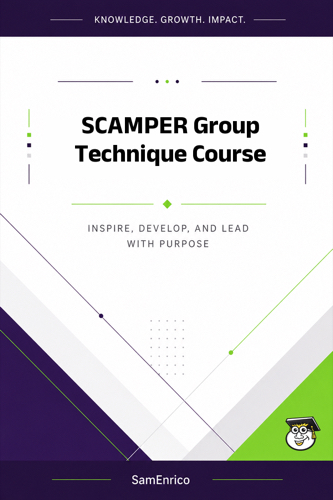
Non-FictionSelf-HelpCreativity Techniques
SCAMPER Group Technique Course eBook
Teaches Substitute, Combine, Adapt, Modify, Put to
Teaches Substitute, Combine, Adapt, Modify, Put to other uses, Eliminate, Reverse for teams.
Formats
Free sample
Chapter 1: The Broken Hour...--–- Maria had just wasted forty-seven hours of her team’s life. She didn’t mean to. She had done everything right: the conference room was booked, the whiteboard was clean, the agenda was printed, and she had even brought donuts. Twelve people sat around the table. The problem was urgent.
The company’s flagship product was losing customers at a rate that made the CEO use words Maria had never heard him use before. “We need ideas,” her VP had said. “Big ideas. Disruptive ideas.” So Maria did what any reasonable product manager would do. She opened the floor.
“Any ideas?” she asked.The silence that followed lasted eleven seconds. Maria counted. Finally, someone suggested changing the logo from blue to green. Someone else said they should add a dark mode. A third person, clearly trying to sound strategic, said they needed to “align more closely with customer pain points,” which was the kind of sentence that sounded important but meant nothing.
After ninety minutes, the group had produced exactly two actionable ideas: dark mode and a logo change. Maria wrote them on the whiteboard. She stared at them. Dark mode. Logo change.
Her VP looked at her like she had just served him a cold cup of coffee with a dead fly floating in it. “Is this it?” he asked. Maria had no answer.She walked back to her desk and did something she almost never did. She Googled “why do my brainstorms suck.” The search results were a graveyard of buzzwords: “think outside the box,” “blue sky thinking,” “innovation ecosystem.” But one phrase stopped her: production blocking. The idea was simple and devastating.
When a group tries to brainstorm verbally, only one person can speak at a time. While that person talks, everyone else is doing one of three things: forgetting their own idea, censoring themselves because they’re afraid of sounding stupid, or abandoning their idea entirely because the conversation has already moved on. Research from the 1990s, replicated many times since, shows that groups working together verbally generate fewer total ideas and fewer novel ideas than the same number of people working alone. Maria read that sentence three times. She had been making her teams less creative by trying to make them creative together.This chapter is for every Maria who has ever left a brainstorming meeting with a sticky note that says “dark mode” and a sinking feeling that something is deeply wrong with how groups generate ideas.
It is for team leads who have been told to “innovate” but given no tools. It is for facilitators who sense that their sessions are dying but don’t know why. And it is for anyone who has ever sat in a conference room, watched the clock crawl toward the hour mark, and thought, “We could have just emailed each other.”The promise of this book is simple: in fifty minutes, using the SCAMPER method as a group facilitation tool, you can generate more and better ideas than a full day of traditional brainstorming. But before we get to SCAMPER, we have to understand why the default mode of group ideation is broken. Because if you don’t understand the disease, you won’t recognize the cure.The Mathematics of Wasted Time Let’s do a simple calculation.
A typical team of eight people holds a one-hour brainstorming meeting. In that hour, if the facilitator is skilled and the group is engaged, perhaps ten to fifteen people will speak. That means each person speaks for an average of four to six minutes. The other fifty-four minutes, each person is listening, waiting, or mentally checking out. That is a 90% underutilization rate.
You are paying eight people to produce the output of one person.But the math is actually worse than that. Production blocking doesn’t just waste time; it actively destroys ideas. In a classic study published in the Journal of Personality and Social Psychology, researchers compared four-person groups working together verbally against four individuals working alone. The individuals working alone generated 60% to 80% more ideas, and their ideas were rated as significantly more creative by independent judges. When you put people in a room together and ask them to speak one at a time, they produce less than the sum of their parts.
They produce a fraction.Why? Three mechanisms are at work. First, forgetting. While one person speaks, others are holding their own ideas in working memory. Working memory is fragile; it holds about four items for about twenty seconds without rehearsal.
If the person speaking takes thirty seconds to make their point, the person waiting has already forgotten half of what they were going to say. Second, censorship. The social pressure of a room causes people to filter themselves. “Will this sound stupid?” “Will my boss think I’m wasting time?” “Has someone already said something similar?” These questions are silent assassins of creativity. Third, abandonment.
Even if an idea survives forgetting and censorship, the conversation may move in a direction that makes the idea irrelevant by the time the person gets a turn.Maria’s meeting was a textbook case. The first person spoke about the logo. By the time the third person spoke about dark mode, the first person had forgotten their second idea. The fourth person, a junior designer, had a genuinely radical idea about pricing but decided it was “too risky” to say out loud. The fifth person checked their phone.
The meeting died a slow, public death.The Seven Silent Killers of Group Ideation Production blocking is the engine of failure, but it runs on fuel from seven specific psychological and social dynamics. Understanding these killers is essential because the SCAMPER method we will learn in this book is designed to bypass each one directly.Killer 1: Evaluation apprehension. People are terrified of being judged. This is not a weakness; it is a hardwired survival mechanism. In tribal contexts, being judged negatively could mean exile, which could mean death.
Your brain treats a brainstorming meeting the same way it treats a saber-toothed tiger. The result: people offer safe, obvious, boring ideas. Dark mode is safe. A logo change is safe. Reorganizing the company around a subscription model is terrifying.Killer 2: Social loafing.
In a group, individuals exert less effort because they assume others will pick up the slack. This is the “free rider” problem. In a traditional brainstorm, it is nearly impossible to tell who is contributing and who is just nodding along. The result: three people do 80% of the talking, and five people contribute nothing but their presence.Killer 3: Conformity pressure. As Solomon Asch’s famous experiments demonstrated, people will give an obviously wrong answer if everyone else in the room is giving it.
In a brainstorming context, the first few ideas set a trajectory. If the first person suggests a logo change, the second person suggests a different logo change, and the third person suggests a website update, the fourth person is unlikely to suggest firing the CEO. The group converges on a narrow range of safe, similar ideas.Killer 4: Production blocking itself. The mechanism we already described. One speaker at a time means…
This is the end of the free sample. Get the eBook to keep going. Buy now
About this book
Details
- Author
- Greenfield Janean
- Publisher
- SamEnrico
- Language
- English
- Genre
- Non-Fiction, Self-Help, Creativity Techniques
- Released
- 2026-06-11
- Pages (approx.)
- 155
- Available as
- eBook, Audiobook

Read better in the ZLOADR app
Your eBooks on your phone or tablet. Sign in with your SamEnrico account and start reading.
More by Greenfield Janean
 Skill Challenge Balance GuideGreenfield Janean$11.99
 Senior Grief and Self WorthGreenfield Janean$11.99
 Acupuncture for Digestive HealthGreenfield Janean$11.99
 Melatonin Dosage GuideGreenfield Janean$11.99
 Geriatric MassageGreenfield Janean$11.99
 Self Hypnosis for Financial AnxietyGreenfield Janean$11.99
 Bite Mark on ObjectsGreenfield Janean$11.99
 The Battle of the Bulge: Hitler's Last Roll of the Dice (1944-45)Greenfield Janean$11.99
 The Codebreaker and the Machine: Alan Turing’s Forgotten WarGreenfield Janean$11.99
 Sea Urchins: Spiky EchinodermGreenfield Janean$11.99
 How to Produce Deep FryersGreenfield Janean$11.99
 A Collector's Handbook to the Volvo 123gtGreenfield Janean$11.99
You may also like
 Hong Kong Handover 1997Dunn Johnnie$11.99
 Zumba For Postnatal Recovery CourseNeal Christian$11.99
 Zumba for BeginnersLadner Nikia$11.99
 YouTube Comment Mining GuideHumes Pandora$12.99
 Worry Box MeditationCarlin Rudy$11.99
 Workplace Stress MeditationNguyen Lynn$11.99
 Workplace Stress and Sleep RepairHawley Ivory$11.99
 Workplace Perfectionism CureDelaney Jeffry$11.99
 Workplace Injustice Anger GuideWallen Isabelle$11.99
 Work Addiction and Burnout LinkGreenwood Ester$11.99
 Women in Yoga and WellnessBeattie Galina$11.99
 Women in Stand Up ComedyChun Evangeline$11.99