
Non-FictionBusiness BriefAgile
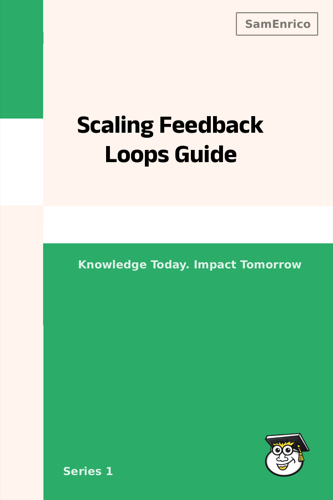
Scaling Feedback Loops Guide eBook
Shorten cycle time from customer request to releas
Shorten cycle time from customer request to release.
Formats
Free sample
Chapter 1: The Speed Paradox--–- In the winter of 2012, a little-known e-commerce startup called Stitch Fix made a seemingly reckless decision. They decided to deploy code to production every single day. At the time, most online retailers deployed once a month, or once a quarter if they were cautious. Their competitors called them irresponsible. Their engineers were terrified.
Their board asked if they had lost their minds.What happened next defied every conventional wisdom about software delivery. Not only did Stitch Fix not break more often – they broke less. Their mean time to recover from incidents dropped from hours to minutes. Their customer satisfaction scores climbed. Their cycle time from customer request to working software shrank from weeks to days.
And within three years, they had built a data-driven personal styling engine that would take them public at a valuation of nearly $2 billion.This is the speed paradox. The organizations that deliver fastest are not the ones that sacrifice quality or stability. They are the ones that have mastered the art of closing feedback loops. And they understand something that most technology leaders get painfully wrong: speed is not a tax you pay for innovation. Speed is the innovation.The Myth of the Quality Trade-Off Every software leader has heard it.
Usually whispered in a hallway after a production incident, or muttered in a retrospective when someone suggests deploying more frequently. “We can’t go faster,” they say. “We’ll break things. We need to be careful.”This intuition feels right. If you rush, you make mistakes.
If you make mistakes, customers suffer. Therefore, speed causes suffering. It is a tidy, logical chain of reasoning that has crippled more engineering organizations than any technical debt ever could.The only problem is that the data says exactly the opposite.In 2018, the largest multi-year study of software delivery performance ever conducted reached a conclusion that shook the industry. The research team, led by Dr. Nicole Forsgren at Dev Ops Research and Assessment (DORA), analyzed data from over 31,000 engineering organizations worldwide.
They measured deployment frequency, lead time, mean time to recover, and change failure rate. They controlled for company size, industry, and technology stack.What they found was unmistakable: high-performing organizations deployed 46 times more frequently than low performers, had 2,555 times shorter lead times, recovered from incidents 2,604 times faster, and had half the change failure rate.Let that sink in. The fastest organizations were not just faster. They were also more stable.This finding has been replicated across banking, healthcare, retail, and government. It holds for startups and Fortune 500s.
It holds for COBOL mainframes and serverless Node.js functions. The relationship between speed and stability is not a trade-off. It is a virtuous cycle.Why Speed Creates Stability To understand why faster delivery leads to fewer failures, you must first understand how software actually breaks.Most production incidents do not arise from malicious intent or gross incompetence. They arise from a much more mundane cause: surprise. The database behaves differently than the test environment.
The API rate limits unexpectedly. The edge case no one thought about finally appears at 3 AM on a Tuesday.Surprise is a function of time. The longer a change sits between “written” and “running in production in front of real users,” the more the world changes around it. Other services update. Traffic patterns shift.
Business rules evolve. By the time you finally deploy, the context of your change has drifted so far that you are effectively flying blind.Short cycle time collapses that gap. When you deploy multiple times per day, the environment barely has time to change between deployments. Your assumptions remain valid. Your tests reflect reality.
And when something does go wrong – because something always goes wrong – the change that caused the problem is tiny. A few lines of code. A single configuration tweak. You are not hunting through two months of commits from twelve engineers. You are looking at five minutes of work from one person.This is the first law of feedback loop scaling: small batches fail less and recover faster.The Hidden Cost of Waiting Most organizations measure the wrong things.
They track utilization – how busy their engineers are. They track output – how many story points they completed. They track activity – how many meetings, how many pull requests, how many tickets closed.These metrics are seductive because they feel productive. Everyone looks busy. The boards are full of moving cards.
But they mask the single most important variable in software delivery: waiting.Consider two teams. Team Alpha completes one feature per week, with engineers working on three things simultaneously. Team Beta completes one feature per week, with engineers working on one thing at a time. From a throughput perspective, they look identical. But their cycle times are radically different.In Team Alpha, each feature takes three weeks from start to finish because of context switching and queueing.
In Team Beta, each feature takes one week. The customer waits three times longer for exactly the same output. The organization learns three times slower. And every day of waiting, the potential value of that feature decays.This is the second law of feedback loop scaling: cycle time is determined more by waiting than by working.The implications are profound. You can double your engineering headcount, but if you do not reduce waiting, you will barely improve cycle time.
You can rewrite your entire architecture, but if you maintain handoffs and approvals, you will see marginal gains. The leverage point for speed is not more output. It is less queue.The Economics of Delay Every day that a feature sits unreleased has a cost. Sometimes that cost is obvious. A bug fix that would save $100,000 per day in fraud losses – every day it is delayed, you lose $100,000.
A feature that would convert 2% more trial users – every day of delay, you leave money on the table.But most costs of delay are invisible. They show up as opportunities not pursued, competitors not challenged, customers not delighted. They compound like interest on a loan you did not know you took.Economists call this the cost of delay. In product development, it is the single most important financial metric that almost no one tracks.Consider a simple model. You are building a feature that will generate $1 million in annual value once fully released.
It will take six months to build and deploy. If you could compress that cycle to three months, what is the economic impact?The naive answer is $500,000 – you get six months of value instead of three. But the real answer is much larger. You also get six extra months of learning. Six extra months of customer feedback.
Six extra months to iterate, improve, and compound. And you reduce the risk that the market changes, a competitor launches, or your assumptions prove wrong.In high-uncertainty environments – which is to say, all modern software development – the option value of speed dwarfs the direct revenue impact. Being able to learn twice as fast means you can correct mistakes twice as quickly. It means you can double your number of experiments per year. It means you can pivot before the runway runs out.This is why venture capitalists fund speed.
This is why Amazon, Netflix, and Google obsess over cycle time. They are not optimizing for efficiency. They are optimizing…
This is the end of the free sample. Get the eBook to keep going. Buy now
About this book
Details
- Author
- Matson Lashawn
- Publisher
- SamEnrico
- Language
- English
- Genre
- Non-Fiction, Business Brief, Agile
- Released
- 2026-06-09
- Pages (approx.)
- 123
- Available as
- eBook, Audiobook

Read better in the ZLOADR app
Your eBooks on your phone or tablet. Sign in with your SamEnrico account and start reading.
More by Matson Lashawn
 Anger And Child Food RefusalMatson Lashawn$11.99
 Momentum Time Horizon StrategyMatson Lashawn$11.99
 Priority Matrix Time BlockingMatson Lashawn$11.99
 The Alchemist of Wall Street: How a 17th-Century Merchant Outsmarted the Dutch East India CompanyMatson Lashawn$11.99
 The Neon Underground: How a Secret 80s Club Shaped Music ForeverMatson Lashawn$11.99
 Green Energy Opportunity MapMatson Lashawn$12.99
 Canadian Express Entry For Trades PrimerMatson Lashawn$12.99
 Understanding HyperkalemiaMatson Lashawn$17.99
 How to Become a Chemical Reclamation Equipment OperatorMatson Lashawn$11.99
 Elder Abuse IdentificationMatson Lashawn$11.99
You may also like
 Hong Kong Handover 1997Dunn Johnnie$11.99
 Zumba For Postnatal Recovery CourseNeal Christian$11.99
 Zumba for BeginnersLadner Nikia$11.99
 YouTube Comment Mining GuideHumes Pandora$12.99
 Worry Box MeditationCarlin Rudy$11.99
 Workplace Stress MeditationNguyen Lynn$11.99
 Workplace Stress and Sleep RepairHawley Ivory$11.99
 Workplace Perfectionism CureDelaney Jeffry$11.99
 Workplace Injustice Anger GuideWallen Isabelle$11.99
 Work Addiction and Burnout LinkGreenwood Ester$11.99
 Women in Yoga and WellnessBeattie Galina$11.99
 Women in Stand Up ComedyChun Evangeline$11.99