
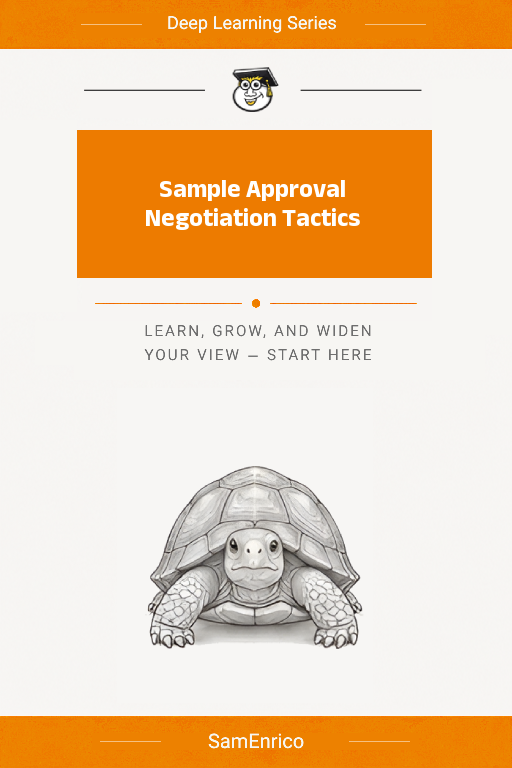
Sample Approval Negotiation Tactics eBook
Push for free samples or cost sharing on shipping
Push for free samples or cost sharing on shipping while securing pre production sample approval rights.
Formats
Free sample
Chapter 1: The Postage Test--The fifty-dollar shipping fee was the only thing standing between Elena Vargas and a two-hundred-thousand-dollar disaster.The buyer, a mid-sized retailer with a gleaming website and a buyer named Marcus who spoke with the easy confidence of someone who had never been told no, had just laughed at her request. "Fifty dollars for a sample? Elena, come on. Every other vendor ships for free. You're going to lose this deal over fifty bucks?"Elena had been a procurement manager for eleven years.
She had heard this exact sentence, in different voices and across three industries, at least two hundred times. And for the first five years of her career, she had caved every single time.She would apologize for asking. She would eat the cost. She would tell herself it was a marketing expense, that the real money was in the purchase order, that being reasonable and flexible was how you built relationships.Then the invoices would go unpaid. Or the buyer would disappear after receiving samples from five competitors.
Or, worst of all, the buyer would approve the sample with a vague "looks good" email, wait for mass production, and then reject the entire container over a microscopic color variation that had been clearly visible in the sample.Elena learned the hard way. This chapter is about what she learned—and what you will learn so you don't have to repeat her mistakes.The fifty-dollar shipping fee is not about money. It never was. The fifty-dollar shipping fee is a test. It is the smallest possible barrier to entry you can place between a serious buyer and a time-wasting collector.
And how a buyer responds to that fifty-dollar test predicts, with terrifying accuracy, how they will behave when the stakes are fifty thousand dollars or five hundred thousand dollars.This chapter dismantles the most expensive myth in B2B sales and manufacturing: the belief that giving away free samples with free shipping is a harmless, even generous, marketing expense. It is not harmless. It is the single fastest way to attract the wrong buyers, drain your engineering resources, and set yourself up for disputes that will erase your profit margin entirely.You will learn the Postage Test, the two buyer archetypes that determine your fate, the hidden costs of "free" that no one talks about, and the one unbreakable rule that will save you from the most common trap in sample negotiation.Let us begin with the story of how Elena finally stopped caving—and why you should too.The Anatomy of a Sample Disaster Elena's turning point came in her eighth year, working for a specialty chemical company that made industrial adhesives. A potential buyer—let us call him "Fast Eddie"—wanted samples of a custom formulation. Not off-the-shelf stock.
A custom blend that would require three days of lab time from a Ph D chemist, plus raw materials that cost the company three hundred dollars per batch.Fast Eddie was charming. He talked about volume. He mentioned a Fortune 500 client he was "about to close." He said the sample was just a formality. And when Elena mentioned a five-hundred-dollar sample fee (materials plus lab time, no markup), Fast Eddie was offended."Five hundred dollars? For a tube of glue?
Your competitors send samples for free."Elena, still in her "reasonable and flexible" phase, waived the fee. She also waived the forty-dollar shipping charge because Fast Eddie said his company "didn't have a process for vendor shipping reimbursements under a hundred dollars."The total cost to Elena's company: five hundred forty dollars plus three days of a Ph D chemist's time, which at a loaded rate of one hundred fifty dollars per hour came to another three thousand six hundred dollars in opportunity cost. Total investment: over four thousand dollars.Fast Eddie received the sample. He sent a one-line email: "Looks good, thanks." Then he disappeared.Three months later, Elena saw Fast Eddie's face on the website of a competitor. He had taken her sample, reverse-engineered it (or simply given it to her competitor as a reference), and placed an order elsewhere.That was when Elena invented the Postage Test, though she did not call it that at the time.
She simply decided that from that day forward, no buyer would get a free sample and free shipping. At least one friction point would remain. And the cheapest, cleanest friction point was shipping.The next buyer who asked for a sample was told: "The sample is free, but you'll need to provide your Fed Ex account number for shipping." The buyer provided it without hesitation, placed a forty-thousand-dollar order two weeks later, and paid every invoice on time for the next four years.The fifty-dollar test worked.The Postage Test: Why Small Dollars Predict Big Behavior The Postage Test rests on a simple psychological principle: willingness to invest a small amount signals commitment; unwillingness to invest any amount signals the absence of commitment.This is not speculation. Behavioral economists have documented the "sunk cost effect" for decades: people who have invested even a trivial amount of money in a course of action are significantly more likely to follow through than those who have invested nothing. The reason is cognitive dissonance.
If I paid fifty dollars for shipping, my brain will work hard to justify that expense by treating the relationship as valuable. If I paid nothing, my brain feels no such pressure.In the context of sample negotiation, the Postage Test works as a filter. Serious buyers understand that samples have real costs—materials, labor, shipping, handling. They do not expect everything for free. They may negotiate, but they will accept reasonable cost-sharing as a good-faith deposit.
Professional sample collectors, on the other hand, refuse to pay anything. Their entire business model depends on extracting free samples from as many vendors as possible, then using those samples to pit vendors against each other for the lowest possible price.How can you tell the difference? The Postage Test gives you a clear answer.Apply the test at the earliest possible moment. When a buyer requests a sample, do not immediately say yes or no. Instead, respond with a simple statement: "We can provide the sample.
Please provide your courier account number (Fed Ex, DHL, or UPS) for shipping."Then watch what happens.The serious buyer will provide the account number within one business day, often within hours. They may ask a clarifying question about weight or dimensions, but they will not argue about the principle of paying for shipping.The professional sample collector will respond with any of the following scripts:"Our policy is that vendors pay for samples.""Other vendors ship for free. Why can't you?""We don't have an account set up for that. Can you bill us?""This is a small box. It can't cost that much.""We need the sample to evaluate you as a vendor.
You should be paying us."Each of these responses is a red flag. Not a deal-killer on its own, but a warning that you are dealing with a buyer who views your sample as a free good to be extracted, not as a step in a mutually…
This is the end of the free sample. Get the eBook to keep going. Buy now
About this book
Details
- Author
- Masterson Ayesha
- Publisher
- SamEnrico
- Language
- English
- Genre
- Non-Fiction, Business Brief
- Released
- 2026-05-30
- Pages (approx.)
- 135
- Available as
- eBook, Audiobook

Read better in the ZLOADR app
Your eBooks on your phone or tablet. Sign in with your SamEnrico account and start reading.
More by Masterson Ayesha
 LTC Insurance Premium Reduction GuideMasterson Ayesha$11.99
 War and Genocide MasterMasterson Ayesha$11.99
 Antidepressant Access In Poor Nations GuideMasterson Ayesha$11.99
 Breath Awareness for Labor PainMasterson Ayesha$11.99
 Gacy's Construction Business FrontMasterson Ayesha$11.99
 FCPA Defense Contractor CasesMasterson Ayesha$11.99
 The Sobriety Journal MethodMasterson Ayesha$11.99
 Hoarding Parent ChildhoodMasterson Ayesha$11.99
 San Martin JoseMasterson Ayesha$11.99
 The Last Dance of the Cosmos: How a Single Photo Changed Astronomy ForeverMasterson Ayesha$11.99
 Blood and Chromosomes: The Genetic Legacy of the Italian CampaignMasterson Ayesha$11.99
 The Sky Pioneers: Women Who Charted the Pacific's Secrets (1920s)Masterson Ayesha$11.99
You may also like
 Hong Kong Handover 1997Dunn Johnnie$11.99
 Zumba For Postnatal Recovery CourseNeal Christian$11.99
 Zumba for BeginnersLadner Nikia$11.99
 YouTube Comment Mining GuideHumes Pandora$12.99
 Worry Box MeditationCarlin Rudy$11.99
 Workplace Stress MeditationNguyen Lynn$11.99
 Workplace Stress and Sleep RepairHawley Ivory$11.99
 Workplace Perfectionism CureDelaney Jeffry$11.99
 Workplace Injustice Anger GuideWallen Isabelle$11.99
 Work Addiction and Burnout LinkGreenwood Ester$11.99
 Women in Yoga and WellnessBeattie Galina$11.99
 Women in Stand Up ComedyChun Evangeline$11.99