
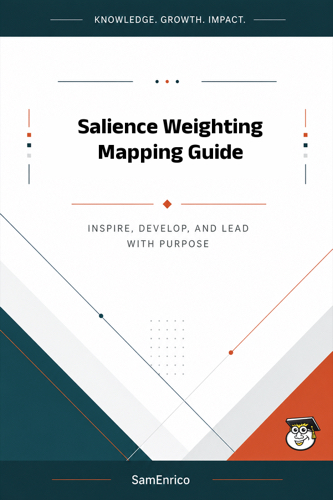
Non-FictionStrategic AtlasAttribute Weighting
Salience Weighting Mapping Guide Audiobook
Incorporate attribute importance weights into posi
by Bonner Minh
Incorporate attribute importance weights into positioning maps for realistic competitive views.
Formats
Free sample
Chapter 1: The $50 Million Blind Spot--–- In 2016, the CEO of a $2.4 billion outdoor apparel brand sat in a glass-walled conference room overlooking the Rocky Mountains. Before him lay a beautifully rendered perceptual map. His brand, let us call it Summit Gear, occupied a pristine position in the upper-right quadrant—high quality, moderate price. No direct competitor sat within a centimeter on the map. The consulting team beamed.
The marketing budget was approved: $50 million to reinforce that ideal position.Eighteen months later, Summit Gear’s sales had dropped 22 percent. Their market share had been eaten not by the competitors on that glossy map, but by a direct-to-consumer startup that didn't even appear in their analysis. When the post-mortem team interviewed 1,400 lost customers, a devastating pattern emerged. The startup had won on an attribute Summit Gear had dismissed as unimportant: sustainability. In the CEO’s survey, sustainability ranked 7th out of 12 attributes, with only 8 percent of customers rating it “very important.” The flat map had buried the truth.
That 8 percent belonged to a customer segment that grew from 5 percent to 35 percent of the market while Summit Gear was busy defending a position nobody cared about.This book exists because of that $50 million mistake. And because the fix—salience weighting—takes one week and a spreadsheet.The Map That Lies Every marketer has drawn one. Two axes. Four quadrants. Dots representing brands.
It is elegant, intuitive, and almost always wrong. Not because the data is inaccurate, but because the underlying assumption is false: that every attribute matters equally.A traditional perceptual map treats a one-point difference on “cup holder quality” the same as a one-point difference on “engine reliability.” In the auto industry, that assumption is absurd. Yet marketers make it every day. They average survey responses across hundreds of customers, plot the results, and make billion-dollar decisions based on the geometry that emerges.Consider the following. A standard auto industry survey asks customers to rate brands on attributes like “styling,” “comfort,” “fuel efficiency,” and “safety.” Each attribute gets a 1-to-10 score.
The software averages those scores across all respondents and places brands on a map where the distance between any two points represents overall similarity.The problem is that “overall similarity” is a mathematical fiction. Two brands might appear close together on the map because they both have decent styling and acceptable fuel efficiency. But if customers make purchase decisions based almost entirely…
This is the end of the free sample. Get the Audiobook to keep going. Buy now
About this book
Details
- Author
- Bonner Minh
- Publisher
- SamEnrico
- Language
- English
- Genre
- Non-Fiction, Strategic Atlas, Attribute Weighting
- Released
- 2026-06-11
- Pages (approx.)
- 135
- Available as
- eBook, Audiobook

Listen in the VoxFlicks app
Audiobooks and audio dramas wherever you go. Sign in with your SamEnrico account and press play.
More by Bonner Minh
 Shingles Vaccine HistoryBonner Minh$11.99
 GoodNotes Digital FlashcardsBonner Minh$11.99
 Remote Retreats Virtual AlternativesBonner Minh$11.99
 Digital Planner Etsy VAT GuideBonner Minh$11.99
 The Silk Road Heist: A Caravan of DeceptionBonner Minh$11.99
 Frozen Echoes: The Lost Expedition of the *Polaris*Bonner Minh$11.99
 Ultimate Handbook Guide to Podgorica : (Montenegro) Travel GuideBonner Minh$11.99
 Cost Center Allocation GuideBonner Minh$12.99
 Board Meeting Frequency GuideBonner Minh$12.99
 Understanding Chondrodysplasia Situs Inversus Imperforate Anus PolydactylyBonner Minh$17.99
 National Account CoordinatorBonner Minh$11.99
You may also like
 Hong Kong Handover 1997Dunn Johnnie$11.99
 Zumba For Postnatal Recovery CourseNeal Christian$11.99
 Zumba for BeginnersLadner Nikia$11.99
 YouTube Comment Mining GuideHumes Pandora$12.99
 Worry Box MeditationCarlin Rudy$11.99
 Workplace Stress MeditationNguyen Lynn$11.99
 Workplace Stress and Sleep RepairHawley Ivory$11.99
 Workplace Perfectionism CureDelaney Jeffry$11.99
 Workplace Injustice Anger GuideWallen Isabelle$11.99
 Work Addiction and Burnout LinkGreenwood Ester$11.99
 Women in Yoga and WellnessBeattie Galina$11.99
 Women in Stand Up ComedyChun Evangeline$11.99