
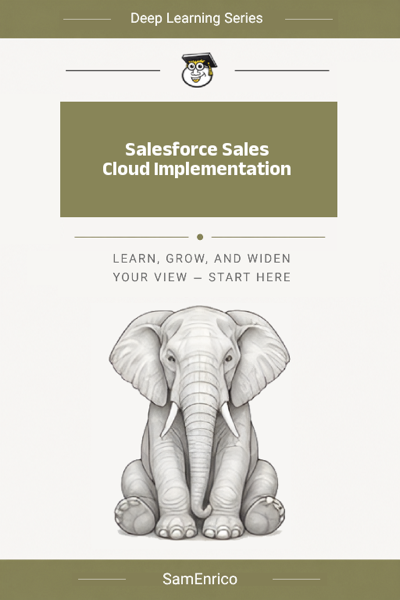
Salesforce Sales Cloud Implementation eBook
A Coursebook on Salesforce Sales Cloud Implementat
A Coursebook on Salesforce Sales Cloud Implementation
Formats
Free sample
Chapter 1: The Revenue Mirage...–- It was 10:47 on a Tuesday morning when Sarah, the VP of Sales at a $47 million software company, made a confession that would reshape my understanding of CRM implementations entirely. “We’ve had Salesforce for fourteen months,” she said, sliding her laptop across the conference table to face me. “And I still don’t know which three deals I should be flying to Chicago for next week.”The screen showed an Opportunity dashboard with seventy-three brightly colored charts, nine separate forecast categories, and a pipeline value that her CFO had publicly called “creative fiction” at the last board meeting. Sarah had spent 187,000onlicenses,another187,000 on licenses, another 187,000onlicenses,another42,000 on a consulting partner to “implement” the system, and countless hours of her sales team’s time logging activities, filling in fields, and attending training sessions they had all silently resented. What she had to show for it was not a sales enablement engine but an expensive, slow, and deeply untrusted database that her reps circumvented at every opportunity—logging deals in Excel, tracking tasks on sticky notes, and updating their “real” pipeline during one-on-one meetings with her.“I thought Salesforce was supposed to fix this,” Sarah said, and the exhaustion in her voice was not the fatigue of hard work but the specific, hollowed-out weariness of someone who had been sold a solution that became another problem.That conversation is why this chapter exists.
Not to teach you how to click buttons in Salesforce—there are hundreds of You Tube videos for that. But to reframe everything you think you know about Sales Cloud implementation from the ground up. Because Sarah’s company did not have a Salesforce problem. They had a revenue visibility problem, a sales process problem, an adoption problem, a data trust problem, and a governance problem—all of which they had mistakenly believed a piece of software would solve simply by existing in their tech stack.The Great Misunderstanding: CRM as Magic Wand The most expensive mistake in B2B sales technology is the belief that implementation means installation. I have seen this error repeat across more than two hundred companies, from seven-person startups to global enterprises with seven-figure Salesforce contracts.
A CEO reads an article about AI-powered forecasting. A VP of Sales attends a conference and sees a demo of a beautifully automated opportunity management workflow. A board member asks, “Why don’t we have the same CRM as our peers?” And suddenly, a purchase order is cut, a project is kicked off, and a team of well-intentioned consultants begins configuring fields, building reports, and scheduling training—all before anyone has answered the only question that matters:What specific sales problem are we trying to solve, and how will we measure whether we solved it?Without an answer to that question, your Sales Cloud implementation is not a project. It is an act of performance theater that will end, inevitably, with a highly paid VP sliding a laptop across a conference table and admitting they have no idea which deals to chase.This chapter introduces the framework that turns Sales Cloud from an expensive database into a revenue engine. It is called the Revenue Engine Framework, and it rests on five interdependent pillars that must be built together—not sequentially, not in isolation, and never by accident.
These pillars are not a checklist. They are a system. Neglect any one, and the entire structure collapses.The Five Pillars of Sales Cloud Success Before we examine each pillar, understand this: they are ordered by their impact on failure, not by their sequence in implementation. If you skip to configuration before understanding adoption, you will build a system no one uses. If you prioritize data migration before process alignment, you will import chaos at scale.
If you focus on security before iteration, you will create a fortress that cannot evolve.Pillar One: User Adoption (The 40% Weight)In the unified success framework that governs this book, user adoption represents 40% of your go-live success score. This is not because adoption is more important than data quality or technical correctness—but because without adoption, the other pillars produce nothing of value. A perfectly configured Sales Cloud with 100% data accuracy and flawless security that no sales rep ever logs into is not a partial success. It is a complete failure that cost you hundreds of thousands of dollars.Adoption is not achieved through mandates, threats, or executive announcements that “we are a Salesforce shop now.” Adoption is earned through design, training, and continuous reinforcement. A rep will use your CRM if and only if three conditions are met:First, using the system must be faster than not using it.
If logging a call takes forty-five seconds, a rep will do it. If it takes two minutes and requires clicking through three screens, they will not—or they will type “called client” into a notes field and call it compliance.Second, the system must provide value to the rep before it demands value from them. This is the asymmetry that most implementations get backward. Companies demand that reps enter data to feed executive dashboards, but they provide nothing in return except vague promises about “better visibility.” The rep thinks: Visibility for whom? Not for me.
I know my deals. The solution is to design features that help reps sell—automated task reminders, next-step recommendations, territory intelligence—before asking them to populate fields for corporate reporting.Third, the system must be trusted. If a rep enters a deal and watches it disappear because of a sharing rule they do not understand, they will stop entering deals. If they log an email and cannot find it later because the activity timeline is cluttered with automated garbage, they will stop logging emails. Trust is fragile and expensive to rebuild.Pillar Two: Data Health (The 30% Weight)Data health accounts for 30% of your success score because bad data is not neutral—it is actively destructive.
A forecast built on inaccurate data does not produce a null result; it produces a confident wrong answer that drives bad decisions. A territory assignment based on stale account information does not cause a neutral outcome; it sends a rep to visit a company that closed its Chicago office eighteen months ago.Data health has three layers, and most implementations address only the first.Layer one is prevention: validation rules, required fields, and picklist values that stop bad data at the door. A validation rule that prevents closing an opportunity without a contract number is a simple but powerful defense. Most organizations have these rules in place. They are necessary but not sufficient.Layer two is detection: duplicate rules, matching rules, and scheduled reports that identify data decay after it enters the system.
A weekly report showing “Accounts with no activity in 90 days” is a detection mechanism. Most organizations do not run these reports consistently, and when they do, they lack the authority to act on them.Layer three is remediation: the processes and ownership assignments for fixing bad data once found. This is where most implementations fail. A duplicate account report that lands in a shared inbox with no owner and no SLA is not a remediation…
This is the end of the free sample. Get the eBook to keep going. Buy now
About this book
Details
- Author
- Houston Victor
- Publisher
- SamEnrico
- Language
- English
- Genre
- Non-Fiction, Informative, Educational
- Released
- 2026-05-11
- Pages (approx.)
- 157
- Available as
- eBook, Audiobook

Read better in the ZLOADR app
Your eBooks on your phone or tablet. Sign in with your SamEnrico account and start reading.
More by Houston Victor
 Reading Emotional Cues GuideHouston Victor$11.99
 Trance Trigger AnchoringHouston Victor$11.99
 Explaining Employment GapHouston Victor$11.99
 Stress Exercise PrescriptionHouston Victor$11.99
 Body Scan Meditation MBSR GuideHouston Victor$11.99
 Relationship Building for RecruitersHouston Victor$11.99
 Hypnosis Tips GuideHouston Victor$11.99
 Burnout Recovery for Dental ProfessionalsHouston Victor$11.99
 Hoover Great DepressionHouston Victor$11.99
 The Last Roar of the Nian: China's Lunar New Year BeastHouston Victor$11.99
 The Green Phoenix of Agincourt: How the English Bowmen Saved a ForestHouston Victor$11.99
 The Day the Internet Broke: How a Single Tweet Toppled a GiantHouston Victor$11.99