
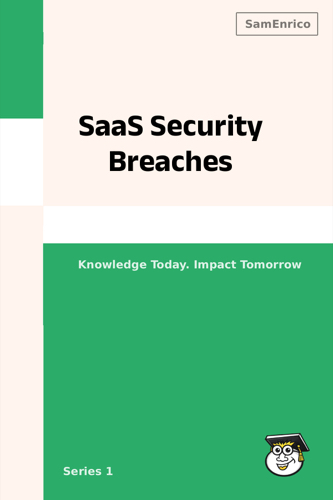
Non-FictionAnnual CheckupSaaS Security
SaaS Security Breaches eBook
Review Salesforce, Microsoft 365, and Google Works
Review Salesforce, Microsoft 365, and Google Workspace compromise incidents.
Formats
Free sample
Chapter 1: The 60% Lie...--It was 3:47 AM when Sarah’s phone lit up with the alert she had spent her entire career dreading. "Potential data exfiltration detected: 47,000 records exported from Salesforce API in the last 90 minutes." She sat up in bed, her heart already racing before her brain fully processed the words. The notification came from her organization’s security information and event management system, a tool she had personally configured to catch exactly this kind of anomaly. But knowing it was possible and watching it happen in real time were two very different things.By the time her coffee finished brewing, she had confirmed the worst. The attacker wasn’t using a stolen password.
They weren’t brute-forcing their way in. They were using a legitimate OAuth token issued two years ago to a sales engagement platform that her team had approved after a thirty-minute security review. That platform had been compromised five days ago. The attackers now had valid credentials to query her Salesforce instance directly, bypassing every control she had put in place. The logs showed the API calls originated from an IP address in Eastern Europe, but the user agent claimed to be the sales platform’s legitimate service.
Salesforce had faithfully logged every single query as authorized because, from the platform’s perspective, it was.Sarah had done everything right. She had implemented multi-factor authentication across the entire organization. She had rolled out a zero-trust network access solution. She had mandatory security training every quarter. And none of it mattered because the breach didn’t come through her firewall, her email gateway, or her endpoint protection.
It came through an API integration that her team had approved, documented, and then forgotten about. The OAuth token had sat there like a ticking clock, granting access to any attacker who could compromise the third-party vendor she had trusted.This is not a hypothetical scenario. It is a composite of dozens of real breaches that have occurred over the past three years across Salesforce, Microsoft 365, and Google Workspace environments. And the most frightening part is that the security industry has been looking in the wrong direction.The Illusion of Provider Responsibility The single most dangerous vulnerability in modern enterprise security is not a zero-day exploit. It is not a sophisticated nation-state hacking tool.
It is a simple, widespread, and deeply entrenched false belief: that the cloud provider is responsible for protecting customer data inside their Saa S applications. This belief is so common that it has a name in security circles—the shared responsibility fallacy—and it is directly responsible for the majority of Saa S breaches that make headlines.Let us start with the raw data, because the numbers are staggering. A survey conducted by a major cloud security alliance in early 2025 found that 61% of businesses believe Microsoft, Google, or Salesforce is fully responsible for protecting customer data inside their respective Saa S applications. When you break that number down by role, the problem becomes even more alarming. Among C-suite executives, the number rises to 73%.
Among board members, it hits 81%. Among IT managers, it drops to 42%. The people writing the security budgets and approving the risk registers are the ones most likely to believe that someone else is handling it.The reality is exactly the opposite. Every major Saa S provider publishes a Shared Responsibility Model, usually buried in a terms of service document or a security whitepaper that almost no one reads. In simple terms, the provider secures the things they control: physical data centers, network infrastructure, hypervisors, and the core application’s uptime and availability.
The customer secures everything else: identity governance, third-party app approvals, sharing settings, user training, access reviews, and incident response. The provider builds the vault. The customer is responsible for the keys, the alarms, and the guards at the door.Here is the distinction that matters most. The provider guarantees that no external attacker will break through their infrastructure layer. They patch their servers.
They monitor their network. They rotate their own internal credentials. And they have never, in the history of major Saa S providers like Salesforce, Microsoft, and Google, had a successful breach at that infrastructure layer. But the provider does not—and legally cannot—guarantee that a customer’s data will remain safe from an attacker who uses a legitimate customer-approved integration, a compromised employee credential, or a misconfigured sharing setting. Because from the provider’s perspective, that activity is authorized.
The customer gave permission. The provider simply logs the transaction and moves on.This is the illusion that this book exists to shatter. You can have the most secure cloud platform in the world. You can have SOC 2 reports, ISO certifications, and five-nines uptime SLAs. And none of it will protect you from an OAuth token you approved three years ago to a chatbot vendor whose security team was working with a shoestring budget and whose build pipeline was compromised by a single phishing email.The Salesforce Paradox Nowhere is this illusion more visible than in the case of Salesforce.
Salesforce has built one of the most secure enterprise cloud platforms on the planet. Their infrastructure team is world-class. Their bug bounty program has paid out millions of dollars to researchers who have found and reported vulnerabilities. And to date, there has never been a successful breach of Salesforce’s core infrastructure by an external attacker. The platform itself remains secure.And yet, customer data is stolen from Salesforce orgs every single week.
The disconnect between platform security and customer data security could not be more stark.Consider the typical Salesforce compromise. It almost never begins with an attacker breaking into Salesforce’s servers. Instead, it begins with a third-party integration. A marketing automation platform. A sales engagement tool.
A customer support chatbot. A data enrichment service. These vendors all request OAuth access to a customer’s Salesforce instance, usually with scopes that grant read and write access to opportunities, contacts, cases, and sometimes custom objects containing highly sensitive data. The customer approves the integration, often after a perfunctory security review that consists of little more than checking the vendor’s website for a trust page and asking for a SOC 2 report that no one actually reads.The OAuth token is issued. The integration works.
The business is happy. And then everyone forgets about it.Six months later, the marketing team cancels the vendor subscription. No one revokes the OAuth token. The vendor’s security team fails to rotate their own internal credentials. An attacker compromises the vendor’s build pipeline.
The attacker finds the still-active OAuth token. The attacker queries the Salesforce API for every record the token has permission to access. Salesforce logs every query as legitimate. The attacker extracts customer data, partner lists, and sometimes hard-coded AWS keys stored in custom text fields. The breach is discovered weeks or months later, usually by a customer who notices anomalous API call volume in their event monitoring logs—if they have event monitoring enabled at all.Salesforce did nothing wrong.
Their platform performed exactly as designed. The customer gave the token away, and the customer never revoked it. The breach was entirely preventable. And it happens constantly.The…
This is the end of the free sample. Get the eBook to keep going. Buy now
About this book
Details
- Author
- Ledbetter Luella
- Publisher
- SamEnrico
- Language
- English
- Genre
- Non-Fiction, Annual Checkup, SaaS Security
- Released
- 2026-06-09
- Pages (approx.)
- 149
- Available as
- eBook, Audiobook

Read better in the ZLOADR app
Your eBooks on your phone or tablet. Sign in with your SamEnrico account and start reading.
More by Ledbetter Luella
 Creator Health Insurance GuideLedbetter Luella$11.99
 OUD Medications in PregnancyLedbetter Luella$11.99
 The Binge Eating Recovery WorkbookLedbetter Luella$11.99
 Executive Imposter SyndromeLedbetter Luella$11.99
 The Ghost of Pablo Escobar: Cursed Gold and Cartel Paranormal EncountersLedbetter Luella$11.99
 Fair Trade Export CertificationLedbetter Luella$12.99
 Search Console Breadcrumbs ReportLedbetter Luella$12.99
 Understanding PreeclampsiaLedbetter Luella$17.99
 Commercial Sales RepresentativeLedbetter Luella$11.99
 How to Become a Compo CasterLedbetter Luella$11.99
You may also like
 Hong Kong Handover 1997Dunn Johnnie$11.99
 Zumba For Postnatal Recovery CourseNeal Christian$11.99
 Zumba for BeginnersLadner Nikia$11.99
 YouTube Comment Mining GuideHumes Pandora$12.99
 Worry Box MeditationCarlin Rudy$11.99
 Workplace Stress MeditationNguyen Lynn$11.99
 Workplace Stress and Sleep RepairHawley Ivory$11.99
 Workplace Perfectionism CureDelaney Jeffry$11.99
 Workplace Injustice Anger GuideWallen Isabelle$11.99
 Work Addiction and Burnout LinkGreenwood Ester$11.99
 Women in Yoga and WellnessBeattie Galina$11.99
 Women in Stand Up ComedyChun Evangeline$11.99