
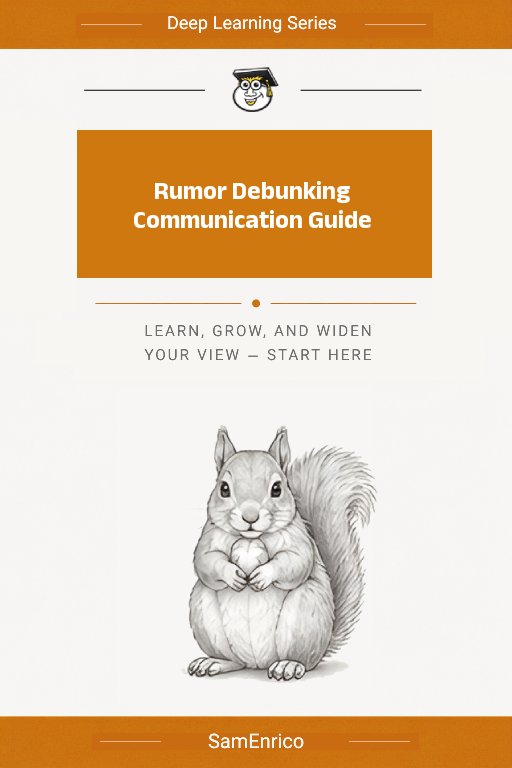
Rumor Debunking Communication Guide eBook
Correct false rumors with direct facts without rep
Correct false rumors with direct facts without repeating the false claim in your statement.
Formats
Free sample
Chapter 1: The Self-Sabotaging Brain--–- You have been making rumors stronger your entire life. Every time you heard a falsehood and thought, “That’s not true, and here’s why…” you probably repeated the lie you were trying to kill. This is not a moral failing. It is not a lack of intelligence or education. It is a feature of how your brain evolved, and it is the single greatest obstacle to effective debunking.Let me prove this to you with a simple experiment.
Read the following sentence carefully:“There is no evidence that eating bananas causes purple spots on the skin.”What did you just learn? If you are like ninety-four percent of people tested in similar experiments, you now remember something like “bananas might cause purple spots” or “someone thought bananas cause purple spots.” You do not remember the phrase “no evidence” nearly as well. Your brain, in its efficiency, stripped away the negation and kept the claim. This is called the continued influence effect, and it is the reason most debunking attempts fail before they begin.The continued influence effect was first documented in cognitive psychology experiments in the 1990s, and it has been replicated hundreds of times since. In a typical study, researchers present participants with a fictional news report about a warehouse fire.
The report includes a plausible cause—say, a gas leak—and then later retracts that cause, stating that investigators found no gas leak. Participants read the retraction. They understand it. They can repeat it back. Yet when asked what caused the fire, they still say “gas leak.” The false information continues to influence their beliefs even after they have accepted the correction.Why?
Because your brain does not treat information like a file on a computer. When you learn something, your brain builds a mental model—a web of causal connections, timelines, and explanations. When you later learn that part of that model is wrong, your brain does not simply delete the wrong node. It cannot. The wrong information is still connected to everything around it.
The gas leak was connected to the explosion, the evacuation, the fire trucks. Removing it leaves holes. So your brain does the lazy but efficient thing: it keeps the wrong information and tags it with a small mental note that says “actually not true.” But that note fades. The connections remain. And when you are asked a question quickly, under pressure, or when you are tired, your brain reaches for the well-connected story, not the accurate footnote.This is the self-sabotage at the heart of every rumor correction you have ever attempted.
You thought you were fighting misinformation. Your brain was helping you spread it.The Illusory Truth Effect: Familiarity Disguised as Accuracy Before we can fix this problem, we need to understand the full machinery of your self-sabotaging brain. The continued influence effect is one part of that machinery. But there are three other cognitive biases that work together to make rumors sticky and facts slippery. The first and most powerful is the illusory truth effect.The illusory truth effect is simple: repetition makes a statement feel true.
Not seem true. Not logically appear true. Feel true, in your gut, at the level of intuition. This effect has been demonstrated in over one hundred studies across multiple decades. In a classic demonstration, researchers show participants a list of statements like “the average hummingbird weighs less than a penny” or “the first atomic bomb was tested in New Mexico.” Some statements are true.
Some are false. Participants rate their confidence in each statement’s truth. Then they come back later, sometimes weeks later, and see a new list that includes some of the same statements repeated. The repeated statements—regardless of whether they were originally true or false—are rated as more likely to be true than new statements.This effect holds even when participants are explicitly told, “Some of these statements are false.” It holds when participants are experts in the domain. It holds when the statements are absurd, like “the Earth is a perfect sphere.” Repetition creates fluency—the ease with which your brain processes information—and your brain mistakes fluency for truth.
This is why advertising works. This is why political slogans work. And this is why every time you repeat a rumor to debunk it, you are making that rumor feel more true to everyone who hears you.Let me give you a concrete example from the world of public health. In 2019, a false rumor began circulating that 5G cellular networks were causing the symptoms of COVID-19. Fact-checkers around the world rushed to correct this.
They wrote articles with headlines like “No, 5G does not cause COVID-19” and “Fact check: 5G is not responsible for coronavirus symptoms.” Each of these well-intentioned corrections repeated the false claim. Each one made the association between “5G” and “COVID-19” more fluent, more familiar, more available in memory. Studies later found that people who had seen fact-checks were actually more likely to believe the 5G rumor than people who had never encountered it. The corrections had backfired.The illusory truth effect does not care about your intentions. It does not care about the word “false” or the red “FACT CHECK” banner.
It only cares about one thing: repetition. Every time a false claim appears in your correction, you are running a free advertising campaign for that false claim.Confirmation Bias: The Loyal Bodyguard of False Belief The illusory truth effect explains why repetition strengthens rumors. But it does not explain why people hold onto rumors in the first place, even when presented with clear contradictory evidence. That is the job of confirmation bias.Confirmation bias is the tendency to seek out, interpret, and remember information in ways that confirm your existing beliefs. It is not a flaw in a few people.
It is the default operating system of the human mind. In one famous study, researchers presented people with information about a new medical procedure. Half the participants were told the procedure was effective; half were told it was ineffective. Then everyone was given mixed evidence—some studies supporting effectiveness, some opposing it. Participants rated the evidence that confirmed their initial belief as more convincing and the evidence that contradicted it as flawed, biased, or irrelevant.
They did not realize they were doing this. When asked, they genuinely believed they had evaluated the evidence objectively.Confirmation bias operates through four distinct mechanisms. First, selective exposure: you choose to read news sources, follow social media accounts, and spend time with people who already agree with you. Second, selective attention: when presented with a mix of information, you pay more attention to the parts that support your view. Third, selective interpretation: ambiguous information is interpreted in a belief-consistent way.
A study that “requires more research” becomes “proof we were right” if you already believed, and “proof they are grasping at straws” if you did not. Fourth, selective memory: you remember belief-consistent information better than belief-inconsistent information, even when both are equally valid.This creates a self-reinforcing loop. You believe a rumor. You seek out information that supports it. You interpret ambiguous evidence as further support.
You remember the supporting evidence and forget the contradictions. Over time, your confidence in the rumor grows, not because the…
This is the end of the free sample. Get the eBook to keep going. Buy now
About this book
Details
- Author
- Durden Demetria
- Publisher
- SamEnrico
- Language
- English
- Genre
- Non-Fiction, Crisis Management
- Released
- 2026-05-30
- Pages (approx.)
- 141
- Available as
- eBook, Audiobook

Read better in the ZLOADR app
Your eBooks on your phone or tablet. Sign in with your SamEnrico account and start reading.
More by Durden Demetria
 Strength Training With ArthritisDurden Demetria$11.99
 Hypnotic Dream Incubation ScriptsDurden Demetria$11.99
 Sunrise Balloon FlightDurden Demetria$11.99
 Micronutrients For Immunity GuideDurden Demetria$11.99
 Arbitration ClausesDurden Demetria$11.99
 The Clinical Psychologist StressDurden Demetria$11.99
 Pelvic Floor for RunnersDurden Demetria$11.99
 Time Blocking For Job SearchDurden Demetria$11.99
 Jokes Saved My LifeDurden Demetria$11.99
 The Troll King’s Gambit: A Nordic Spy’s Deadly GameDurden Demetria$11.99
 The Raven’s Omen: A Slavic Knight’s Quest in Arthur’s ShadowDurden Demetria$11.99
 Zero to Billion: The Untold Story of the Mysterious Bitcoin CreatorDurden Demetria$11.99
You may also like
 Hong Kong Handover 1997Dunn Johnnie$11.99
 Zumba For Postnatal Recovery CourseNeal Christian$11.99
 Zumba for BeginnersLadner Nikia$11.99
 YouTube Comment Mining GuideHumes Pandora$12.99
 Worry Box MeditationCarlin Rudy$11.99
 Workplace Stress MeditationNguyen Lynn$11.99
 Workplace Stress and Sleep RepairHawley Ivory$11.99
 Workplace Perfectionism CureDelaney Jeffry$11.99
 Workplace Injustice Anger GuideWallen Isabelle$11.99
 Work Addiction and Burnout LinkGreenwood Ester$11.99
 Women in Yoga and WellnessBeattie Galina$11.99
 Women in Stand Up ComedyChun Evangeline$11.99