
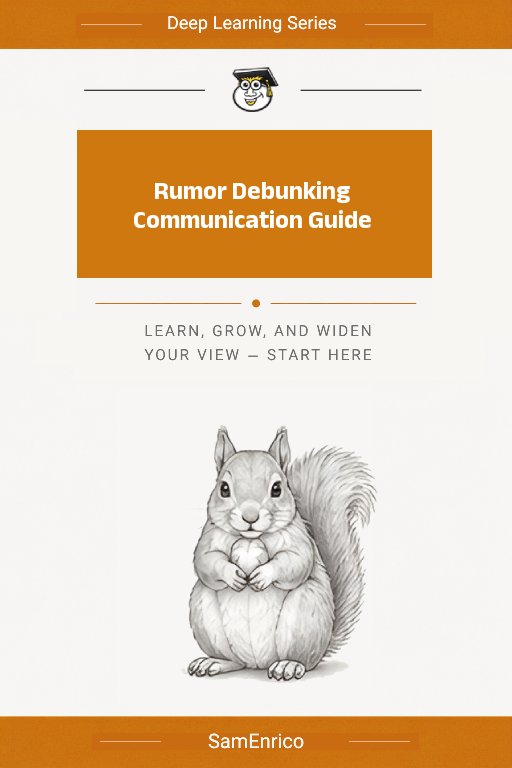
Rumor Debunking Communication Guide
Correct false rumors with direct facts without rep
Correct false rumors with direct facts without repeating the false claim in your statement.
Formats
About this book
Free sample
Chapter 1: The Self-Sabotaging Brain--–- You have been making rumors stronger your entire life. Every time you heard a falsehood and thought, “That’s not true, and here’s why…” you probably repeated the lie you were trying to kill. This is not a moral failing. It is not a lack of intelligence or education. It is a feature of how your brain evolved, and it is the single greatest obstacle to effective debunking.Let me prove this to you with a simple experiment.
Read the following sentence carefully:“There is no evidence that eating bananas causes purple spots on the skin.”What did you just learn? If you are like ninety-four percent of people tested in similar experiments, you now remember something like “bananas might cause purple spots” or “someone thought bananas cause purple spots.” You do not remember the phrase “no evidence” nearly as well. Your brain, in its efficiency, stripped away the negation and kept the claim. This is called the continued influence effect, and it is the reason most debunking attempts fail before they begin.The continued influence effect was first documented in cognitive psychology experiments in the 1990s, and it has been replicated hundreds of times since. In a typical study, researchers present participants with a fictional news report about a warehouse fire.
The report includes a plausible cause—say, a gas leak—and then later retracts that cause, stating that investigators found no gas leak. Participants read the retraction. They understand it. They can repeat it back. Yet when asked what caused the fire, they still say “gas leak.” The false information continues to influence their beliefs even after they have accepted the correction.Why?
Because your brain does not treat information like a file on a computer. When you learn something, your brain builds a mental model—a web of causal connections, timelines, and explanations. When you later learn that part of that model is wrong, your brain does not simply delete the wrong node. It cannot. The wrong information is still connected to everything around it.
The gas leak was connected to the explosion, the evacuation, the fire trucks. Removing it leaves holes. So your brain…
This is the end of the free sample. Get the eBook to keep going. Buy now
Contents
- Chapter 1
- Chapter 2
- Chapter 3
- Chapter 4
- Chapter 5
- Chapter 6
- Chapter 7
- Chapter 8
- Chapter 9
- Chapter 10
- Chapter 11
- Chapter 12
Details
- Author
- Durden Demetria
- Publisher
- SamEnrico
- Language
- English
- Genre
- Non-Fiction, Crisis Management
- Released
- 2026-05-30
- Pages (approx.)
- 141
- Available as
- eBook, Audiobook

Read better in the ZLOADR app
Your eBooks on your phone or tablet. Sign in with your SamEnrico account and start reading.
More by Durden Demetria
 Strength Training With ArthritisDurden Demetria$11.99
 Hypnotic Dream Incubation ScriptsDurden Demetria$11.99
 Sunrise Balloon FlightDurden Demetria$11.99
 Micronutrients For Immunity GuideDurden Demetria$11.99
 Arbitration ClausesDurden Demetria$11.99
 The Clinical Psychologist StressDurden Demetria$11.99
 Pelvic Floor for RunnersDurden Demetria$11.99
 Time Blocking For Job SearchDurden Demetria$11.99
 Jokes Saved My LifeDurden Demetria$11.99
 The Troll King’s Gambit: A Nordic Spy’s Deadly GameDurden Demetria$11.99
 The Raven’s Omen: A Slavic Knight’s Quest in Arthur’s ShadowDurden Demetria$11.99
 Zero to Billion: The Untold Story of the Mysterious Bitcoin CreatorDurden Demetria$11.99
You may also like
 White Squire Defense StrategyChapin Broderick$12.99
 Voting Rights Plan DefenseThames Sterling$12.99
 Unocal Proportionality Test GuideDaniels Leroy$12.99
 Third Party Endorsement During ScandalMccurdy Suzy$12.99
 Successor Training Without Founder PresenceMetzger Kasi$12.99
 Sprinkler System Accidental TriggeringCummings Heather$12.99
 Solo Founder Health Emergency PlanSaunders Lester$12.99
 Smoke Odor Removal From OfficeJackson Maureen$12.99
 Smoke Damaged Painting RestorationLake Charmaine$12.99
 Small Business Ransomware Survival GuideAndrus Gerda$12.99
 Shareholder Rights Plan ExpirationMarcum Talisha$12.99
 Shareholder Identification DefenseWilliamson Doug$12.99