
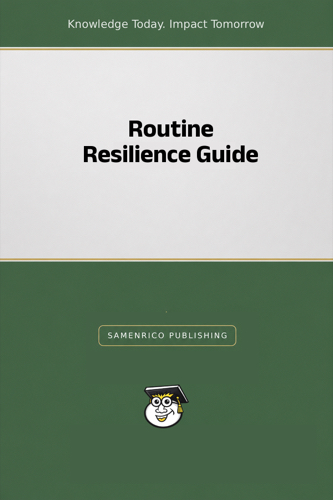
Free sample
Chapter 1: The Neurological Callus–- The first lie your brain tells you every morning is that you have already reached your limit. The second lie is that resilience is something you are born with—or without. This chapter dismantles both lies by revealing the single most important discovery in modern behavioral science: resilience is not a personality trait. It is a physical structure in your brain, built one microscopic repetition at a time. And like any physical structure, it can be fortified, thickened, and made impervious to the shocks that shatter the unprepared.Every morning, before your feet touch the floor, your brain runs a cost-benefit analysis.
Should you get up now or hit snooze? Should you exercise or scroll social media? Should you tackle that difficult conversation or avoid it? These calculations consume enormous cognitive energy, which is why your brain has evolved a powerful shortcut: it defaults to whatever it did yesterday. This is the neurological bedrock of habit formation, and it is also the secret weapon of the resilient.Most people misunderstand resilience because they have only witnessed its effects—the calm executive during a crisis, the athlete who finishes despite injury, the single parent who holds everything together.
They assume resilience is a force of will, a burst of heroic effort summoned from nowhere. This assumption is not only wrong; it is dangerous. It suggests that if you are not resilient, you simply are not trying hard enough. Nothing could be further from the truth.Resilience is a neurological callus. A callus forms when your skin is exposed to repeated friction.
The first time you grip a shovel, your hands blister. The tenth time, they harden. The hundredth time, you do not notice the friction at all. Your brain operates on the exact same principle. The first time you face a difficult task—waking up early, saying no to a request, sitting with uncomfortable emotions—your neural pathways fire chaotically.
It hurts. You feel incompetent. But the tenth time, the pathway smooths. The hundredth time, the behavior requires almost no conscious effort. You have grown a callus.This chapter introduces the foundational tool of the entire Routine Resilience Guide: the Micro-Win Journal.
But before you open that journal, you must understand the architecture of the brain you are trying to rewire. You must understand why small wins are not just motivational tricks but biological necessities. And you must accept a truth that will either liberate you or terrify you: you are not lazy. You are not weak. You are simply operating with an untrained brain.The Architecture of Agency: How Your Brain Decides Who Is in Charge To understand resilience, you must first understand the civil war that rages inside your skull every waking moment.
Your brain contains two competing systems, and the outcome of their battle determines whether you will act or freeze, persist or quit, grow or stagnate.The first system is the prefrontal cortex—the rational command center located directly behind your forehead. This is the part of your brain that plans, analyzes, and resists temptation. It allows you to calculate long-term consequences, override impulsive urges, and choose the harder right over the easier wrong. When you decide to wake up early despite exhaustion, that is your prefrontal cortex overruling your primitive instincts. When you choose to have a difficult conversation rather than avoid it, that is your prefrontal cortex asserting its authority.The second system is the amygdala—two small almond-shaped clusters deep in your brain's temporal lobes.
The amygdala is your threat-detection system. It scans the environment for danger, and when it perceives a threat, it floods your body with cortisol and adrenaline. Your heart rate spikes. Your breathing quickens. Your digestion slows.
Blood rushes to your muscles. This is the fight-or-flight response, and it saved your ancestors from predators. But here is the problem: the amygdala cannot distinguish between a saber-toothed tiger and a difficult email. It cannot tell the difference between a physical threat and a social one. A deadline, a performance review, a confrontation with a partner, an empty bank account—these trigger the exact same physiological response as a predator.The prefrontal cortex and the amygdala are locked in constant competition.
When your prefrontal cortex is strong and well-rested, it can calm the amygdala, contextualize threats, and choose rational responses. But when you are tired, hungry, stressed, or overwhelmed, the amygdala seizes control. You become reactive rather than proactive. You snap at loved ones. You binge-eat.
You scroll mindlessly. You abandon your routines.Here is the critical insight that changes everything: the prefrontal cortex is trainable. It is a muscle. And like any muscle, it grows stronger with use and atrophies with disuse. Every time you complete a small task that your brain wanted to avoid—making your bed, sending that email, doing five pushups—you are putting your prefrontal cortex in the gym.
You are thickening the neural pathways that support self-control, planning, and resilience. You are building a callus.The Small Win Hypothesis: Why Grand Gestures Fail Most people try to build resilience through what this book calls heroic acts—the marathon run with no training, the all-night work session, the dramatic declaration of change made on January 1st. Heroic acts produce adrenaline spikes, which feel powerful. You feel invincible for a moment. But adrenaline does not build structure.
It burns hot and fast, leaving you depleted and often injured. The day after the heroic act, you crash. You oversleep. You eat poorly. You abandon the project.
Then you conclude that you lack willpower, that you are simply not the kind of person who succeeds.This is a catastrophic misunderstanding of how the brain learns. Your brain does not learn through intensity; it learns through frequency. A single 100-pound lift does not build muscle; one hundred 10-pound lifts do. A single hour of intense focus does not build attention; ten minutes of daily focus does. The compound effect of small, consistent actions is not just a motivational slogan.
It is the fundamental law of neuroplasticity—the brain's ability to reorganize itself by forming new neural connections throughout life.Admiral William H. Mc Raven, the former commander of U.S. Special Operations Command, captured this principle in his famous commencement address at the University of Texas. He told the graduating class that if they wanted to change the world, they should start by making their bed every morning. The audience chuckled, but Mc Raven was dead serious.
He explained that making your bed is the first task of the day. If you complete it, you have already achieved one small win before breakfast. And if you have a terrible day—and you will have terrible days—you will return home to a made bed. That made bed will remind you that you are capable of order, that you have agency, that you are not a victim of your circumstances.Mc Raven understood what neuroscience has since confirmed: small wins are not symbolic. They are structural.
Each small win releases dopamine, the neurotransmitter associated with reward and motivation. Dopamine does not just make you feel good; it strengthens the neural pathways that produced the winning behavior. It…
This is the end of the free sample. Get the eBook to keep going. Buy now
About this book
Details
- Author
- Banks Wayne
- Publisher
- SamEnrico
- Language
- English
- Genre
- Non-Fiction, Self-Help / Habits
- Released
- 2026-06-06
- Pages (approx.)
- 147
- Available as
- eBook, Audiobook

Read better in the ZLOADR app
Your eBooks on your phone or tablet. Sign in with your SamEnrico account and start reading.
More by Banks Wayne
 Gaming Career Derailment GuideBanks Wayne$11.99
 The Cult Childhood RecoveryBanks Wayne$11.99
 Financial Stress And Housing Insecurity GuideBanks Wayne$11.99
 Waterfall Mist VisualizationBanks Wayne$11.99
 The RSV Vaccine GuideBanks Wayne$11.99
 Teen Apology Skills GuideBanks Wayne$11.99
 Imposter Syndrome For VolunteersBanks Wayne$11.99
 Full Term Stillbirth JourneyBanks Wayne$11.99
 Wild West Wonders: The Buffalo Soldiers' LegacyBanks Wayne$11.99
 The Great Emoji Heist: How a Symbol Stole the WorldBanks Wayne$11.99
 The Last Emperor of Ice: The Untold Saga of the Inuit Explorer Who Mapped the ArcticBanks Wayne$11.99
 Growing Sorbus (Rowan, Whitebeam)Banks Wayne$11.99
You may also like
 Hong Kong Handover 1997Dunn Johnnie$11.99
 Zumba For Postnatal Recovery CourseNeal Christian$11.99
 Zumba for BeginnersLadner Nikia$11.99
 YouTube Comment Mining GuideHumes Pandora$12.99
 Worry Box MeditationCarlin Rudy$11.99
 Workplace Stress MeditationNguyen Lynn$11.99
 Workplace Stress and Sleep RepairHawley Ivory$11.99
 Workplace Perfectionism CureDelaney Jeffry$11.99
 Workplace Injustice Anger GuideWallen Isabelle$11.99
 Work Addiction and Burnout LinkGreenwood Ester$11.99
 Women in Yoga and WellnessBeattie Galina$11.99
 Women in Stand Up ComedyChun Evangeline$11.99