
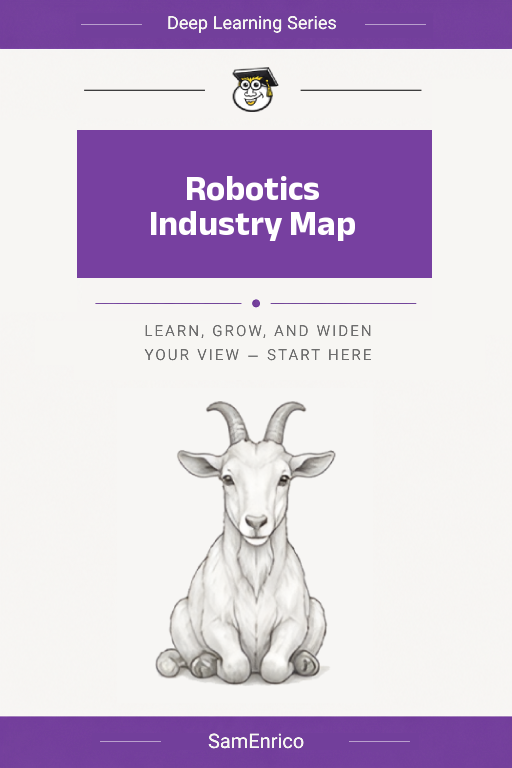
Non-FictionStrategic AtlasRobotics
Robotics Industry Map Audiobook
Compare ABB, Fanuc, Yaskawa, and Kuka on industria
by Combs Oralee
Compare ABB, Fanuc, Yaskawa, and Kuka on industrial versus collaborative robot specialization.
Formats
Free sample
Chapter 1: The Hidden Crisis--–- On a humid July morning in 2024, the plant manager of a $400 million automotive supplier in Ohio made a decision that would cost him his job within eighteen months. He had done everything right by traditional metrics. He benchmarked three vendors. He calculated ROI based on purchase price. He chose the robot with the lowest upfront cost and fastest delivery.
Within a year, that decision had created a cascade of failures: production line stoppages, a near-miss safety incident that triggered an OSHA investigation, and a hidden software licensing bill that ate up the supposed savings three times over. The robots worked. But they worked against his workforce, not alongside them. His story never made the news. But in the private Slack channels and Whats App groups where manufacturing executives share their real experiences, it became a cautionary legend.
The lesson, repeated like a grim mantra: Choosing a robot is not buying a tool. Choosing a robot is picking a technology partner for the next decade. And most executives are doing it blind.This book exists because that plant manager's story is not an exception. It is the rule.The robotics industry is in the midst of the most profound transformation since Unimate first swung its hydraulic arm onto a General Motors assembly line in 1961. That transformation has a name, though you will not find it in any vendor's marketing brochure.
It is the shift from Automation 1.0 to Automation 2.0, and it is happening right now, in full view, while the vast majority of manufacturing executives are still making decisions based on the rules of the previous era.Automation 1.0 was simple. You bought an industrial robot. You put it inside a safety cage. You programmed it once. It repeated the same motion, at the same speed, with the same precision, for ten or fifteen or twenty years.
Humans stayed outside the cage. The robot never learned. It never adapted. It never collaborated. And that was fine, because the problem it solved was simple: speed and repeatability at scale.Automation 2.0 is not simple.
In Automation 2.0, robots share workspace with humans. They switch between high-speed industrial mode and safe collaborative mode depending on the moment. They connect to cloud-based digital twins. They learn from repetitive tasks and adjust their own paths. They are not programmed; they are trained.
They are not isolated; they are integrated into every layer of the manufacturing execution system, from enterprise resource planning to…
This is the end of the free sample. Get the Audiobook to keep going. Buy now
About this book
Details
- Author
- Combs Oralee
- Publisher
- SamEnrico
- Language
- English
- Genre
- Non-Fiction, Strategic Atlas, Robotics
- Released
- 2026-06-01
- Pages (approx.)
- 152
- Available as
- eBook, Audiobook

Listen in the VoxFlicks app
Audiobooks and audio dramas wherever you go. Sign in with your SamEnrico account and press play.
More by Combs Oralee
 TradeDepot Exit PlaybookCombs Oralee$11.99
 Road Rage And Caffeine IntakeCombs Oralee$11.99
 Extended Exhale TechniqueCombs Oralee$11.99
 The Postpartum Blood Pressure GuideCombs Oralee$11.99
 Favoritism Anger ManagementCombs Oralee$11.99
 Peter Brook's Empty Space: Reinventing Theater in the 1960sCombs Oralee$11.99
 Understanding Phosphate DiabetesCombs Oralee$17.99
 How to Start a Chemically Pure Sugars Business (Beginners Guide)Combs Oralee$11.99
 Accounts AssistantCombs Oralee$11.99
 One Page Plan for Side HustleCombs Oralee$12.99
You may also like
 Hong Kong Handover 1997Dunn Johnnie$11.99
 Zumba For Postnatal Recovery CourseNeal Christian$11.99
 Zumba for BeginnersLadner Nikia$11.99
 YouTube Comment Mining GuideHumes Pandora$12.99
 Worry Box MeditationCarlin Rudy$11.99
 Workplace Stress MeditationNguyen Lynn$11.99
 Workplace Stress and Sleep RepairHawley Ivory$11.99
 Workplace Perfectionism CureDelaney Jeffry$11.99
 Workplace Injustice Anger GuideWallen Isabelle$11.99
 Work Addiction and Burnout LinkGreenwood Ester$11.99
 Women in Yoga and WellnessBeattie Galina$11.99
 Women in Stand Up ComedyChun Evangeline$11.99