
Non-FictionHealth & WellnessPeer Support
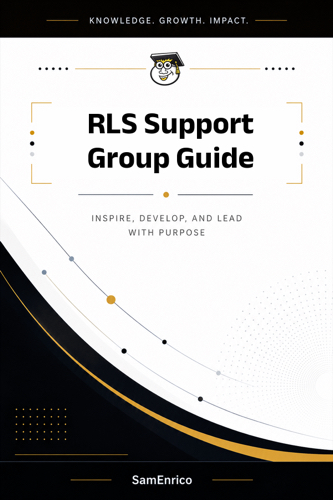
RLS Support Group Guide eBook
Connects with others online and locally.
Connects with others online and locally.
Formats
Free sample
Chapter 1: The 2 AM Truth--The first time you thought about dying, you were probably lying down.That's the cruel irony of Restless Legs Syndrome. The thing your body demands most—rest—is the very thing that triggers the torture. You lie down, exhausted beyond reason, your eyes heavy, your mind finally quiet. And then it begins. Not pain, exactly.
Something worse. Something that has no name in any language you speak. A crawling. A pulling. A deep, bone-level urgency that screams move while every other cell in your body screams sleep.So you move.
You get up. You walk to the kitchen and stand in the dark, flexing your calves, shifting your weight from foot to foot. You try the bathroom floor because the tile is cool. You try the living room carpet because the texture feels different. You try the stairs because the up-and-down motion sometimes helps.
Nothing works. Nothing ever works. You walk back to bed, lie down again, and within sixty seconds—sometimes thirty, sometimes ten—the sensation returns. It is 2 AM. You have been awake for nineteen hours.
You have tried everything. And you are completely, utterly alone.This is the 2 AM truth that every nightwalker knows: Restless Legs Syndrome is not a condition. It is a thief. It steals your sleep, your patience, your relationships, your career, and—if left unchecked—your will to live.This chapter is not going to fix your legs. Not yet.
We cannot fix anything until we name the thing that is broken. And the thing that is broken is not just your dopamine pathways or your iron levels or your circadian rhythms. What RLS has broken, first and foremost, is your belief that you are a normal human being entitled to a normal human life.We are going to rebuild that belief. But first, we have to look at what you have lost.The Invisible Illness Paradox Restless Legs Syndrome occupies a unique and vicious position in the hierarchy of human suffering. Cancer patients get sympathy.
Heart attack survivors get accommodations. People with broken bones get casts, and strangers hold doors for them, and everyone understands that they are hurting.RLS patients get told to try yoga.This is the invisible illness paradox: because your suffering cannot be seen, it is assumed not to exist. You look fine. You are not in a wheelchair. You are not missing limbs.
You are not bleeding. Therefore, according to the logic of a world that only believes what it can see, you must be fine.Except you are not fine. You are dying by millimeters, night after night, in a private hell that no one else can witness because everyone else is asleep.Dr. Arthur Walters, a pioneering RLS researcher, once described the condition as "the most common disease you've never heard of." That's accurate but incomplete. A better description might be "the most common disease that everyone has heard of and no one takes seriously." Your friends have heard of restless legs.
They saw a commercial for a medication once. They think it's a minor annoyance, like a hangnail or a mosquito bite. They have absolutely no idea that you have considered ending your life because of it.Consider this statistic: according to the American Medical Association and multiple international studies, between 10 and 15 percent of adults experience RLS symptoms. That is one in seven people. That is more than diabetes.
More than asthma. More than all cancers combined. And yet, when was the last time you saw an RLS awareness campaign? When was the last time your employer offered an accommodation for RLS? When was the last time a well-meaning relative didn't suggest that you "just need to relax more"?The invisibility of RLS is not an accident.
It is a structural feature of how the medical system and society at large view conditions that primarily strike at night. We have a word for illnesses that happen when the sun is up: diseases. We have a word for illnesses that happen when the sun is down: imaginary.The Suicide Question No One Wants to Ask Let us speak plainly about something that most books on this topic dance around. Severe RLS is associated with a rate of suicidal ideation that rivals major depressive disorder. Robert Yoakum, whose foundational work Restless Legs Syndrome: Relief and Hope for Sleepless Victims of a Hidden Epidemic gave this community its first real voice, wrote bluntly that some of his patients had been "driven to suicide" by the condition.
He was not being dramatic. He was being clinical.Think about what it takes to drive a human being to suicide. Not sadness. Not disappointment. Not even grief, as devastating as grief is.
Suicide usually requires a specific cocktail: prolonged suffering, no foreseeable end to that suffering, and the absolute certainty that no one understands or can help.RLS delivers that cocktail on a silver platter.The prolonged suffering is obvious. You have not slept properly in months. Maybe years. Sleep deprivation is not an inconvenience; it is a torture technique recognized by the Geneva Conventions. When a government wants to break a prisoner's will, they deprive them of sleep.
And you have been doing it to yourself, involuntarily, every single night.The no foreseeable end piece is what breaks people. With most illnesses, there is a trajectory. You get diagnosed, you receive treatment, you get better. Maybe not completely better, but better. With RLS, the trajectory is often the opposite.
You try medication A. It works for a while, then it stops working, and your symptoms come back worse than before. That is augmentation, and we will discuss it in detail in Appendix C. You try medication B. It works, but the side effects are brutal.
You try magnesium. You try iron supplements. You try compression socks and CBD oil and acupuncture and prayer. Nothing works consistently. Nothing works forever.
The hope you feel at the beginning of each new treatment is matched only by the despair you feel when it fails.And the no one understands piece is the final nail. You have tried to explain it. You have said "my legs feel weird" and watched your partner's eyes glaze over. You have said "I can't sleep" and watched your boss's patience run out. You have said "it's a neurological condition" and watched your friends change the subject.
After enough of these interactions, you stop explaining. You stop reaching out. You start believing that you are alone in this.You are not alone. The 10 to 15 percent statistic is real. The support groups we will discuss in later chapters are real.
The people who have stood in their kitchens at 2 AM, crying silently so they wouldn't wake their families, are real. And many of them—most of them, in fact—have gotten better. Not cured, necessarily. But better. Functional.
Even happy.This book exists because of those people. They are the ones who figured out that isolation is not a side effect of RLS. It is the primary weapon the disease uses against you. And the only way to disarm that weapon is to find your tribe.The Nightwalker Identity Let me introduce a term that will appear throughout…
This is the end of the free sample. Get the eBook to keep going. Buy now
About this book
Details
- Author
- Rafferty Cara
- Publisher
- SamEnrico
- Language
- English
- Genre
- Non-Fiction, Health & Wellness, Peer Support
- Released
- 2026-06-11
- Pages (approx.)
- 141
- Available as
- eBook, Audiobook

Read better in the ZLOADR app
Your eBooks on your phone or tablet. Sign in with your SamEnrico account and start reading.
More by Rafferty Cara
 Perimenopause PMS GuideRafferty Cara$11.99
 Gacy's Marriages and RelationshipsRafferty Cara$11.99
 Cocaine Recovery and SexRafferty Cara$11.99
 Peg System Speed RecallRafferty Cara$11.99
 Insider Trading Diamond HeistRafferty Cara$11.99
 Collaborative Mind MappingRafferty Cara$11.99
 Bipolar Self Monitoring CourseRafferty Cara$11.99
 Retirement Asset Custodian GuideRafferty Cara$11.99
 Into the Abyss: The Forgotten Descent of the Trieste to the Mariana TrenchRafferty Cara$11.99
 The Selkie's Lament: A Love Torn Between Land and SeaRafferty Cara$11.99
 The Art Heist That Shocked the World: The Gardner Museum CaperRafferty Cara$11.99
 Growing RhexiaRafferty Cara$11.99
You may also like
 Hong Kong Handover 1997Dunn Johnnie$11.99
 Zumba For Postnatal Recovery CourseNeal Christian$11.99
 Zumba for BeginnersLadner Nikia$11.99
 YouTube Comment Mining GuideHumes Pandora$12.99
 Worry Box MeditationCarlin Rudy$11.99
 Workplace Stress MeditationNguyen Lynn$11.99
 Workplace Stress and Sleep RepairHawley Ivory$11.99
 Workplace Perfectionism CureDelaney Jeffry$11.99
 Workplace Injustice Anger GuideWallen Isabelle$11.99
 Work Addiction and Burnout LinkGreenwood Ester$11.99
 Women in Yoga and WellnessBeattie Galina$11.99
 Women in Stand Up ComedyChun Evangeline$11.99