
Non-FictionInformativeEducational
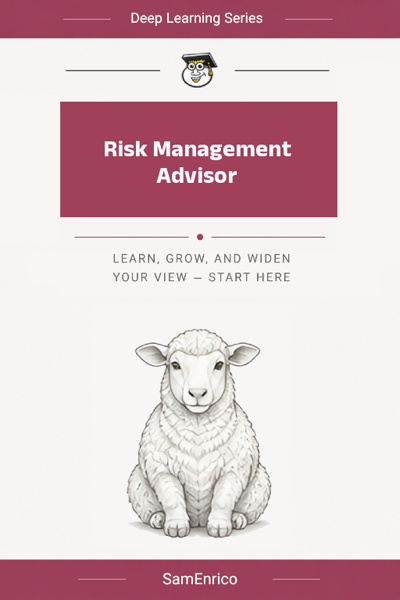
Risk Management Advisor eBook
A Coursebook on Risk Management Advisor
by Duffy Andrew
A Coursebook on Risk Management Advisor
Formats
Free sample
Chapter 1: The $47 Billion Mistake...--–- On a spring morning in 2012, a trader named Bruno Iksil sat at his desk in JPMorgan Chase’s London office and did what he had done thousands of times before. He entered a series of credit default swap trades—complex financial instruments that act as insurance against corporate bond defaults. But these trades were different. They were not hedges to protect the bank. They were speculative positions so large, so concentrated, and so poorly understood by his managers that they would eventually lose 6.2billion.Withinmonths,thefigurewouldberevisedtoover6.2 billion.
Within months, the figure would be revised to over 6.2billion.Withinmonths,thefigurewouldberevisedtoover9 billion. The press gave Iksil a nickname: the London Whale.The London Whale trade is not just a story about a rogue trader. It is a story about risk. It is a story about how the most sophisticated financial institution in the world—a bank with thousands of risk managers, billions of dollars in risk technology, and a reputation for prudent management—lost its way because its leaders misunderstood what risk actually means. They thought risk was about numbers on a spreadsheet.
They thought risk was about compliance with internal limits. They thought risk was something that happened to other banks.They were wrong.This chapter is about the most fundamental question in risk management: What is risk? Not the dictionary definition. Not the textbook cliché. The real, practical, actionable definition that separates organizations that fail from those that thrive in uncertainty.
You will learn why the London Whale was not an anomaly but a predictable consequence of a flawed understanding of risk. You will learn how risk management evolved from insurance purchasing to a strategic discipline. And you will learn the critical distinction between risk management and risk-avoidance—a distinction that determines whether you become a trusted advisor or just another compliance officer who says no.What Is Risk? Beyond the Simple Definition Ask a hundred people to define risk, and ninety-nine will say something like “the chance of something bad happening.” That definition is not wrong, but it is dangerously incomplete. It focuses only on threats.
It assumes risk is always negative. And it ignores the most important word in professional risk management: objectives.The international standard for risk management, ISO 31000, uses a different definition: Risk is the effect of uncertainty on objectives.Let us break that down into its three critical elements.First, uncertainty. If an outcome is certain, there is no risk. You know exactly what will happen. Risk arises when the future is not predictable—when multiple outcomes are possible, and you do not know which will occur.
Uncertainty is not a flaw in your analysis. It is a feature of reality.Second, objectives. A risk only matters in relation to something you care about. A deadline. A financial target.
A safety standard. A reputation. If you have no objectives, you have no risk. This is why the first step in any risk process is always to ask: What are we trying to achieve?Third, effects. These effects can be negative (threats) or positive (opportunities).
A new competitor entering your market could steal your customers—that is a threat. But a new technology could also reduce your costs—that is an opportunity. The risk management advisor must manage both.The London Whale case illustrates all three elements perfectly. The uncertainty was enormous—no one knew how the credit markets would move. The objectives were clear—JPMorgan wanted to generate trading profits while protecting its balance sheet.
And the effects were both negative (billions in losses, regulatory fines, reputational damage) and, had the trades worked, positive (billions in profit). The risk was not the trades themselves. The risk was the effect of uncertainty on JPMorgan’s objectives.The Dual Nature of Risk: Threats and Opportunities Most organizations spend 95 percent of their risk management time on threats. They identify what could go wrong, analyze how bad it could be, and plan responses to prevent it. This is necessary.
But it is also incomplete.The organizations that truly excel at risk management—the ones that use uncertainty to their advantage—spend just as much time on opportunities. They ask: What could go right? Where is the upside? How can we increase the probability or impact of positive outcomes?Consider a pharmaceutical company developing a new drug. The threats are obvious: clinical trials could fail, regulators could reject the application, competitors could launch a better drug.
But the opportunities are equally real: the drug could work better than expected, the market could be larger than forecast, the drug could be approved for additional uses. A risk management advisor who only raises threats is seen as a pessimist. An advisor who also identifies and pursues opportunities is seen as a strategist.This does not mean pretending that threats do not exist. It means balancing the ledger. Every risk has two sides.
Your job is to illuminate both.The Evolution of Risk Management: From Insurance to Integration Understanding where risk management came from helps explain why many organizations still do it poorly. The discipline is surprisingly young.The Insurance Era (Pre-1970s). For most of business history, “risk management” meant buying insurance. If something might go wrong—a fire, a lawsuit, a theft—you transferred the financial consequence to an insurance company. Everything else was simply “the cost of doing business.” There were no chief risk officers, no risk registers, no probability-impact matrices.
Risk was something you paid someone else to worry about.The Quantitative Revolution (1970s-1990s). Financial markets changed everything. Derivatives, options, and swaps allowed banks and investors to hedge risks in ways previously impossible. Risk management became mathematical. The development of Value at Risk (Va R) in the 1990s gave traders a single number—the maximum loss expected over a given period at a given confidence level—that seemed to summarize their risk exposure.
For a time, quants and Ph Ds replaced insurance brokers as the face of risk management.But the quantitative revolution had a dark side. As the collapse of Long-Term Capital Management (LTCM) in 1998 demonstrated, models are only as good as their assumptions. LTCM’s models said a Russian debt default would happen “once in the history of the universe.” It happened in 1998. The fund lost $4.6 billion in four months and nearly collapsed the global financial system. The lesson: quantitative risk analysis is powerful, but blind trust in models is a risk in itself.The Operational Awakening (1990s-2000s).
High-profile disasters in the 1990s and early 2000s revealed that risk extended far beyond finance. Barings Bank collapsed in 1995 because a single rogue trader in Singapore hid $1.3 billion in losses. The Mars Climate Orbiter crashed in 1999 because one engineering team used metric units while another used imperial units. Enron imploded in 2001 because executives committed fraud and auditors failed to stop them. These were not market risks or credit risks.
They were operational risks—failures of processes, people, and systems. Risk management expanded to include internal controls, compliance, and business continuity.The Strategic Integration Era (2008-Present). The 2008 global financial crisis was a watershed moment. Organizations that had believed their risk models were sophisticated discovered that they had missed systemic risk entirely. A single…
This is the end of the free sample. Get the eBook to keep going. Buy now
About this book
Details
- Author
- Duffy Andrew
- Publisher
- SamEnrico
- Language
- English
- Genre
- Non-Fiction, Informative, Educational
- Released
- 2026-05-07
- Pages (approx.)
- 129
- Available as
- eBook, Audiobook

Read better in the ZLOADR app
Your eBooks on your phone or tablet. Sign in with your SamEnrico account and start reading.
More by Duffy Andrew
 Heart Healthy Exercise PrescriptionDuffy Andrew$11.99
 Sibling Hoarding GuideDuffy Andrew$11.99
 Golfer Back Pain GuideDuffy Andrew$11.99
 Flame Retardant Risk GuideDuffy Andrew$11.99
 The Ashes Reborn: How a Century-Old Rivalry Defined Cricket's Golden AgeDuffy Andrew$11.99
 How to Produce ChippersDuffy Andrew$11.99
 AI Retail Accounting GuideDuffy Andrew$12.99
 How to Become a Harbor MasterDuffy Andrew$11.99
You may also like
 Hong Kong Handover 1997Dunn Johnnie$11.99
 Zumba For Postnatal Recovery CourseNeal Christian$11.99
 Zumba for BeginnersLadner Nikia$11.99
 YouTube Comment Mining GuideHumes Pandora$12.99
 Worry Box MeditationCarlin Rudy$11.99
 Workplace Stress MeditationNguyen Lynn$11.99
 Workplace Stress and Sleep RepairHawley Ivory$11.99
 Workplace Perfectionism CureDelaney Jeffry$11.99
 Workplace Injustice Anger GuideWallen Isabelle$11.99
 Work Addiction and Burnout LinkGreenwood Ester$11.99
 Women in Yoga and WellnessBeattie Galina$11.99
 Women in Stand Up ComedyChun Evangeline$11.99