
Non-FictionInformativeEducational
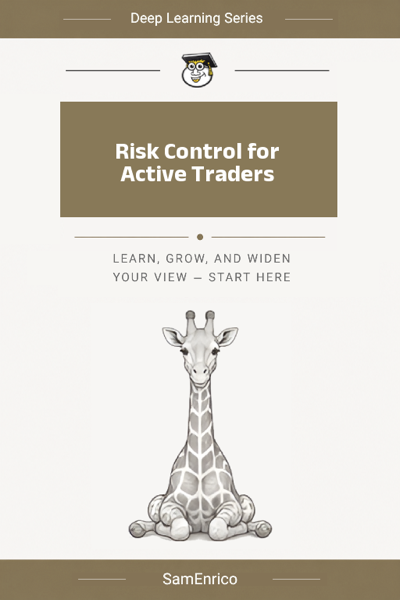
Risk Control for Active Traders eBook
A Coursebook on Risk Control for Active Traders
A Coursebook on Risk Control for Active Traders
Formats
Free sample
Chapter 1: The 40% Solution--Most traders believe they need to be right most of the time to make money. This single belief has destroyed more trading accounts than leverage, market crashes, or bad brokers combined.Let me say that again: the obsession with being right is the most expensive psychological flaw in all of trading.If you walked into a casino and someone offered you a game where you would lose sixty times out of one hundred but still walk away rich, you would take that game in a heartbeat. Yet when the same mathematics applies to trading, most retail traders reject it. They chase eighty percent win rates. They hold losing positions because “the trade is still right.” They move stop-losses down because they cannot admit that a $50 stock might go to $48.
And they blow up—slowly or quickly, but inevitably—because they never learned the one lesson that separates professionals from amateurs: being right is irrelevant. Being profitable is everything.This chapter will destroy every assumption you have about what makes a successful trader. It will show you, with simple arithmetic, why a trader who is wrong sixty percent of the time can outperform a trader who is right eighty percent of the time. It will introduce the concept of asymmetric payoffs—the hidden engine of all professional trading. And it will give you a formula that will change how you think about every single trade you ever place.By the end of this chapter, you will no longer fear being wrong.
You will fear being wrong by the wrong amount.The Myth of the High Win Rate Walk into any trading chat room, Reddit forum, or Discord server, and you will hear the same boast: “I win eighty percent of my trades.” The traders making this claim genuinely believe they have found the holy grail. They post screenshots of green after green after green. They attract followers. They sell courses.And then, six months later, they vanish.What happened? They did not suddenly lose their ability to pick winners.
Their eighty percent win rate was probably real—for a while. The problem is that a high win rate is not only insufficient for profitability; it can be dangerously misleading. Traders with high win rates tend to develop a specific fatal flaw: they let their losers run.Here is the math that explains why.Imagine two traders. Trader A has an eighty percent win rate. Trader B has a forty percent win rate.
Who makes more money?The answer: it depends entirely on how much they win when they win and how much they lose when they lose.Trader A wins eight out of ten trades. But his winning trades average a $100 profit, and his losing trades average a $400 loss. His expectancy per trade—the average amount he makes per trade—is calculated as follows:(0.8 × $100) + (0.2 × -$400) = $80 - $80 = $0.Trader A breaks even. Despite winning eighty percent of the time, he makes no money.Trader B wins only four out of ten trades. But her winning trades average a $400 profit, and her losing trades average a $100 loss.
Her expectancy:(0.4 × $400) + (0.6 × -$100) = $160 - $60 = $100 per trade.Trader B makes $100 per trade despite losing sixty percent of the time.This is not a hypothetical curiosity. This is the fundamental arithmetic of trading. Professional traders do not obsess over win rates. They obsess over risk-to-reward ratios. They know that a thirty percent win rate with a three-to-one reward-to-risk ratio is highly profitable, while a ninety percent win rate with a one-to-one ratio is one bad streak away from disaster.Let me show you the table that changed my own trading forever.The Breakeven Win Rate Formula There is a simple formula that every active trader should memorize.
It tells you the win rate you need to break even given your average risk-to-reward ratio.Breakeven Win Rate = 1 / (1 + Average Risk-to-Reward Ratio)Let us unpack that.Your risk-to-reward ratio (often written as R:R) is the ratio of your average loss to your average win. If you risk $1 to make $2, your R:R is 1:2. If you risk $1 to make $3, your R:R is 1:3. If you risk $1 to make $1, your R:R is 1:1.Plug that ratio into the formula. For a 1:2 R:R:1 / (1 + 2) = 1 / 3 = 33.3%You need only a 33.3% win rate to break even.
Every win rate above that is profitable.For a 1:3 R:R:1 / (1 + 3) = 1 / 4 = 25%You need only a 25% win rate to break even.For a 1:1 R:R:1 / (1 + 1) = 1 / 2 = 50%You need a 50% win rate to break even.This formula is liberating. It means that a trader who risks $500 to make $1,500 (a 1:3 R:R) can be wrong seventy-five percent of the time and still not lose money. A trader who risks $500 to make $500 (a 1:1 R:R) must be right half the time just to stay flat.Now look at the chart again. Notice how the required win rate drops dramatically as the R:R widens. At 1:2, you can be wrong two thirds of the time and still survive.
At 1:3, you can be wrong three quarters of the time. At 1:4, you can be wrong eighty percent of the time.Think about what this means for your psychology. If you know that you can be wrong seventy-five percent of the time and still make money, a single loss stops feeling like a catastrophe. A losing streak stops feeling like a personal failure. You stop needing to be right.
You start needing to manage your losses.This is the single greatest psychological shift in trading. It is the difference between amateurs who pray for green days and professionals who know that losses are simply the cost of doing business.The Beach and the Battleground Kenneth Grant, one of the most underappreciated voices in trading literature, introduced a distinction that every active trader should tattoo onto their forearm. He called it “The Beach” and “The Battleground.”The Beach is your profit target—the price level where you take your money and walk away. It is called the Beach because when you get there, you relax. You are done.
The trade worked. You do not need to squeeze out the last tick or wait for the moon. You take your profit and go enjoy your life.The Battleground is your stop-loss—the price level where you admit defeat. It is called the Battleground because if price reaches this level, you are under attack. Your analysis was wrong.
The market is doing something you did not expect. The only rational response is to retreat, preserve your capital, and live to trade another day.Here is the truth that most traders never accept: without a Battleground, every trade is a gamble.Not an investment. Not a speculation. A gamble.Because if you do not know exactly where you are wrong, you are not trading. You are hoping.
And hope is not a strategy. Hope is what makes a trader hold a $50 stock all the way down to $30, then $20, then $10, telling themselves “it has to come back.”It does not have to come back. The market does not owe you anything. Your analysis does not matter. Your ego does not matter.
The only thing that matters is what price does. And when price hits your Battleground, the trade is over.The chapter will revisit…
This is the end of the free sample. Get the eBook to keep going. Buy now
About this book
Details
- Author
- Crockett Nicky
- Publisher
- SamEnrico
- Language
- English
- Genre
- Non-Fiction, Informative, Educational
- Released
- 2026-06-02
- Pages (approx.)
- 145
- Available as
- eBook, Audiobook

Read better in the ZLOADR app
Your eBooks on your phone or tablet. Sign in with your SamEnrico account and start reading.
More by Crockett Nicky
 The Joy Breath TrainingCrockett Nicky$11.99
 Self Esteem for Academic CareersCrockett Nicky$11.99
 Letting Go of Emotional PainCrockett Nicky$11.99
 Combat Medic Burnout PreventionCrockett Nicky$11.99
 The Waco ArmorCrockett Nicky$11.99
 Rosetta Stone GuideCrockett Nicky$11.99
 Hadal Snailfish DiscoveryCrockett Nicky$11.99
 Art History Memory PalaceCrockett Nicky$11.99
 Purpose Without BurnoutCrockett Nicky$11.99
 The Alchemist of Florence: The Secret Fire of the RenaissanceCrockett Nicky$11.99
 The Silk Road to the Sky: The Forgotten High-Altitude Explorers of the AndesCrockett Nicky$11.99
 Glitch in the Code: The Day the Internet Almost BrokeCrockett Nicky$11.99
You may also like
 Hong Kong Handover 1997Dunn Johnnie$11.99
 Zumba For Postnatal Recovery CourseNeal Christian$11.99
 Zumba for BeginnersLadner Nikia$11.99
 YouTube Comment Mining GuideHumes Pandora$12.99
 Worry Box MeditationCarlin Rudy$11.99
 Workplace Stress MeditationNguyen Lynn$11.99
 Workplace Stress and Sleep RepairHawley Ivory$11.99
 Workplace Perfectionism CureDelaney Jeffry$11.99
 Workplace Injustice Anger GuideWallen Isabelle$11.99
 Work Addiction and Burnout LinkGreenwood Ester$11.99
 Women in Yoga and WellnessBeattie Galina$11.99
 Women in Stand Up ComedyChun Evangeline$11.99