
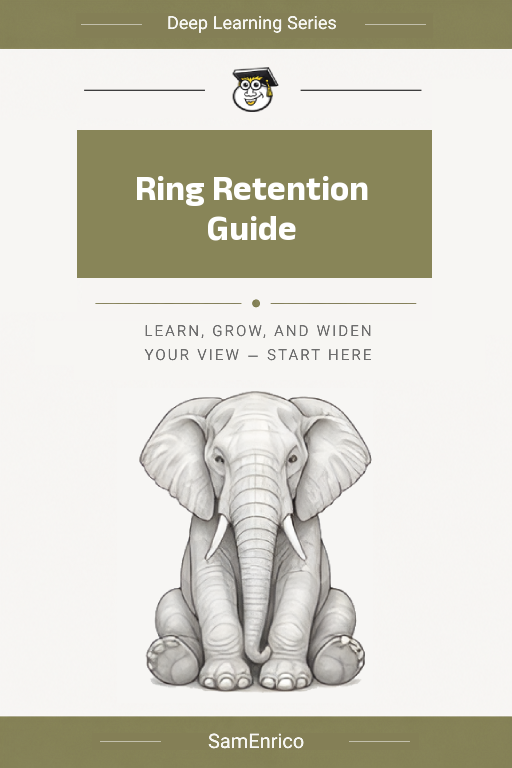
Ring Retention Guide eBook
Explore subscription video storage, neighborhood a
by Canty Marcel
Explore subscription video storage, neighborhood alerts, and device lock-in for home security ecosystem.
Formats
Free sample
Chapter 1: The $60 Doorbell--– I bought my first Ring doorbell on Prime Day. It was 59.99,downfrom59.99, down from 59.99,downfrom99.99. I remember feeling clever, even victorious. I had beaten the system. I had waited for the sale, compared prices across three websites, and finally pulled the trigger at 2:00 AM while holding a toddler in one arm and my phone in the other.
That is the kind of tired, desperate consumer that Amazon's algorithm dreams about.The box arrived two days later. White and blue, reassuringly heavy, promising "Peace of Mind" in bold sans-serif font. I installed it myself over a Saturday afternoon. I drilled holes into my century-old brick facade, ran the tiny wire leveling tool across the mounting bracket three times until it was perfect, and synced the device to my phone while standing on a ladder in the rain. When the doorbell chimed through my living room Echo Show for the first time, I felt a surge of pride.
I was a modern homeowner. I was secure. I was in control.Three years later, I had spent $1,200 on subscriptions, batteries, and a cellular backup I never used. I had received 47,000 notifications—most of them leaves, shadows, and the mailman walking back to his truck. I had watched my neighbor's cat urinate on my welcome mat at 3:00 AM approximately 400 times.
And I had come to a slow, uncomfortable realization: the doorbell didn't belong to me. I belonged to it.This book is the story of that realization. But more importantly, it is the story of what I did next. I learned that the $60 doorbell was not a bargain. It was bait.
And once you understand that, once you see the trap for what it is, you have two choices: stay inside the cage and learn to live there, or find the door.The Razor and the Blade To understand why your Ring doorbell costs 60,youhavetoforgeteverythingyouthinkyouknowaboutpricing.Mostproductsarepricedtomakeaprofitonthefirstsale.Ifacompanyspends60, you have to forget everything you think you know about pricing. Most products are priced to make a profit on the first sale. If a company spends 60,youhavetoforgeteverythingyouthinkyouknowaboutpricing.Mostproductsarepricedtomakeaprofitonthefirstsale.Ifacompanyspends40 to manufacture a widget, they sell it for 60andkeepthe60 and keep the 60andkeepthe20 difference. This is how commerce has worked for centuries. It is simple, honest, and completely irrelevant to the world of smart home devices.Ring operates on a model that dates back to 1903, when King Camp Gillette invented the disposable safety razor.
Gillette sold the razor handle at a steep loss—sometimes giving it away for free—because he knew that every handle required blades. And blades needed to be replaced constantly. The handle was the hook. The blades were the profit. A century later, printers followed the same model: cheap hardware, expensive ink.
Then video game consoles: loss-leading hardware, expensive games. Then Keurig: cheap coffee makers, expensive pods.Ring is Gillette for the digital age. Only instead of blades, they sell subscriptions. Instead of ink, they sell video storage. And instead of coffee pods, they sell the nagging fear that if you cancel, you will miss the one moment that matters.Here is the math that Ring does not want you to see.
According to supply chain analyses published by Tech Insights in 2024, the Ring Video Doorbell (second generation) costs approximately 103tomanufacture.Thatincludesthecamerasensor,theinfrared LEDs,themotiondetector,the Wi−Fichip,thespeaker,themicrophone,thebattery,theplastichousing,andtheassemblylabor.Addanother103 to manufacture. That includes the camera sensor, the infrared LEDs, the motion detector, the Wi-Fi chip, the speaker, the microphone, the battery, the plastic housing, and the assembly labor. Add another 103tomanufacture.Thatincludesthecamerasensor,theinfrared LEDs,themotiondetector,the Wi−Fichip,thespeaker,themicrophone,thebattery,theplastichousing,andtheassemblylabor.Addanother12 for packaging, shipping, and returns processing. The total landed cost is roughly $115.Ring sells this doorbell for 99.99.On Prime Day,theysellitfor99.99. On Prime Day, they sell it for 99.99.On Prime Day,theysellitfor59.99.They lose between 15and15 and 15and55 on every single doorbell they sell.This is not a mistake.
It is not a clearance sale. It is not Amazon subsidizing a loss leader for customer acquisition. It is a deliberate, meticulously engineered pricing strategy designed to do one thing: put a Ring device on your home at any cost, because once it is there, the real revenue begins.The average Ring subscriber pays 99.99peryearforthe Basicplan.Theaveragecustomerkeepstheirdevicefor4.7years.Thatis99.99 per year for the Basic plan. The average customer keeps their device for 4.7 years. That is 99.99peryearforthe Basicplan.Theaveragecustomerkeepstheirdevicefor4.7years.Thatis470 in subscription revenue.
The average customer owns 2.3 Ring devices (a doorbell and a stick-up cam, typically). That is $1,080 in total subscription revenue over the lifetime of the relationship.The $55 loss on the doorbell is recouped within seven months of subscription payments. Everything after that is pure profit.This is not an opinion. It is the business model of every successful hardware-plus-subscription company in the world. And once you see it, you cannot unsee it.
Your doorbell is not a product. It is a customer acquisition channel shaped like a doorbell.The False Economy of DIYThe day I installed my own doorbell, I felt like a god. I had overcome the fear of drilling into brick. I had decoded the cryptic wiring diagram. I had synced the device without calling customer support.
I posted a photo of the finished installation on social media with the caption "Hardware installed. Who's ringing now?" I received seventeen likes and three comments praising my handyman skills.What I did not know, at that proud and foolish moment, was that I had just fallen into the second trap. The first trap was the price. The second trap is psychology. It is called the sunk cost fallacy, and it is one of the most powerful forces in consumer behavior.The sunk cost fallacy works like this: once you have invested time, money, or effort into something, you become irrationally attached to it.
You continue investing because walking away feels like admitting that your initial investment was wasted. This is why people sit through terrible movies. It is why gamblers chase losses. And it is why you will keep paying for your Ring subscription long after you have stopped seeing the value.Consider what you actually did to install that doorbell. You watched a You Tube tutorial (twenty minutes).
You gathered tools (fifteen minutes). You drilled holes (ten minutes of terror). You ran wires (twenty minutes of frustration). You synced the device (thirty minutes of "why isn't this working?"). You adjusted the motion zones (another hour of trial and error).
By the time the doorbell was operational, you had invested somewhere between two and four hours of your life, plus a non-trivial amount of emotional energy.Now ask yourself: would you throw all of that away to save 100peryear?Therationalanswerisyes,absolutely,because100 per year? The rational answer is yes, absolutely, because 100peryear?Therationalanswerisyes,absolutely,because100 per year is real money and your time is already spent. But the emotional answer is no. You feel attached to that doorbell. You feel proud of it.
It is yours. You made it work.Ring knows this. They have behavioral economists on staff who have studied this exact phenomenon. The company has filed patents related to "user retention through effort-based commitment." One patent, filed in 2022 and granted in 2024, describes a system that "encourages…
This is the end of the free sample. Get the eBook to keep going. Buy now
About this book
Details
- Author
- Canty Marcel
- Publisher
- SamEnrico
- Language
- English
- Genre
- Non-Fiction, Strategic Atlas, Retention Strategy
- Released
- 2026-06-01
- Pages (approx.)
- 130
- Available as
- eBook, Audiobook

Read better in the ZLOADR app
Your eBooks on your phone or tablet. Sign in with your SamEnrico account and start reading.
More by Canty Marcel
 TikTok Ad Revenue GuideCanty Marcel$11.99
 Nightmare Desensitization CourseCanty Marcel$11.99
 Political Anger TriggersCanty Marcel$11.99
 The Teen Self Esteem Through SportsCanty Marcel$11.99
 Bridge Loan LBO Structures GuideCanty Marcel$11.99
 The Candace's Gold: The Heist That Built a KingdomCanty Marcel$11.99
 Curly-coated Retriever BreedingCanty Marcel$11.99
 Understanding Progressive AcromelanosisCanty Marcel$17.99
 Executive Summary for HR PlansCanty Marcel$12.99
 How to Start a Hobby in WindsurfingCanty Marcel$11.99
You may also like
 Xero Retention GuideWenzel Loralee$12.99
 Wix Retention GuideOdell Ava$12.99
 SurveyMonkey GuideHershberger Corie$12.99
 Netflix Engagement GuideParham Tana$12.99
 Masterclass GuideBlue Fay$12.99
 HubSpot RetentionRankin Delicia$12.99
 Headspace Retention GuideMotley Altha$12.99
 Glassdoor RetentionShephard Sylvie$12.99
 Evernote GuidePaxton Marvel$12.99
 Duolingo Retention GuideCooks Adrianne$12.99
 Dollar Shave ClubMayhew Mikel$12.99
 DocuSign RetentionHardesty Buena$12.99