
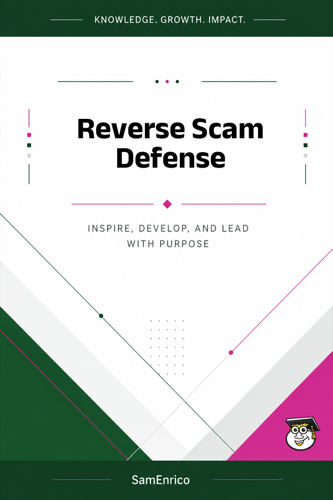
Reverse Scam Defense eBook
Common scams targeting seniors and how to avoid.
Common scams targeting seniors and how to avoid.
Formats
Free sample
Chapter 1: The $3.4 Billion Silence--The phone rang at 11:47 on a Tuesday morning. Margaret, seventy-three years old and four years into retirement, recognized the area code as her grandson’s college town. She answered on the second ring. A young man’s voice, cracking with panic, said: “Grandma? Grandma, it’s me.
I’m in trouble.”She froze. The voice sounded like Tyler. Maybe a little higher than usual, maybe a little muffled, but he was crying. “I was in an accident,” the voice continued. “I hit a car.
There was a pregnant woman. They arrested me. Please, Grandma, don’t call Mom and Dad. I’m so scared.”Margaret’s heart slammed against her ribs. She had raised three children and helped with five grandchildren.
The protective instinct that had kept babies alive for two hundred thousand years of human evolution roared to life. “What do you need?” she asked.“Bail,” the voice said. “Nine thousand dollars. They said if I pay today, they won’t put it on my record. Please, Grandma.
Please.”She wrote down the instructions. Wire transfer to an address she did not recognize. A phone number that was not Tyler’s. She drove to her bank at noon. The teller, a young woman named Jessica, looked at the amount and asked gently, “Are you sure about this?”Margaret said yes.
She was not confused. She was not senile. She was rescuing her grandson.The money left her account at 12:47 PM. At 1:15, she called her daughter to let her know Tyler was safe. Her daughter said, “Mom, Tyler is in class.
He just texted me.”The voice on the phone was not Tyler. It had never been Tyler. And the nine thousand dollars was gone.This is not a cautionary tale. This is a crime report. And it happens three hundred times a day in the United States.The New Landscape of Theft Let us begin with a number that will sound abstract until it becomes personal: $3.4 billion.That is the annual cost of elder fraud in the United States, according to data from the Federal Deposit Insurance Corporation and the Consumer Financial Protection Bureau.
To understand what that number means, consider this: $3.4 billion is more than the annual revenue of the television network CBS. It is more than the gross domestic product of several small countries. It is, in real terms, the single largest transfer of wealth from one generation to another that is completely illegal, almost entirely unreported, and astonishingly easy to execute.But the dollar figure, staggering as it is, tells only part of the story. The rest of the story lives in the aftermath of Margaret’s wire transfer: the shame that kept her from telling anyone for three days; the fear that her children would take away her checkbook; the slow, grinding realization that she would never see that money again; and the quiet erosion of trust that followed—distrust of the phone, distrust of the doorbell, distrust of her own judgment.Scammers are not random opportunists. They are not lone wolves working out of basements.
The modern scam industry is organized, data-driven, and ruthlessly efficient. Call centers in countries with extradition loopholes operate on shift schedules. Data brokers sell “sucker lists” —contact information for seniors who have fallen for scams before, along with notes on which emotional triggers worked. Artificial intelligence systems scrape social media to learn family structures, pet names, birthdays, and travel plans. Voice cloning software can now reproduce a convincing replica of a loved one’s voice from as little as three seconds of audio lifted from a Tik Tok video or a voicemail greeting.The senior who picks up the phone today is not facing a con artist.
She is facing an industry.Why This Book Is Different Every year, well-meaning organizations publish pamphlets with titles like “Avoiding Scams: A Guide for Seniors.” These pamphlets are typically written in 10-point font, use words like “fraudulently,” and are handed out at senior centers where they are politely accepted and then placed in a drawer next to the expired coupons.They do not work.They do not work because they treat seniors as passive recipients of information rather than active participants in their own defense. They do not work because they list warning signs in dense paragraphs that no one memorizes. And they do not work because they assume that the problem is a lack of knowledge when the real problem is the hijacking of ancient, powerful, entirely normal human emotions.This book is not a pamphlet. This book is a playbook.The philosophy at its core is called Reverse Scam Defense. The term is simple: instead of reacting to a scammer’s attack with fear and urgency—exactly what the scammer wants—you use the scammer’s own tools against them.
Scammers rely on three weapons: urgency, isolation, and emotional manipulation. The Reverse Scam Defense weaponizes the opposite: delay, verification, and third-party involvement.You will learn, in the chapters that follow, not just how to recognize scams but how to build a personal defense system that makes you a fundamentally harder target than the senior sitting next to you at bingo. Because here is the dirty secret of the scam industry: scammers are looking for the easiest target in the room. They are not masterminds. They are predators who follow predictable patterns.
And when you learn to disrupt those patterns, you stop being prey.The Three Advantages You Already Have Before we examine any specific scam—and we will examine a dozen of them in detail—you need to understand that you are not starting from a position of weakness. You have three advantages that scammers genuinely fear.Advantage One: Experience You have been alive for six or seven or eight decades. In that time, you have seen versions of nearly every con that exists. The “grandparent in jail” scam is a variation of the “stranger needs help” con that existed long before telephones. The tech support scam is a digital version of the “repairman who overcharges” grift.
Your brain has pattern recognition software built in from decades of lived experience. The problem is that scammer tactics are designed to bypass that software by triggering emotional override. Once you learn to spot the emotional trigger, your experience becomes your greatest asset.Advantage Two: Pattern Recognition Scammers have tells. They are not good actors. The voice on the phone that claims to be your grandson but does not know the name of his cat.
The email that claims to be from Amazon but misspells “account.” The charity caller who cannot name the city where their “police benevolent association” is located. Your brain is wired to notice these mismatches. The scammer’s job is to rush you past that noticing. Your job, in Reverse Scam Defense, is to slow down long enough to let your pattern recognition do its work.Advantage Three: Time This is the killer advantage. Scammers cannot wait.
Their business model depends on urgency. If you delay by ten minutes, they lose. If you delay by twenty-four hours, they have moved on to the next phone number. You, on the other hand, can wait forever. There is…
This is the end of the free sample. Get the eBook to keep going. Buy now
About this book
Details
- Author
- Mattison Lupe
- Publisher
- SamEnrico
- Language
- English
- Genre
- Non-Fiction, Health & Wellness, Scam Prevention
- Released
- 2026-06-09
- Pages (approx.)
- 150
- Available as
- eBook, Audiobook

Read better in the ZLOADR app
Your eBooks on your phone or tablet. Sign in with your SamEnrico account and start reading.
More by Mattison Lupe
 Plan B Effectiveness TimelineMattison Lupe$11.99
 Compulsive Spending and MarriageMattison Lupe$11.99
 Shame and Guit Tracking LogMattison Lupe$11.99
 Anxiety Induced Menopause InsomniaMattison Lupe$11.99
 Emotional Intelligence for IntrovertsMattison Lupe$11.99
 Body Language Reading GuideMattison Lupe$11.99
 Self Hypnosis for MigraineMattison Lupe$11.99
 Kabaddi Kings: The Untold Story of India's Ancient SportMattison Lupe$11.99
 The Blood Diamond Ransoms: The Slave Traders of the Congo RiverMattison Lupe$11.99
 How to Become a CookerMattison Lupe$11.99
 Money Avoidance FixMattison Lupe$12.99
 Jumia Seller Fee Structure GuideMattison Lupe$12.99