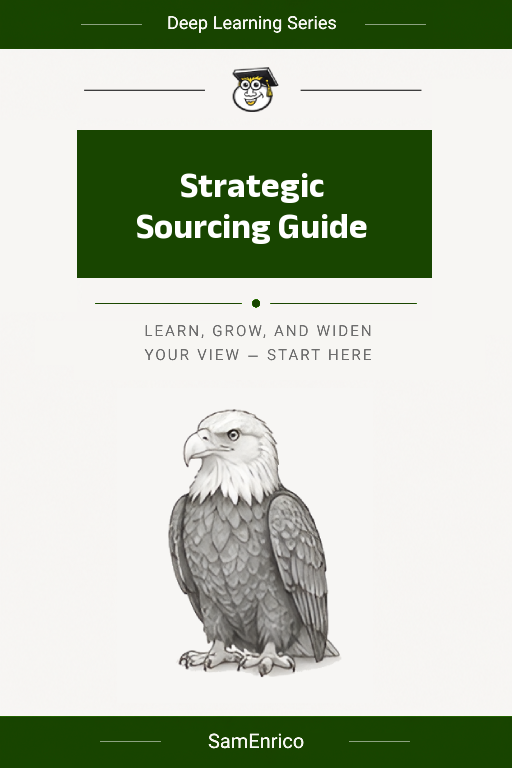
Reverse Auction Strategy Guide eBook
Conducts competitive online reverse auctions for h
Conducts competitive online reverse auctions for high-spend categories to drive price transparency and supplier competition.
Formats
Free sample
Chapter 1: The $40 Million Mistake--The email arrived at 9:47 AM on a Tuesday. Subject line: "Auction Results – Congratulations!" The body contained a single number: $4,287,000. That was the apparent savings from a thirty-minute reverse auction for raw materials. The procurement director forwarded it to her boss with a one-word message: "Done."Eighteen months later, that same procurement director sat in a windowless conference room across from three lawyers from the company's outside counsel. The auction had saved 4.3milliononpaper.Therealcost—aftersupplierbankruptcy,productionlineshutdowns,litigation,andemergencysourcingatspotprices—was4.3 million on paper.
The real cost—after supplier bankruptcy, production line shutdowns, litigation, and emergency sourcing at spot prices—was 4.3milliononpaper.Therealcost—aftersupplierbankruptcy,productionlineshutdowns,litigation,andemergencysourcingatspotprices—was44.8 million in the opposite direction. She had not saved money. She had lost forty million dollars.This is not a cautionary tale. It is the norm.Every year, organizations run thousands of reverse auctions. Most celebrate the headline savings number.
Fewer than one in ten ever audits whether those savings survived to the bottom line. And when they do audit, they discover what the procurement director in that conference room learned the hard way: reverse auctions do not fail because the technology is broken. They fail because the strategy is broken.This chapter is the autopsy of that failure. It will introduce you to the three hidden bodies buried inside most "successful" reverse auctions. It will show you why crushing the price is not the same as creating value.
And it will give you a diagnostic framework to determine whether your next auction is destined for celebration or for that same windowless conference room.But first, a confession. The story above is true. The numbers have been disguised, but the event happened. The procurement director still works in the industry. She still runs reverse auctions.
And she still has never told her CEO what really happened. She will read this book, and she will recognize herself. By the end of this chapter, you will know how to avoid becoming her.The Day the Savings Disappeared Let us reconstruct what actually happened in that auction, because the details matter more than the headline.The category was industrial fasteners—bolts, nuts, washers, and specialty threaded components used in heavy manufacturing. Annual spend: approximately $24 million. The incumbent supplier had held the contract for eleven years.
Their pricing had never been benchmarked. Their quality was acceptable. Their delivery was reliable. And they had raised prices by 4-6 percent annually for the past seven years, always citing "raw material volatility" and "transportation inflation."A new procurement director arrived and decided to run a reverse auction. She invited the incumbent and three challengers.
She wrote a specification that described the fasteners by size, material grade, and coating requirements. She set a thirty-minute auction with a soft close (auto-extension on late bids). She watched the screen as prices dropped 8 percent, then 12 percent, then 18 percent.When the clock stopped, a challenger had won. Price reduction: 18.2 percent. Annual savings: $4.37 million.
She celebrated.Here is what she did not know at the time. The winning supplier had never manufactured that specific grade of fastener before. They had capacity, but not capability. Their bid assumed a raw material price that had already increased by 11 percent the week after the auction. Their quality control systems had never been audited.
And their insurance policy excluded product liability for "critical application fasteners"—exactly the category she was buying.The first shipment arrived six weeks late. The second shipment failed quality inspection. The third shipment never arrived because the supplier's bank called in their line of credit—they had been bidding below cost on multiple contracts and had run out of cash. Meanwhile, the incumbent supplier had already reassigned their production capacity to other customers. They would take the buyer back, but at a 22 percent premium over the original price.The procurement director spent the next twelve months on a crisis sourcing project.
She bought fasteners on the spot market at prices 15-40 percent above the original incumbent pricing. She shut down production lines three times. She missed quarterly earnings by $0.08 per share, directly attributable to the fastener shortage. Her bonus was zero.The auction had saved 4.3milliononpaper.Theactualfinancialimpactwasalossof4.3 million on paper. The actual financial impact was a loss of 4.3milliononpaper.Theactualfinancialimpactwasalossof44.8 million.Why the Headline Number Lied The headline savings number—the difference between the incumbent's last price and the winner's bid—is almost always wrong.
It is wrong for three reasons, each of which will be explored in depth throughout this book. For now, understand the three lies that headline numbers tell.Lie Number One: The Price Is Not the Cost.The winning bid in that fastener auction was $4.3 million below the incumbent's pricing. But the winning supplier could not deliver. The cost of non-delivery—lost production, emergency sourcing, quality failures—far exceeded any possible savings. A lower price that destroys value is not a saving; it is a loss dressed in different clothing.Lie Number Two: The Incumbent's Price Was Not the Market Price.The incumbent had raised prices every year for seven years.
Their pricing was not competitive; it was a monopoly rent. Comparing the winning bid to an inflated incumbent price creates the illusion of savings that were never real. The true market price was probably much closer to the winning bid than to the incumbent's price. The "savings" were simply the elimination of an unjustified premium.Lie Number Three: The Savings Stopped the Day the Supplier Failed.Savings are only real if they persist. A supplier who bids below cost will eventually raise prices, reduce quality, or go bankrupt.
Savings that disappear in month six are not savings for the year. They are a short-term loan that must be repaid with interest.The fastener auction failed on all three counts. The price was not the cost. The incumbent's price was not the market. And the savings did not persist.
The headline number was a fiction from start to finish.The Buyer-versus-Supplier Trap To understand why these failures are so common, you must understand a psychological trap that affects even experienced procurement professionals. Call it the buyer-versus-supplier trap.When a buyer sits down to negotiate traditionally, they are in a relationship mindset. They talk to suppliers. They ask questions. They learn about constraints and opportunities.
They build enough trust to share information. The negotiation is adversarial, but it is also human.When that same buyer opens a reverse auction platform, something shifts. The screen anonymizes suppliers. The ticking clock creates urgency. The descending price creates a sense of momentum.
The buyer begins to feel like a game master, pulling levers and watching suppliers react. The suppliers become opponents. The auction becomes a contest to be won.This is not speculation. Neuroscience research on competitive bidding shows that the same brain regions activated during physical competition—the anterior cingulate cortex and the insula—activate during reverse auctions. Buyers experience a dopamine rush when prices drop.
They experience frustration when bidding stalls. They make decisions based on emotion and then rationalize them with logic.The buyer-versus-supplier trap has three specific consequences.Consequence One: Bid Shading. Suppliers learn that aggressive bidding triggers aggressive buyer behavior. So they shade their bids—bidding just enough to stay in the game…
This is the end of the free sample. Get the eBook to keep going. Buy now
About this book
Details
- Author
- Cates Marguerita
- Publisher
- SamEnrico
- Language
- English
- Genre
- Non-Fiction, Operational Efficiency Manual, Strategic Sourcing
- Released
- 2026-05-29
- Pages (approx.)
- 138
- Available as
- eBook, Audiobook

Read better in the ZLOADR app
Your eBooks on your phone or tablet. Sign in with your SamEnrico account and start reading.
More by Cates Marguerita
 The Emotional Anticipation GuideCates Marguerita$11.99
 Breath Awareness For Grief WavesCates Marguerita$11.99
 Depreciation for Solar AssetsCates Marguerita$11.99
 The EQ for New Fathers GuideCates Marguerita$11.99
 Scoliosis Body Acceptance GuideCates Marguerita$11.99
 The Devil’s Dice: How the Russian Mafia Took Over Europe’s CasinosCates Marguerita$11.99
 Understanding Mandibulofacial Dysostosis Deafness Postaxial PolydactylyCates Marguerita$17.99
 Strategy Meeting Culture BuildingCates Marguerita$12.99
 Medical EditorCates Marguerita$11.99
 How to Start a Pedicure Business (Beginners Guide)Cates Marguerita$11.99