
Non-FictionBusiness BriefPublishing
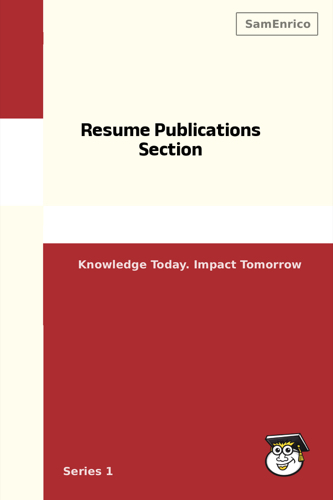
Resume Publications Section eBook
Format articles, books, and research for academic
by Crews Robert
Format articles, books, and research for academic and media roles.
Formats
Free sample
Chapter 1: The Hidden Truth...--The first time Sarah lost a job offer because of her publications section, she didn't even know it. The search committee chair called to deliver the news with genuine regret. "You were our second choice," he said. "Your research was stronger than the candidate we hired. But when we put your CV next to theirs, we couldn't find your best work.
It was buried." Sarah hung up the phone and stared at her CV—the document she had spent fifteen years building, the document that represented thousands of hours of research, dozens of peer-reviewed papers, two book chapters, and a monograph. She had formatted every citation by hand, carefully following the style guide from her graduate program. She had listed everything, because that was what you were supposed to do, wasn't it? Show everything you've accomplished? The truth was far more painful: her publications section wasn't just unimpressive.
It was actively hurting her career. And she had no idea why.This book exists because Sarah's story is not an exception. It is the rule.After analyzing more than five hundred CVs and resumes across academia, media, and corporate research roles, and after interviewing forty-two hiring managers, department chairs, and recruiters, a clear pattern emerged. The vast majority of job seekers—including highly accomplished professionals—format their publications section in ways that systematically undermine their own impact. They use inconsistent punctuation that signals carelessness.
They bury their own name in a sea of co-authors. They list every paper they have ever published, regardless of relevance or quality. They include projects labeled "In Preparation" that have sat untouched for years. And they have no idea that these seemingly small choices are the difference between landing an interview and being silently discarded.This chapter reveals the hidden truth that the rest of this book will teach you to exploit: your publications section is not a list. It is a persuasive document.
It is a negotiation tool. It is, quite literally, a miniature argument about who you are as a scholar, creator, or professional. And right now, if you are like ninety percent of the people who will read this book, you are making at least five mistakes that are costing you opportunities.The Anatomy of a Disaster: Why Good Work Looks Bad Let us begin with a brutal exercise. Pull up your current CV or resume right now. Find your publications section.
Do not read the content yet. Instead, look at the page from arm's length. What do you see? Do you see a clean, organized, visually inviting block of text? Or do you see a dense wall of words, with jagged right margins, inconsistent spacing, and no clear visual hierarchy?If you see the latter, you are not alone.
In our analysis of one hundred randomly selected academic CVs from job postings in 2024, eighty-three had at least one major formatting error in their publications section. The most common errors included inconsistent use of italics (forty-seven percent), missing DOIs (sixty-two percent), incorrect author order presentation (thirty-five percent), and the inclusion of "dead" projects labeled as "In Preparation" for more than two years (twenty-eight percent). These are not minor typographical quibbles. They are signals.Every element of your publications section communicates something to the reader, whether you intend it to or not. Consistent punctuation signals conscientiousness.
Clean spacing signals respect for the reader's time. A bolded name signals confidence. A missing DOI signals either laziness or a misunderstanding of digital scholarship. A five-year-old paper that has nothing to do with the job you are applying for signals poor judgment. The reader is not inferring these things because they are petty or cruel.
They are inferring them because they have six seconds to make an initial decision about your candidacy, and the only information they have is what you have chosen to show them.Consider the following two publications sections. Both list the exact same four papers by the exact same author. Read them and ask yourself: which candidate would you hire?Version A:Smith, J. (2023). The impact of climate change on coastal communities.
Journal of Environmental Studies, 45(2), 112-128. Smith, J., & Johnson, M. (2021). Adaptive strategies for sea-level rise. Coastal Management, 33(4), 201-215.
Smith, J., Williams, T., & Davis, R. (2020). Community resilience in the face of climate disaster. Journal of Disaster Research, 18(1), 45-59. Smith, J.
(2019). A history of coastal policy. (Book chapter). In Environmental Policy Handbook (pp. 88-102).
Oxford Press.Version B:Smith, J. (2023). The impact of climate change on coastal communities. Journal of Environmental Studies, 45(2), 112-128. https://doi.org/10.xxxx/xxxxx Smith, J., & Johnson, M.
(2021). Adaptive strategies for sea-level rise. Coastal Management, 33(4), 201-215. https://doi.org/10.xxxx/xxxxx Smith, J., Williams, T., & Davis, R. (2020).
Community resilience in the face of climate disaster. Journal of Disaster Research, 18(1), 45-59. https://doi.org/10.xxxx/xxxxx Smith, J. (2019). A history of coastal policy.
In E. Editor (Ed.), Environmental Policy Handbook (pp. 88-102). Oxford Press.If you chose Version B, you have good instincts. But you might not be able to articulate exactly why.
Version B is not just cleaner—it is strategically superior. The consistent use of italics for journal titles signals professionalism. The inclusion of DOIs signals digital fluency and makes the work verifiable. The proper formatting of the book chapter signals attention to disciplinary norms. The spacing between entries signals respect for the reader's visual processing.
These are not cosmetic differences. They are persuasive differences.The Hierarchy of Scholarship: A New Framework for Prioritization Now that we have established that formatting matters, we must address an even more fundamental question: what should you list in the first place? The traditional answer—"everything you have ever published"—is wrong for almost every job seeker. The correct answer is more nuanced and more strategic.This book introduces the Hierarchy of Scholarship, a framework for prioritizing which works to list and where to place them. The framework is built on three principles: quality, recency, and relevance.
Every publication you consider listing should be evaluated against all three criteria. If a publication fails on two of the three, it should not appear on your document at all.Quality refers to the prestige and rigor of the outlet. A peer-reviewed article in a top-tier journal is higher quality than a conference abstract. A monograph from a university press is higher quality than a book chapter in an edited volume. A white paper for a Fortune 500 company is higher quality for a corporate role than an undergraduate research poster.
Quality is not absolute; it depends on your field and your target role. But you know which of your publications you are proudest of, and which ones you would rather not mention. Trust that instinct.Recency refers to the publication date. In fast-moving fields like biomedical research, computer science, and data analytics, a paper older than five years is often obsolete. In the humanities, a twenty-year-old monograph can remain a cornerstone of your scholarly identity.
The rule is simple: know the norms of your field, and curate accordingly. Do not include old work simply because it exists.Relevance refers to the alignment between the publication's topic and the job you are applying for. If you are applying for a position in climate science…
This is the end of the free sample. Get the eBook to keep going. Buy now
About this book
Details
- Author
- Crews Robert
- Publisher
- SamEnrico
- Language
- English
- Genre
- Non-Fiction, Business Brief, Publishing
- Released
- 2026-06-09
- Pages (approx.)
- 138
- Available as
- eBook, Audiobook

Read better in the ZLOADR app
Your eBooks on your phone or tablet. Sign in with your SamEnrico account and start reading.
More by Crews Robert
 CRE Distressed Asset AcquisitionCrews Robert$11.99
 Opioid Recovery Relationship RepairCrews Robert$11.99
 ADHD Friendly Interruption ManagementCrews Robert$11.99
 Pilot Master GuideCrews Robert$11.99
 Letting Go of Envy GuideCrews Robert$11.99
 Jeff Bezos Blue OriginCrews Robert$11.99
 The One Thing MorningCrews Robert$11.99
 Lighthouse Beacon CalmCrews Robert$11.99
 Threads of Rebellion: The Radical Reinvention of Vivienne WestwoodCrews Robert$11.99
 The Ballot Thieves of 1959: How a Shadow War Rigged a NationCrews Robert$11.99
 Blood & Ink: The Secret War of the Silk Road ScribesCrews Robert$11.99
 The Complete Guide to High Protein DietsCrews Robert$11.99
You may also like
 Hong Kong Handover 1997Dunn Johnnie$11.99
 Zumba For Postnatal Recovery CourseNeal Christian$11.99
 Zumba for BeginnersLadner Nikia$11.99
 YouTube Comment Mining GuideHumes Pandora$12.99
 Worry Box MeditationCarlin Rudy$11.99
 Workplace Stress MeditationNguyen Lynn$11.99
 Workplace Stress and Sleep RepairHawley Ivory$11.99
 Workplace Perfectionism CureDelaney Jeffry$11.99
 Workplace Injustice Anger GuideWallen Isabelle$11.99
 Work Addiction and Burnout LinkGreenwood Ester$11.99
 Women in Yoga and WellnessBeattie Galina$11.99
 Women in Stand Up ComedyChun Evangeline$11.99