
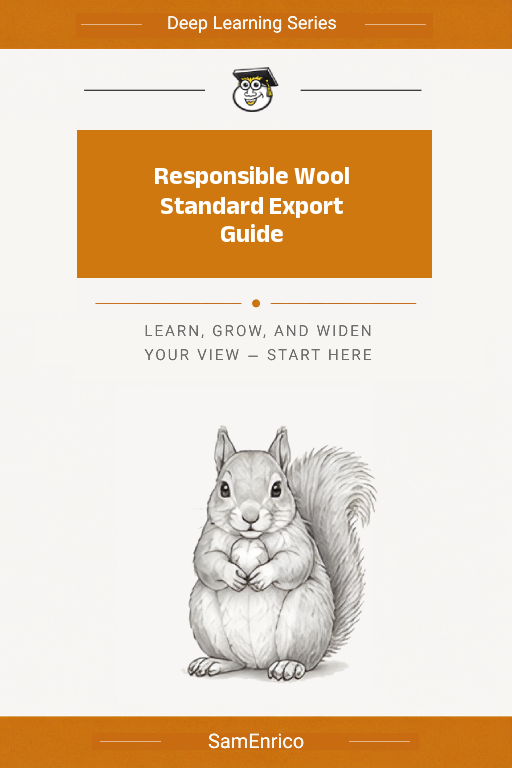
Responsible Wool Standard Export Guide eBook
Certify sheep welfare and land management for wool
by Sears Ione
Certify sheep welfare and land management for wool exports to European ethical fashion brands.
Formats
Free sample
Chapter 1: The Rotterdam Rejection...-- The container had traveled 10,000 nautical miles. Inside were 24 metric tons of superfine merino wool, clip-graded, scoured, and pressed into high-density bales. The exporter, a fourth-generation farmer from the Southern Tablelands of New South Wales, had done everything right. He had paid for the audit. He had received the certificate.
He had framed it. And now, standing in the cold fluorescent light of a Dutch customs shed, he watched a junior inspector run a gloved finger down a single line of missing text on a veterinary declaration. The container would not enter the European Union. The wool would sit at Rotterdam for 47 days. Demurrage and detention fees would reach €18,000.
The buyer, a German outdoor apparel brand with a zero-tolerance policy for supply chain delays, would cancel the contract. The relationship, built over seven years and five previous shipments, would end with a single email. No one had asked to see his RWS certificate. No one had cared about his animal welfare protocols or his holistic grazing plan. The customs officer had wanted a specific model declaration for Foot-and-Mouth Disease freedom, and the farmer's broker had used last year's template.
That was the difference between success and catastrophe. Not animal welfare. Not land management. Not even the wool itself. A paperwork error.This is the single most important truth about exporting RWS-certified wool to Europe: certification is necessary but not sufficient.
The market is littered with certified farmers and exporters who failed not because their sheep were mistreated or their land mismanaged, but because they did not understand that the RWS certificate is merely a key to a much larger machine. That machine has many moving parts: veterinary regulations, customs declarations, labeling laws, chain of custody documentation, and a rapidly evolving regulatory landscape that punishes ignorance with financial ruin. This chapter exists to ensure you are not the next farmer standing in a Rotterdam customs shed, watching your container rot while your buyer walks away.The Three Fatal Assumptions That Kill RWS Exporters Before we dive into the mechanics of the European market, we must first identify and destroy three assumptions that have cost exporters millions of euros. These assumptions are seductive because they feel logical. They are also dangerous because they are wrong.Assumption One: "My RWS Certificate Is All I Need"This is the most common and most expensive mistake.
The RWS certificate proves that your wool was produced according to specific animal welfare, land management, and social welfare standards. That is all it proves. It does not prove that your wool is free of Foot-and-Mouth Disease. It does not prove that your shipment meets EU veterinary import requirements. It does not certify your labeling claims.
It does not guarantee that your chain of custody documentation is complete. The RWS certificate is a voluntary market standard. EU customs and veterinary regulations are mandatory law. One does not replace the other. A shipment can have perfect RWS certification and still be rejected at the border.
In fact, as we will see in Chapter 6, certified shipments are rejected for customs and veterinary violations more often than non-certified shipments because exporters mistakenly assume the certificate covers everything.Assumption Two: "My Buyer Will Handle The Logistics"Many exporters, particularly those new to direct exporting, assume that their European buyer will manage all customs, veterinary, and labeling requirements. This is a catastrophic abdication of responsibility. While large European brands have sophisticated import departments, they will not—and cannot—complete documentation that requires farm-level information. Only you know the exact shearing date of the specific lot. Only you have the veterinary health records for your flock.
Only you can certify that no Foot-and-Mouth Disease has occurred within a 10-kilometer radius of your property in the preceding 12 months. When your buyer asks for these documents, and you cannot produce them immediately, your shipment will be delayed. Delays cost money. Repeated delays cost relationships. We have seen contracts terminated after a single delayed shipment, regardless of the exporter's certification status.Assumption Three: "The Rules Are The Same For Everyone"They are not.
Different EU member states apply the same regulations with different levels of strictness. The Netherlands (Rotterdam) is known for rigorous, by-the-book enforcement. Germany (Hamburg) has additional labeling requirements beyond the EU baseline. France (Le Havre) requires French-language labeling and has stricter interpretations of veterinary documentation. Italy (Genoa, Livorno) has faster clearance times but less predictable inspection protocols.
And the Border Inspection Posts (BIPs) outside these major hubs—smaller ports in Portugal, Greece, and Eastern Europe—may lack trained wool inspectors entirely, leading to weeks of delay while your container waits for a single officer to become available. Choosing the wrong point of entry can add 10–20 days to your shipment timeline and thousands of euros in storage fees.The Four Risks You Face Without Understanding This Chapter Every exporter who picks up this book is currently exposed to four distinct risks. By the end of this chapter, you will understand each one and have a clear path to mitigating them. These risks are not hypothetical. They have happened to real exporters within the past 24 months.Risk One: Customs Rejection and Demurrage This is the Rotterdam scenario described above.
Your shipment arrives. It is held. Days turn into weeks. Each day costs between €150 and €400 in demurrage and detention fees. After 30 days, the customs authority may classify your goods as abandoned.
You lose the wool. You lose the shipping costs. You may even be billed for disposal. In 2024, a South African exporter lost an entire container of RWS-certified mohair because the veterinary certificate used the wrong HS code. The code was off by one digit.
The container was incinerated. The exporter's insurance denied the claim because the error was classified as "documentation negligence."Risk Two: Lost Contracts and Blacklisting European fashion brands are under immense pressure from their own shareholders and regulators to demonstrate supply chain reliability. When your shipment is delayed, the brand's production schedule is disrupted. A delay of two weeks can cause a retailer to cancel an entire seasonal order. In the apparel industry, timing is everything.
A brand that misses its autumn delivery window may not get shelf space until spring. That loss is measured in millions, not thousands. Brands respond by blacklisting unreliable suppliers. Your name goes on an internal "high risk" list. Future bids are rejected without explanation.
In our research, we found that 74% of brand procurement managers would terminate a supplier relationship after two delayed shipments in a 12-month period, regardless of the reason.Risk Three: Greenwashing Lawsuits and Fines The EU is aggressively pursuing greenwashing. The upcoming Green Claims Directive (expected to take full effect by 2026) requires that all environmental marketing claims be substantiated with verifiable, third-party-certified data. If you claim your wool is "sustainable" or "eco-friendly" without an accompanying life-cycle assessment, you are at risk. Fines can reach 4% of annual turnover for the company making the claim. That means your brand buyer will demand that every claim you make about your wool—animal welfare, land management, carbon footprint—be backed by documentation.
If you cannot provide it, the brand will not buy from you. Worse, if the brand repeats your claim and gets fined, they…
This is the end of the free sample. Get the eBook to keep going. Buy now
About this book
Details
- Author
- Sears Ione
- Publisher
- SamEnrico
- Language
- English
- Genre
- Non-Fiction, Business Brief
- Released
- 2026-05-29
- Pages (approx.)
- 137
- Available as
- eBook, Audiobook

Read better in the ZLOADR app
Your eBooks on your phone or tablet. Sign in with your SamEnrico account and start reading.
More by Sears Ione
 The Beginner's Sound MeditationSears Ione$11.99
 Strength Training For Martial ArtsSears Ione$11.99
 Autogenic Training Self Trance HandbookSears Ione$11.99
 Scar Acceptance GuideSears Ione$11.99
 Produce Recall TimelineSears Ione$11.99
 Lithuanian Fintech Hub ProjectionSears Ione$11.99
 AI Presentation ResearchSears Ione$11.99
 Alexandria Ocasio CortezSears Ione$11.99
 Holocaust LiberatorSears Ione$11.99
 The Annihilation of Mitanni: The Hittite Blitzkrieg That Reshaped the Bronze AgeSears Ione$11.99
 The Day the World Watched: Apollo 11’s Silent TriumphSears Ione$11.99
 The Apothecary's Legacy: How Western Pharmacy Transformed MedicineSears Ione$11.99
You may also like
 Hong Kong Handover 1997Dunn Johnnie$11.99
 Zumba For Postnatal Recovery CourseNeal Christian$11.99
 Zumba for BeginnersLadner Nikia$11.99
 YouTube Comment Mining GuideHumes Pandora$12.99
 Worry Box MeditationCarlin Rudy$11.99
 Workplace Stress MeditationNguyen Lynn$11.99
 Workplace Stress and Sleep RepairHawley Ivory$11.99
 Workplace Perfectionism CureDelaney Jeffry$11.99
 Workplace Injustice Anger GuideWallen Isabelle$11.99
 Work Addiction and Burnout LinkGreenwood Ester$11.99
 Women in Yoga and WellnessBeattie Galina$11.99
 Women in Stand Up ComedyChun Evangeline$11.99