
Non-FictionSelf-HelpVerbal Defense
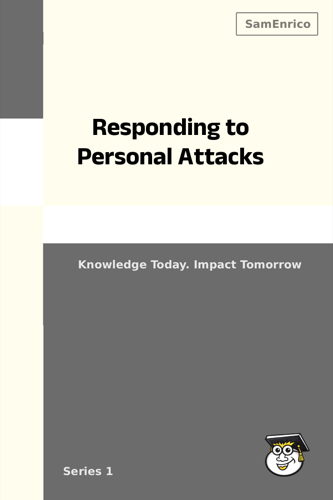
Responding to Personal Attacks eBook
Stays professional when the other person becomes i
Stays professional when the other person becomes insulting.
Formats
Free sample
Chapter 1: The Recognition Problem--Most professionals fail to respond effectively to personal attacks not because they lack courage, intelligence, or emotional strength, but because they fail to recognize an attack as an attack in the moment they need to recognize it. The human brain is wired to process language for meaning first and intent second. You hear the words. You process the grammar. You understand the sentence.
And only then, sometimes seconds later, sometimes hours later, do you realize that you were just insulted. By then, the moment for a response has passed. You said something defensive, or nothing at all. Later that night, replaying the conversation in bed, you think of the perfect comeback. It arrives three hours too late.This chapter exists to close that gap.
By the time you finish reading these pages, you will never again wonder whether you were just attacked. You will know. You will know in the first second, not the third hour. And knowing is the difference between reacting like a victim and responding like a professional.The Anatomy of a Verbal Attack Let us begin with a definition. A verbal attack is any communication intended to diminish, destabilize, or discredit you through language.
Note the word intended. This is crucial. Not every critical comment is an attack. Not every piece of negative feedback is an insult. Your colleague who says "Your numbers were off in the report" may simply be stating a fact.
Your boss who says "I need you to improve your presentation skills" may be doing their job. The distinction between feedback and attack lies not in the words themselves but in the intent behind them and the pattern in which they are delivered.A genuine attack has three signature characteristics. First, it targets you as a person rather than your work or behavior. "This report contains errors" is feedback. "You are careless" is an attack.
The first addresses the product. The second indicts the character. Second, an attack escalates rather than clarifies. Feedback invites dialogue. An attack invites defensiveness.
When you try to clarify an attack—"What specifically do you mean by careless?"—the attacker typically doubles down or becomes vaguer. Third, an attack leaves you feeling smaller after the interaction than before. This is not accidental. That feeling of diminishment is the entire point.One of the most damaging myths in professional culture is the belief that attacks are always obvious. They are not.
Most attacks are subtle, deniable, and designed to look like something else. The attacker wants to wound you without being held accountable for the wounding. This is why so many professionals walk away from conversations feeling terrible but unable to articulate why. They know something happened. They cannot name it.
Without a name, they cannot respond. This chapter gives you the names.The Eight Patterns of Attack Drawing on the linguistic analysis of Suzette Haden Elgin and decades of research in verbal self-defense, we can identify eight distinct patterns of personal attack. Each pattern has its own signature, its own psychological mechanism, and its own vulnerability. Learning these patterns is like learning the grip breaks in jiu-jitsu. Once you know what they are trying to do, you know where to place your hands.Pattern One: The Blamer The Blamer attacks through direct accusation.
"This is your fault." "You ruined this project." "You never listen." The Blamer's signature is certainty without evidence. They do not say "I think" or "It seems." They state their accusations as facts. The psychological mechanism of the Blamer is projection. They feel inadequate, ashamed, or afraid, but they cannot tolerate those feelings in themselves. So they export them to you.
When the Blamer says "You are incompetent," what they really mean is "I feel incompetent, and I need you to feel it instead."The Blamer's vulnerability is specificity. Blamers thrive on vague, global accusations. When forced to get specific, their accusations often collapse. "You ruined this project" becomes, when pressed, "Well, you were late with one email." The gap between the global accusation and the specific evidence reveals the attack for what it is.Pattern Two: The Distracter The Distracter attacks by changing the subject. You are discussing your report.
They bring up your lateness three months ago. You address the lateness. They bring up your tone in a meeting last week. Every time you get close to a resolution, they introduce a new topic, a new grievance, a new irrelevancy. The Distracter's signature is conversational whiplash.
You cannot keep up because they do not want you to keep up.The psychological mechanism of the Distracter is avoidance. There is something they do not want to discuss—usually their own behavior or responsibility. The only way to avoid that discussion is to keep the conversation moving so fast that nothing can land. The Distracter's vulnerability is focus. When you refuse to chase their distractions and repeatedly return to the original topic, their strategy falls apart.
They cannot avoid forever if you refuse to follow.Pattern Three: The Brutalist The Brutalist attacks through weaponized honesty. "I'm just being direct." "Someone had to say it." "I'm not here to make friends." The Brutalist's signature is cruelty wrapped in the language of virtue. They position themselves as brave truth-tellers, which makes you look fragile if you object. The psychological mechanism of the Brutalist is moral licensing. By framing their attack as honesty, they grant themselves permission to be cruel while feeling righteous.The Brutalist's vulnerability is the distinction between honesty and kindness.
Honest feedback can be delivered kindly. The Brutalist chooses cruelty not because honesty requires it but because cruelty is the point. When you name this distinction—"You can be direct without being cruel"—the Brutalist loses their moral cover. They can either soften or reveal themselves as someone who chooses cruelty.Pattern Four: The Victim The Victim attacks by claiming you have hurt them. "I can't believe you would say that to me." "After everything I've done for you." "You're so mean to me." The Victim's signature is the reversal of perpetrator and victim.
They attacked you first, but somehow you are the one apologizing. The psychological mechanism of the Victim is emotional blackmail. They leverage your empathy and your desire to be seen as a good person to extract concessions or silence.The Victim's vulnerability is the timeline. Who attacked first? What happened before their tears?
When you calmly reconstruct the sequence of events, the Victim's narrative often falls apart. They are crying about your response to their attack, not about the attack itself.Pattern Five: The Joker The Joker attacks through insults disguised as humor. "I'm just kidding, relax." "Can't you take a joke?" "You're so sensitive." The Joker's signature is the punchline that lands like a slap. You feel the sting, but when you object, you are accused of having no sense of humor. The psychological mechanism of the Joker is plausible deniability.
They can insult you freely because they can always claim they were joking.The Joker's vulnerability is the invitation to explain the joke. "I don't get it. Can you explain why that's funny?" A real joke can be explained. A disguised attack cannot. When you ask…
This is the end of the free sample. Get the eBook to keep going. Buy now
About this book
Details
- Author
- Goodwin Natasha
- Publisher
- SamEnrico
- Language
- English
- Genre
- Non-Fiction, Self-Help, Verbal Defense
- Released
- 2026-06-08
- Pages (approx.)
- 146
- Available as
- eBook, Audiobook

Read better in the ZLOADR app
Your eBooks on your phone or tablet. Sign in with your SamEnrico account and start reading.
More by Goodwin Natasha
 Francis and the Perfection of JoyGoodwin Natasha$11.99
 Resentment in FamiliesGoodwin Natasha$11.99
 Catherine Succession Plan FailureGoodwin Natasha$11.99
 NVC for ESL LearnersGoodwin Natasha$11.99
 IBS Acupuncture Relief GuideGoodwin Natasha$11.99
 Aggressive Driving CourseGoodwin Natasha$11.99
 Prebiotic Fiber GuideGoodwin Natasha$11.99
 The Ransom of Madrid: Cyberwar in the Shadows of the Spanish Civil WarGoodwin Natasha$11.99
 Love at First Serve: The Unlikely Tennis Romance That Defied the 18th CenturyGoodwin Natasha$11.99
 How to Produce Interior LaTeX Flat PaintGoodwin Natasha$11.99
 A Collector's Handbook to the Humber SnipeGoodwin Natasha$11.99
 Service Providers Guide to Primary CareGoodwin Natasha$11.99
You may also like
 Hong Kong Handover 1997Dunn Johnnie$11.99
 Zumba For Postnatal Recovery CourseNeal Christian$11.99
 Zumba for BeginnersLadner Nikia$11.99
 YouTube Comment Mining GuideHumes Pandora$12.99
 Worry Box MeditationCarlin Rudy$11.99
 Workplace Stress MeditationNguyen Lynn$11.99
 Workplace Stress and Sleep RepairHawley Ivory$11.99
 Workplace Perfectionism CureDelaney Jeffry$11.99
 Workplace Injustice Anger GuideWallen Isabelle$11.99
 Work Addiction and Burnout LinkGreenwood Ester$11.99
 Women in Yoga and WellnessBeattie Galina$11.99
 Women in Stand Up ComedyChun Evangeline$11.99