
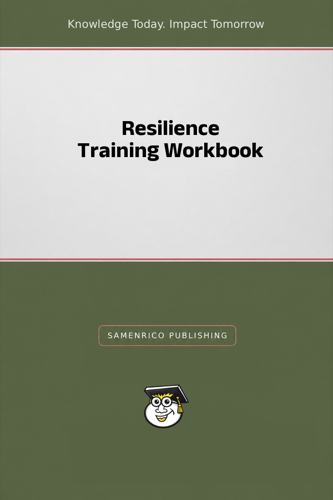
Non-FictionSelf-HelpResilience
Resilience Training Workbook eBook
Bounce back from setbacks stronger using this prac
Bounce back from setbacks stronger using this practical psychology guide for everyday challenges.
Formats
Free sample
Chapter 1: The Setback Myth--–- You have been lied to about resilience. Not by malicious forces, but by a culture that celebrates the wrong kind of strength. The lie sounds noble: "Tough it out," "grin and bear it," "what doesn't kill you makes you stronger." These phrases are printed on inspirational posters, repeated by well-meaning coaches, and etched into the common sense of everyday life. They are also, by the evidence of psychology and neuroscience, mostly wrong. The belief that resilience means stoic endurance—pushing through pain without flinching, returning to exactly who you were before—has left millions of people burned out, ashamed of their normal emotional responses, and convinced that something is broken inside them when in fact nothing is.
This chapter dismantles that myth and replaces it with a working definition of resilience that will serve as the foundation for everything that follows. You will learn the critical difference between mere recovery and post-traumatic growth. You will take a diagnostic assessment that reveals your unique resilience profile across seven core domains. And you will begin the process of rewriting the stories you tell yourself about setbacks—not with toxic positivity, but with a flexible, evidence-based lens that distinguishes between what is temporary and what is permanent, what is specific and what is pervasive, and crucially, what you should blame on circumstances versus what you can control through action.The Cultural Lie About "Bouncing Back"Walk into any bookstore or scroll through any self-help section of a podcast app, and you will encounter a staggering consensus: resilience is the ability to withstand adversity without breaking. The metaphor is almost always mechanical—a steel beam, a bridge cable, a fortress wall.
The implication is clear: strong things do not bend. Strong things do not change. They resist. And when they are tested, they return to their original shape as if nothing happened.This metaphor is catastrophically wrong for human beings.Human beings are not steel beams. We are biological organisms with nervous systems that learn, memories that encode, and meaning-making machinery that cannot help but interpret every event.
When a steel beam is stressed and then released, it returns to its exact prior state. When a human being is stressed—fired from a job, rejected by a partner, diagnosed with an illness—they do not return to their prior state. They are changed. The question is not whether they will change, but in what direction. The research on post-traumatic growth, pioneered by psychologists Richard Tedeschi and Lawrence Calhoun, shows that a significant percentage of people who experience major adversity report not just recovery but improvement.
They develop deeper relationships, greater appreciation for life, clearer sense of personal strength, expanded possibilities for their future, and spiritual or existential development.But here is what the inspirational posters never tell you: post-traumatic growth does not come from "toughing it out." It comes from the opposite. It comes from acknowledging pain, naming it, integrating it into a coherent life story, and actively constructing meaning from the wreckage. The steel beam metaphor is not just inaccurate—it is harmful. It teaches people that their pain is a failure of toughness rather than a signal for attention. It shames normal emotional responses.
And it sets up an impossible standard: return to exactly who you were before, as if trauma leaves no trace.This book operates from a different premise. Resilience is not the absence of change. Resilience is the capacity to direct the direction of change. You will be changed by setbacks. That is inevitable.
The question is whether you will be changed in ways that leave you smaller, more fearful, and more brittle—or larger, wiser, and more flexible. The chapters ahead will teach you the specific skills that separate these two trajectories.Recovery Versus Post-Traumatic Growth Let us draw a distinction that will appear throughout this workbook. Recovery means returning to your baseline level of functioning after a setback. You lose your job, you feel terrible for three months, and then gradually you feel as okay as you did before. This is not nothing.
Recovery is real, it is valuable, and for many people it is the best possible outcome in the short term. But recovery is not the ceiling of human resilience. It is the floor.Post-traumatic growth, or PTG, means emerging from adversity with measurable improvements in at least one domain of your life. People who experience PTG do not just feel "okay again." They feel different. They report statements like: "I have a greater appreciation for the value of my own life." "I established new paths for my life that I would not have considered before." "I have more compassion for others who suffer." "I feel stronger than I realized I was." "My spiritual or philosophical beliefs deepened."PTG is not the same as being grateful for trauma.
No one should be grateful for being fired, betrayed, or diagnosed with a serious illness. PTG is not about minimizing or romanticizing suffering. It is about recognizing that human beings have a remarkable capacity to extract meaning from difficulty—and that meaning-making is a skill, not a lucky accident. Some people do it automatically. Most do not.
But everyone can learn it.Throughout this workbook, you will be asked not just to recover from setbacks but to ask a second question: What can I learn? What can I become? That second question is the engine of PTG. It does not erase the pain of the first question. It adds a layer of possibility that makes the pain bearable.The 7 Cs of Resilience: Your Diagnostic Framework Before you can train resilience, you need to know where you are starting from.
The 7 Cs model, developed through decades of research in developmental psychology and positive psychology, provides a comprehensive map of the resilience landscape. Each C represents a domain of capacity. Most people are strong in some Cs and weak in others. The goal is not to become perfect in all seven. The goal is to identify your gaps and deliberately strengthen them.Competence is the ability to handle situations effectively.
It is the skill set you bring to a challenge. When you are competent, you know what to do and you know that you know. Competence is built through practice, feedback, and incremental mastery.Confidence is the belief in your ability to succeed. It is not the same as competence. You can be highly competent but lack confidence (impostor syndrome).
You can be overconfident but lack competence (the Dunning-Kruger effect). Resilience requires the sweet spot: realistic confidence grounded in actual skill.Connection is the quality of your relationships and your willingness to seek and offer support. This is the most underrated C. Individualistic cultures celebrate the lone hero, but the research is unambiguous: people with strong social networks recover faster from every type of adversity, from heart attacks to job loss to grief. Connection is not weakness.
It is the single best predictor of resilience.Character is your moral compass—your sense of what matters, what is right, and who you want to be. Setbacks test character not by erasing it but by revealing it. People with clear, articulated values are less likely to be derailed…
This is the end of the free sample. Get the eBook to keep going. Buy now
About this book
Details
- Author
- Wentworth Theresia
- Publisher
- SamEnrico
- Language
- English
- Genre
- Non-Fiction, Self-Help, Resilience
- Released
- 2026-06-08
- Pages (approx.)
- 131
- Available as
- eBook, Audiobook

Read better in the ZLOADR app
Your eBooks on your phone or tablet. Sign in with your SamEnrico account and start reading.
More by Wentworth Theresia
 Fiverr Negative Review ResponseWentworth Theresia$11.99
 The Clockwatching InductionWentworth Theresia$11.99
 Nightmare Processing For New ParentsWentworth Theresia$11.99
 Post Explosion ReflectionWentworth Theresia$11.99
 NamUs Cold Case Detective TrainingWentworth Theresia$11.99
 Trying To ConceiveWentworth Theresia$11.99
 Public Speaking for ManagersWentworth Theresia$11.99
 The Golden Thread: Hypatia and the Library of AlexandriaWentworth Theresia$11.99
 Iron and Ice: The Teutonic Knights' Baltic CrusadeWentworth Theresia$11.99
 A Beginners Guide to Harpastum (Volume 1)Wentworth Theresia$11.99
 How to Produce NozzlesWentworth Theresia$11.99
 Turkish Tuition Fees GuideWentworth Theresia$12.99
You may also like
 Hong Kong Handover 1997Dunn Johnnie$11.99
 Zumba For Postnatal Recovery CourseNeal Christian$11.99
 Zumba for BeginnersLadner Nikia$11.99
 YouTube Comment Mining GuideHumes Pandora$12.99
 Worry Box MeditationCarlin Rudy$11.99
 Workplace Stress MeditationNguyen Lynn$11.99
 Workplace Stress and Sleep RepairHawley Ivory$11.99
 Workplace Perfectionism CureDelaney Jeffry$11.99
 Workplace Injustice Anger GuideWallen Isabelle$11.99
 Work Addiction and Burnout LinkGreenwood Ester$11.99
 Women in Yoga and WellnessBeattie Galina$11.99
 Women in Stand Up ComedyChun Evangeline$11.99