
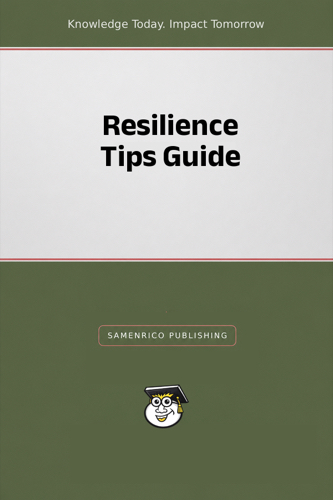
Free sample
Chapter 1: The Unlearned Strength--–- Imagine, for a moment, that you are holding a heavy barbell. Your muscles tremble. Your breath shortens. Every fiber of your being wants to drop it and walk away. But you don't.
You hold. You push. You complete the set. The next day, you do it again. And again.
Over weeks and months, what was impossibly heavy becomes manageable. What broke you before now barely registers.No one looks at the person who can deadlift twice their body weight and says, "They were just born with that." We understand, intuitively, that strength is built through repeated stress, recovery, and adaptation. We call this process training.Yet when we look at someone who can weather a financial collapse without panicking, who can receive devastating medical news without disintegrating, who can lose a loved one and eventually find their way back to joy—when we see these forms of strength, we say something very different. We say, "They are naturally resilient." We say, "They have something I don't."This chapter exists to correct that error. Resilience is not a gift bestowed upon a lucky few.
It is a learnable, trainable, buildable set of skills. And like any skill worth having, it follows predictable principles that anyone—absolutely anyone—can master with the right instruction and deliberate practice.The Most Expensive Lie You Have Been Told Let me be direct: the belief that resilience is an innate personality trait has done more damage to more people than almost any other psychological myth. It has convinced millions that their struggles are evidence of fundamental defect rather than normal response. It has silenced countless voices that might have asked for help, because asking for help would mean admitting inadequacy. It has turned the natural human response to adversity—pain, confusion, fear, grief—into a character flaw.The research could not be clearer.
Across dozens of longitudinal studies, meta-analyses, and intervention trials, the evidence converges on a single conclusion: resilience is predicted not by fixed traits but by specific, teachable skills and environmental conditions.Consider the landmark Kauai Longitudinal Study, which followed 698 children from birth to middle age. Two-thirds of these children grew up in stable, low-risk environments. One-third experienced four or more significant risk factors by age two: poverty, maternal mental illness, family instability, parental substance abuse, and more.Among that high-risk group, the outcomes were not uniform. One-third developed serious behavioral and learning problems by age ten. One-third developed into competent but cautious adults—capable but constrained.
And one-third grew into remarkably successful, confident, caring adults who built stable careers, healthy relationships, and meaningful lives.What distinguished the resilient third from the struggling third? Not IQ. Not temperament. Not some mysterious "resilience gene." The researchers identified a short list of protective factors: the presence of at least one stable, supportive relationship with an adult; the development of basic problem-solving skills; a sense of self-efficacy and internal control; and the ability to find meaning in difficulty.Every single one of these factors can be taught. Every single one can be strengthened through practice.
Every single one is accessible to anyone willing to do the work.The Three Pillars of Trainable Resilience Over the past four decades, researchers across developmental psychology, neuroscience, organizational behavior, and trauma studies have converged on a model of resilience that looks very different from the "born that way" myth. This book organizes that research into three interconnected pillars. Think of them not as a checklist to complete but as a tripod: all three are necessary, and if any one is weak, the entire structure wobbles.Pillar One: The Resilient Mindset The first pillar concerns how you interpret events. Between every adversity and your response lies a crucial step—your interpretation. Two people can experience the identical setback and have radically different responses based entirely on how they explain what happened and what it means.This is not positive thinking.
It is not about slapping a smile on suffering. It is about developing the ability to see reality clearly—including its painful dimensions—while also maintaining enough hope and agency to take constructive action. The research on "explanatory style" shows that people who habitually explain bad events as temporary, specific, and external to their core identity are far more resilient than those who explain bad events as permanent, pervasive, and personal.We will spend Chapters 2, 3, and 4 building this pillar from the ground up. You will learn to catch automatic negative thoughts before they spiral, to challenge the assumptions that drive your emotional reactions, and to develop what researchers call "cognitive flexibility"—the ability to shift perspectives as circumstances demand.Pillar Two: The Regulated Body The second pillar is the one most resilience books ignore, and that omission has cost readers dearly. You cannot think your way out of a flooded stress response system.
Your brain is not a disembodied computer. It is a biological organ housed in a biological body, dependent on sleep, nutrition, movement, and physiological regulation.Chronic stress elevates cortisol, disrupts sleep architecture, increases systemic inflammation, and impairs the function of your prefrontal cortex—exactly the part of your brain you need most for flexible thinking and emotional regulation. Trying to build resilience while neglecting your body is like trying to build a house on a foundation of sand.This pillar includes evidence-based protocols for sleep hygiene, stress-moderating nutrition, movement as a regulation tool, and specific physiological techniques—breathing, grounding, mindfulness—that directly influence your nervous system. These are not optional add-ons. They are core components of resilience.
Chapter 5 is devoted entirely to this pillar.Pillar Three: The Connected Self The third pillar contradicts every Western myth of the lone hero. The evidence is overwhelming: resilient people are not rugged individualists who need no one. They are people embedded in networks of supportive relationships. They ask for help. They offer help.
They belong.The Harvard Study of Adult Development, which has followed hundreds of men for nearly a century, found that the single strongest predictor of late-life happiness and health was not cholesterol levels, not exercise habits, not career success. It was the quality of a person's close relationships. People who were most connected to others lived longer, stayed healthier, and weathered crises better than those who were isolated.This does not mean you need a hundred friends or a perfect family. It means you need a small number of relationships characterized by trust, mutual support, and the ability to be vulnerable without fear of judgment. Chapter 6 is dedicated to building and maintaining these relationships.The Five Levels of Resilience Mastery The Three Pillars are the foundation, but resilience is not just about surviving.
It is about growing. It is about moving through levels of capability, from basic stability to the remarkable capacity to find opportunity in chaos.Level One: Physical Health Before you can think flexibly, regulate emotions, or reach out to others, you need a body that is not in constant crisis mode. This level includes sleep, nutrition, movement, and physiological regulation. Without these, nothing else works reliably. This corresponds to Pillar Two.Level Two: Problem-Solving Skills Once your body is stable, you need the practical ability to analyze problems, generate solutions, and take action.…
This is the end of the free sample. Get the eBook to keep going. Buy now
About this book
Details
- Author
- Avalos Lovella
- Publisher
- SamEnrico
- Language
- English
- Genre
- Non-Fiction, Self-Help / Tips
- Released
- 2026-06-08
- Pages (approx.)
- 133
- Available as
- eBook, Audiobook

Read better in the ZLOADR app
Your eBooks on your phone or tablet. Sign in with your SamEnrico account and start reading.
More by Avalos Lovella
 Social Media Detox for ComparersAvalos Lovella$11.99
 The Foster Child Worth RecoveryAvalos Lovella$11.99
 Side Hustle Social PressureAvalos Lovella$11.99
 Gambling Family Intervention GuideAvalos Lovella$11.99
 Vaccine Contraindications GuideAvalos Lovella$11.99
 Teen Skills Inventory GuideAvalos Lovella$11.99
 Molar Pregnancy UnderstandingAvalos Lovella$11.99
 Imposter Syndrome For AthletesAvalos Lovella$11.99
 Galileo's Revolution: Eyes to the StarsAvalos Lovella$11.99
 The Lost Rivers of the Andes: Medieval Explorers and the Underground WorldAvalos Lovella$11.99
 Silicon Shadows: The Infamous HP Printer ScandalAvalos Lovella$11.99
 Growing SollyaAvalos Lovella$11.99
You may also like
 Scripting TipsGass Lynnette$11.99
 Difficult Conversation TipsButts Antonetta$11.99
 Pattern Recognition TipsMatos Melonie$11.99
 Parent Time Tips GuideHardesty Asuncion$11.99
 Nightmare Tips GuideGates Rossana$11.99
 Anticipatory Grief TipsHamilton Kristy$11.99
 Remote Work Tips GuideGlory Sharkey$11.99
 Memory Palace TipsCambell Julianna$11.99Memory Palace TipsCambell Julianna$11.99
 Pain Meditation TipsLiles Hassie$11.99
 Interruption Tips GuideTobin Hobert$11.99
 Habit Tips GuideLister Lekisha$11.99