
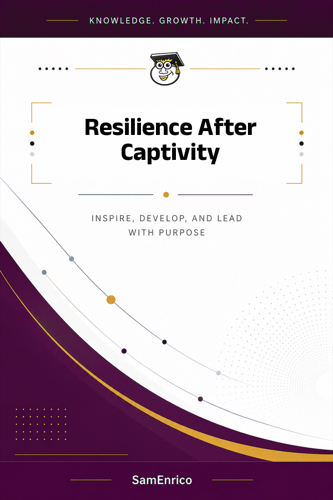
Non-FictionBiographyResilience
Resilience After Captivity eBook
Building new life after hostage ordeal.
by Toler Elna
Building new life after hostage ordeal.
Formats
Free sample
Chapter 1: The Door That Didn't Close--The first morning you wake up free, you will expect to feel joy. You will expect the sunlight to feel warmer, the coffee to taste sweeter, the silence of your own bedroom to feel like a sanctuary. You have imagined this moment for months, perhaps years. In the cell, in the jungle, in the room where they kept you, you played this scene over and over: the door opens, you walk out, and the world rushes back in—bright, safe, yours.Then the door actually opens. And nothing feels the way you thought it would.This chapter is about that door.
Not the one your captor controlled—the one you have now, in your own home, that you can lock or leave as you please. The door that should, by every logic, feel like freedom. Instead, for most hostages, it feels like a threshold you cannot quite cross. You are out. But you are not back.
And the gap between those two states—out but not back—is where the first days of freedom become a second ordeal.We call this the Reverse Homecoming. It is the single most disorienting experience of early release, and almost no one warns you about it.The Paradox That No One Warns You About Let us begin with a truth that sounds like a contradiction: the first days of freedom often feel worse than the last days of captivity.If you are reading this and you have not yet been released, or you are a family member preparing for a loved one's return, this will sound absurd. How could freedom feel worse than chains? How could your own bed feel more dangerous than a concrete floor?But if you have already come home, you know exactly what this means. You remember standing in your own kitchen, surrounded by people who love you, and feeling absolutely nothing.
Or feeling rage. Or feeling an urgent need to escape—from the very place you fought to return to.This is not ingratitude. It is not brokenness. It is neurobiology.The Expectation Gap Every hostage survivor carries a fantasy of return. The specific details vary—a particular meal, a particular embrace, a particular room—but the emotional shape is the same: relief, joy, safety, closure.
You have rehearsed this fantasy hundreds of times. In the dark, when the fear was loudest, you held onto the image of walking through your front door and finally, finally, being able to exhale.The problem is not the fantasy. The problem is what happens when reality does not match it.Families, too, carry fantasies. They have imagined your return as a healing moment—the missing piece sliding back into place, the family whole again. The media, if your case was public, has also constructed a narrative: the heroic survivor, the tearful reunion, the triumphant return to normal life.None of these fantasies account for what actually happens when a traumatized nervous system meets a chaotic, loud, demanding, well-intentioned homecoming.We call the gap between what you expected and what you feel the Expectation Gap.
The wider that gap, the more suffering it produces. And for hostage survivors, the gap is a chasm.The Myth of the Red Carpet Let me name something directly: the worst thing you can do for a newly released hostage is throw a party.This sounds cruel. It sounds counterintuitive. But the evidence from decades of hostage debriefings is unanimous. The "red carpet"—the balloons, the extended family, the news cameras, the endless stream of visitors, the repeated requests to "tell us what happened"—creates a predictable cascade of harm.First, it overwhelms a nervous system that has been calibrated for hypervigilance.
After months or years of scanning for threat, your brain cannot simply switch off because someone hung a banner. The same survival systems that kept you alive in captivity now interpret a crowded living room as a threat. Too many voices, too many bodies, too many unpredictable movements—your brain says "danger" even when your mind says "home."Second, the red carpet demands performance. You are expected to be grateful, coherent, emotionally available, and "recovered enough" to reassure everyone around you. This performance is exhausting.
It also prevents the one thing your brain actually needs: quiet, low-stimulation, low-demand rest.Third, the red carpet steals the narrative. The moment you walk through the door, other people begin telling your story for you—how brave you are, how lucky you are, how wonderful it is that you are back. Their version may not match your internal experience. But in the chaos of a homecoming, there is no space to say, "Actually, I don't feel lucky. I feel hollow."The practical takeaway is simple, though it may feel impossible to enforce: the first 72 hours after release should be boring.
Low stimulation. No parties. No interviews. No extended family camped out in your living room. One designated listener—one person only—who fields all questions, manages all communication, and shields you from the world while you do the invisible work of landing.Survival Brain Hangover The core concept of this chapter is what we call Survival Brain Hangover.
It is the neurobiological fact that the systems which kept you alive in captivity do not automatically power down upon release.Let me explain what is happening inside your skull.During captivity, your brain's threat-detection system—the amygdala and its connected networks—operated at maximum capacity, 24 hours a day. This system is designed for short-term crises: a predator, a fight, a fall. It is not designed to run for months or years. But under sustained captivity, it has no choice. Your survival depended on constant vigilance.The amygdala does not know that the door is now unlocked.
It only knows patterns. And the pattern it has learned is that threat is continuous and unpredictable. So when you walk into a quiet living room, your amygdala is still scanning for the guard, the interrogator, the sudden noise that means punishment.This is not a malfunction. It is an adaptation. Your brain rewired itself to keep you alive in an environment where safety did not exist.
That rewiring does not reverse itself in 24 hours, or 72 hours, or sometimes 72 weeks.The "hangover" metaphor is precise. Just as alcohol leaves your system gradually, leaving you with symptoms long after the drinking stopped, captivity leaves your nervous system long after the captivity ended. You are not drunk anymore. But you are not sober. You are in the hangover—and hangovers have their own brutal logic.The Honeymoon Phase and the Crash Almost every hostage survivor experiences two distinct phases in the first week of freedom.
We call them the Honeymoon Phase and the Crash.The Honeymoon Phase lasts roughly the first 24 hours after release. It is characterized by relief, euphoria, and a flood of adrenaline and endorphins. You may feel intensely alive, intensely grateful, intensely connected to everyone around you. You may talk nonstop. You may laugh or cry or both.
This phase is real, but it is also biochemical. Your brain, finally released from the immediate threat of death, dumps a surge of feel-good neurotransmitters as a reward for surviving.The Honeymoon…
This is the end of the free sample. Get the eBook to keep going. Buy now
About this book
Details
- Author
- Toler Elna
- Publisher
- SamEnrico
- Language
- English
- Genre
- Non-Fiction, Biography, Resilience
- Released
- 2026-06-08
- Pages (approx.)
- 130
- Available as
- eBook, Audiobook

Read better in the ZLOADR app
Your eBooks on your phone or tablet. Sign in with your SamEnrico account and start reading.
More by Toler Elna
 The Maharsha TalmudistToler Elna$11.99
 Aging Brain Growth Hormone EffectsToler Elna$11.99
 The Foster Parent Self Care GuideToler Elna$11.99
 Automated Social Media Cutter GuideToler Elna$11.99
 The Quantum Spice Route: Vasco da Gama's Legacy in Modern Particle PhysicsToler Elna$11.99
 From Plow to Plate: The Secret Life of America's Last Family FarmsToler Elna$11.99
 Understanding Brachydactyly Type CToler Elna$17.99
 How to Start a Hobby in Telescope MakingToler Elna$11.99
 Online Grocery Outlook 2026-2030Toler Elna$12.99
 Australian Coding Bootcamp GuideToler Elna$12.99
 Fleet Operations ExecutiveToler Elna$11.99
You may also like
 Hong Kong Handover 1997Dunn Johnnie$11.99
 Zumba For Postnatal Recovery CourseNeal Christian$11.99
 Zumba for BeginnersLadner Nikia$11.99
 YouTube Comment Mining GuideHumes Pandora$12.99
 Worry Box MeditationCarlin Rudy$11.99
 Workplace Stress MeditationNguyen Lynn$11.99
 Workplace Stress and Sleep RepairHawley Ivory$11.99
 Workplace Perfectionism CureDelaney Jeffry$11.99
 Workplace Injustice Anger GuideWallen Isabelle$11.99
 Work Addiction and Burnout LinkGreenwood Ester$11.99
 Women in Yoga and WellnessBeattie Galina$11.99
 Women in Stand Up ComedyChun Evangeline$11.99