
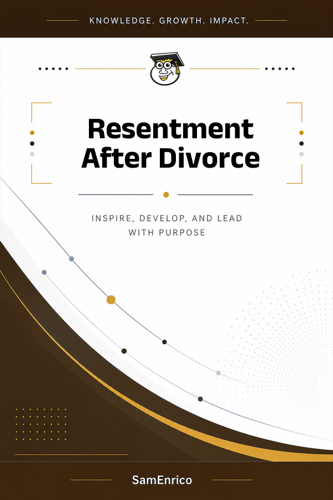
Resentment After Divorce eBook
Release bitterness toward your ex to free yourself
Release bitterness toward your ex to free yourself from the past.
Formats
Free sample
Chapter 1: The Quicksand Pact...--–- The turkey sandwich sat on the passenger seat, innocent as a rock. Claire had bought it automatically—sourdough, turkey, Swiss, no mustard, the same order she'd placed for a decade. She didn't even want it. But old habits die slower than marriages. She was halfway home when the radio played their song.
Not literally their song—there was no single song. It was just a melody from 2014, the year they painted the kitchen yellow and argued about whether to spend their tax return on a trip to Portland or a new couch. They bought the couch. He left six years later. The couch stayed.She pulled into the parking lot of a CVS she had no intention of entering.
Her hands were shaking. Not from grief. From rage. The kind of clean, clarifying rage that feels like truth. She wasn't crying.
She was calculating. She was replaying the text he'd sent that morning about swapping weekends with their daughter. It was reasonable. It was polite. It was infuriating.
How dare he be reasonable now? Where was this reasonableness when he was staying late at work? When he forgot their anniversary? When he said "I love you" like someone reading a script for a play they'd already been fired from?The turkey sandwich grew warm and limp. She didn't eat it.
She sat in the CVS parking lot for forty-seven minutes, running the same loop: He did this. He left. He ruined everything. He doesn't get to be reasonable now. He doesn't get to ask for things.
He doesn't get to exist without my permission.This is the quicksand.Most people think resentment is a feeling. It's not. It's a neurological pact you make with your own brain. Every time you replay the betrayal, you're not processing it. You're deepening a groove.
And the cruelest part? You think you're protecting yourself. You think if you stay angry enough, you'll never be vulnerable again. But the person you're actually harming is the one in the CVS parking lot, letting a six-dollar sandwich go bad while the world spins on without you.Let's be clear about what this book is not. It is not a forgiveness manual.
It is not a guide to "letting go" through deep breathing and affirmations. It is not a collection of platitudes about how "everything happens for a reason." The author of this book has sat in her own CVS parking lot. She has rewritten the same text message forty times before deleting it. She has gone to therapy, done the yoga, bought the journal with the gold foil letters that said "Heal." And none of it worked until she stopped trying to move on and started understanding why she couldn't.This chapter dismantles the single most damaging piece of advice divorced people receive: "Just let it go."You cannot let go of something you are still holding. And you are still holding it because your brain has been trained to hold it.
Not because you're weak. Not because you're bitter. Not because you didn't love them enough or the right way. Because resentment is a loop. And loops require interruption, not willpower.Before we go any further, let me define a term that will appear throughout this book.
When I say "forgiveness," I do not mean reconciliation. I do not mean pretending the harm didn't happen. I do not mean feeling warm feelings toward someone who hurt you. The version of forgiveness I am rejecting is the one that demands you absorb the cost of someone else's cruelty and call it growth. That version is not required.
What is required is releasing your own attachment. And attachment release has nothing to do with them. It has everything to do with the grooves in your brain.Let me show you what I mean.The Neurology of Bitterness Your brain is a river. Thoughts are water. The first time a thought travels down a particular path, it's a trickle.
The hundredth time, it's a stream. The thousandth time, it's a canyon. Resentment is a canyon.When you were married, you carved pathways of attachment. You learned his face in the morning light. You learned the sound of his key in the door.
You learned the rhythm of your arguments—the escalation, the ceasefire, the makeup. Those pathways were neutral once. They were simply the topography of a shared life. But after betrayal, those same pathways become landmines. The key in the door triggers not anticipation but dread.
The morning light triggers not warmth but the memory of the morning he said he was leaving.Here's what no one tells you: the brain does not distinguish between a helpful thought and a harmful one. It only distinguishes between a well-worn path and an unused one. Every time you ruminate, you are not working through the pain. You are deepening the canyon. And a deep canyon is very hard to climb out of.This is why "just let it go" fails.
Letting go implies a single action, a decisive release, like opening your hand and dropping a stone. But resentment is not a stone. It is a landscape. You cannot drop a landscape. You have to re-route the river.Dr.
Norman Doidge, in his work on neuroplasticity, describes how the brain changes itself through focused attention. The good news: canyons can be bypassed. The bad news: bypassing requires that you stop walking down the old one. And stopping is the hardest part, because the old canyon feels true. It feels like loyalty to yourself.
It feels like justice.Claire, sitting in the CVS parking lot, believed she was holding onto her anger to protect herself. If she let it go, she thought, she would be saying that what he did was okay. She would be betraying the woman who had been wronged. This is the most seductive lie of resentment. Anger feels like armor.
But armor that you cannot remove becomes a prison. She wasn't protecting herself. She was visiting the scene of the crime every day and calling it vigilance.The Quicksand Metaphor In the memoir Yellow Paint, the author describes the moment she realized she had become someone she didn't recognize. She writes, "I had become a complete bitch to live with—not because I was angry at him, but because I was angry at myself for staying so long." This is the quicksand. The more you struggle against the anger—by suppressing it, distracting yourself, or forcing positivity—the deeper you sink.Let me be precise about what "struggling" looks like.
Struggling is re-reading old texts to find clues. Struggling is rehearsing what you would say if you saw them at a party. Struggling is checking their social media to see if they look happy (they do) or sad (they don't). Struggling is explaining the entire history to a friend for the tenth time, hoping that this time the friend will say the magic words that make it all make sense. Struggling is trying to meditate your way out of anger, only to find that anger follows you onto the cushion.None of this is weakness.
It is neurology. And neurology can be changed, but not by fighting it.The quicksand metaphor works because quicksand kills only…
This is the end of the free sample. Get the eBook to keep going. Buy now
About this book
Details
- Author
- Chen Casandra
- Publisher
- SamEnrico
- Language
- English
- Genre
- Non-Fiction, Self-Help, Divorce
- Released
- 2026-06-06
- Pages (approx.)
- 134
- Available as
- eBook, Audiobook

Read better in the ZLOADR app
Your eBooks on your phone or tablet. Sign in with your SamEnrico account and start reading.
More by Chen Casandra
 Assertive Email Communication GuideChen Casandra$11.99
 DoorDash Shopping List EfficiencyChen Casandra$11.99
 LGBTQ Child Star IdentityChen Casandra$11.99
 Depression Treatment HandbookChen Casandra$11.99
 Citation Rules for Sacred Texts GuideChen Casandra$11.99
 Failure Reframe WorkbookChen Casandra$11.99
 Steel Beasts of the Eastern FrontChen Casandra$11.99
 Gripen Pilot MemoirChen Casandra$11.99
 The Last Queen of Egypt: Cleopatra's Final GambitChen Casandra$11.99
 The Clockwork Phoenix: How a Victorian Girl Invented the First Steam-Powered WingsChen Casandra$11.99
 The Battle of Leyte Gulf: The Last Stand of the Imperial FleetChen Casandra$11.99
 How to Start a Farmyard Manure Spreader Business (Beginners Guide)Chen Casandra$11.99
You may also like
 Hong Kong Handover 1997Dunn Johnnie$11.99
 Zumba For Postnatal Recovery CourseNeal Christian$11.99
 Zumba for BeginnersLadner Nikia$11.99
 YouTube Comment Mining GuideHumes Pandora$12.99
 Worry Box MeditationCarlin Rudy$11.99
 Workplace Stress MeditationNguyen Lynn$11.99
 Workplace Stress and Sleep RepairHawley Ivory$11.99
 Workplace Perfectionism CureDelaney Jeffry$11.99
 Workplace Injustice Anger GuideWallen Isabelle$11.99
 Work Addiction and Burnout LinkGreenwood Ester$11.99
 Women in Yoga and WellnessBeattie Galina$11.99
 Women in Stand Up ComedyChun Evangeline$11.99