
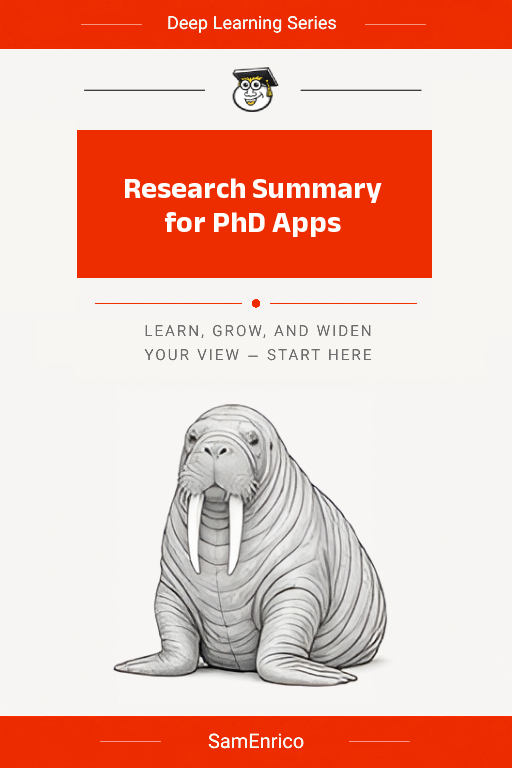
researchStudent's ShortcutResearch Summary
Research Summary for PhD Apps eBook
Writes detailed research summary that demonstrates
Writes detailed research summary that demonstrates deep understanding and compensates for missing publications.
Formats
Free sample
Chapter 1: The Panic Paradox--–- The email arrived at 11:47 PM on a Sunday. Your dream program’s application portal is open. You have a 3.8 GPA, two summers in a lab, and a poster from a regional conference. But as you scroll through the requirements, your stomach drops. There it is: “Please submit a 1,000-word research summary describing your previous research experience, including methods, results, and intellectual contributions.”You have no publications.Your heart races.
Your mind supplies every horror story you have ever heard: the applicant with two first-author Nature papers, the student whose undergraduate thesis won a national award, the person who started a nonprofit AND published AND had a 4.0. You imagine an admissions committee member squinting at your file, muttering, “No publications? Next.”Then you close the laptop and do not open it again for three days.This chapter exists to pull you back from that ledge. The panic you feel is not a sign that you are unqualified. It is a sign that you have absorbed a deeply misleading message about what Ph D admissions committees actually want.
That message—papers or perish—is the single most destructive myth in graduate admissions. And it is, for almost all applicants, completely wrong.This chapter will do four things. First, it will name the exact source of your anxiety and show you why the “missing publication” panic is based on a category error. Second, it will draw a crucial distinction between three documents that applicants constantly confuse—the Research Statement, the Research Proposal, and the Research Summary—and explain why only one of them belongs in your Ph D application. Third, it will reveal what admissions committees are actually looking for when they read your research summary: not a publication list, but evidence of survivability in the first year of a Ph D program.
Finally, it will introduce the single most powerful framework for rewriting your relationship to your own experience—the Plain Language Summary—and end with a diagnostic exercise that will immediately improve any draft you have ever written.By the end of this chapter, you will understand something that most applicants never learn: the research summary is not a test of how much you have published. It is a test of how well you think. And thinking can be demonstrated without a single citation to your name.The Missing Publication Myth: Where It Comes From and Why It Is Wrong Let us name the beast. The “missing publication” panic is the fear that without a peer-reviewed paper—ideally first-author, ideally in a high-impact journal—your application will be dismissed as unserious. This fear is so widespread among undergraduate and post-baccalaureate applicants that it has become a kind of folklore.
It spreads through Reddit forums, whispered warnings from anxious peers, and the occasional boastful Linked In post from a prodigy who published at nineteen.But here is what the folklore leaves out: the vast majority of successful Ph D applicants in most disciplines do not have first-author publications at the time of application.Think about the timeline. A typical undergraduate begins serious research in their sophomore or junior year. By the time they apply to Ph D programs in the fall of their senior year, they have had at most 18 to 24 months of hands-on research experience. In that window, even a productive project may not have completed the full cycle of data collection, analysis, writing, submission, peer review, revision, and acceptance. Peer review alone often takes six to twelve months.
The math simply does not support the expectation that most applicants will have first-author papers.Admissions committees know this. They have access to the same calendar you do. They do not expect undergraduates to have outpaced the normal rhythm of scientific publication.What they do expect is evidence that you have engaged in research at a level that suggests you can survive and thrive in their program. And that evidence comes in many forms: a well-designed experiment, even if the results were null; a thoughtful analysis of existing data, even if you did not collect it yourself; a replication study that confirmed or challenged a published finding; a computational tool you built to automate a tedious lab process; a systematic literature review that identified genuine gaps. None of these require a publication.The panic, then, is not a response to an actual expectation.
It is a response to a comparison. You are comparing your inside view of your own research—with its false starts, failed PCRs, buggy code, and ambiguous results—to the outside view of other people’s highlight reels. And that comparison is fundamentally unfair to yourself.The Three Documents You Are Probably Confusing Part of the panic comes from genuine confusion. Different universities, different countries, and even different departments within the same university use overlapping terminology to mean very different things. Before you can write a strong research summary, you need to know what you are not writing.The Research Statement (Job Market, Postdocs, and Some Fellowships)The Research Statement is a forward-looking document.
It asks: “What will you do as an independent researcher?” It is typically required for faculty jobs, postdoctoral fellowships, and some prestigious graduate fellowships like the NSF GRFP (though even the GRFP has shifted over time). A Research Statement describes your future agenda: the big questions you want to answer, the methods you plan to use, the funding you might pursue, and the labs or facilities you would need. It assumes you have already demonstrated competence as a researcher. It is a sales pitch for your potential as an independent investigator.If you are applying to a standard US Ph D program and they ask for a “research summary,” they are almost certainly not asking for a Research Statement. Do not write about what you will do.
Write about what you have done.The Research Proposal (UK and European Systems)The Research Proposal is a different beast entirely. In UK and European Ph D applications, you are often expected to propose a specific project that you will complete during your doctoral studies. This document includes a literature review, a set of hypotheses or research questions, a detailed methodology, a timeline, and sometimes even a budget. It is essentially a grant proposal written by an applicant. It assumes that you have enough background knowledge to design a feasible project from scratch.Most US Ph D programs do not require a Research Proposal.
There are exceptions—some humanities programs, some interdisciplinary programs—but the default is that you apply to work with a specific professor or within a specific lab, and you will develop your dissertation project after you arrive. If the application says “research summary” and does not explicitly say “proposal,” do not submit a proposal.The Research Summary (US Ph D Applications)The Research Summary is retrospective. It asks: “What have you already done, and what did you learn from doing it?” This is the document this book is about. It is not a contract. It is not a job talk.
It is a carefully crafted narrative of your past research experience, designed to show admissions committees that you understand how research works—the messiness, the decision points, the ethics, the…
This is the end of the free sample. Get the eBook to keep going. Buy now
About this book
Details
- Author
- Galvin Eldora
- Publisher
- SamEnrico
- Language
- English
- Genre
- research, Student's Shortcut, Research Summary
- Released
- 2026-05-30
- Pages (approx.)
- 151
- Available as
- eBook, Audiobook

Read better in the ZLOADR app
Your eBooks on your phone or tablet. Sign in with your SamEnrico account and start reading.
More by Galvin Eldora
 DBT For VeteransGalvin Eldora$11.99
 The Sleep and Grades GuideGalvin Eldora$11.99
 Dreams And Cancer Trauma GuideGalvin Eldora$11.99
 Surgeon Resilience WorkbookGalvin Eldora$11.99
 The Climate Tech Communications GuideGalvin Eldora$11.99
 The Blood Diamond Conspiracy: The 1870s Cape Colony Heist That Shook the EmpireGalvin Eldora$11.99
 International Trade and Finance LawGalvin Eldora$11.99
 How to Start a Palm Oil Refining Business (Beginners Guide)Galvin Eldora$11.99
 Pop Up Locations London GuideGalvin Eldora$12.99
 Understanding Systemic Lupus ErythematosusGalvin Eldora$17.99
You may also like
 Scientific Research On TM GuideMartens Nathanial$11.99
 Research Proposal Methodology Section MasteryPauley Debroah$11.99
 Research Proposal Appendix CompilationRaines Tyisha$11.99
 Academic Researcher Distraction GuideFord Virgil$11.99
 TM Research and ScienceCovert Nicki$11.99
 Social Anxiety Research ReviewRoberge Cole$11.99
 Research Proposal Significance Section GuideBock Tory$12.99
 Research Proposal Reviewer PsychologyLugo Tawanda$11.99
 Research Proposal Research Questions DesignLara Robbi$11.99
 Research Proposal References and CitationsPatten Shanice$11.99
 Research Proposal Mixed Methods DesignCameron Omega$11.99
 Research Proposal Data Management PlanAnderson Roberto$12.99