
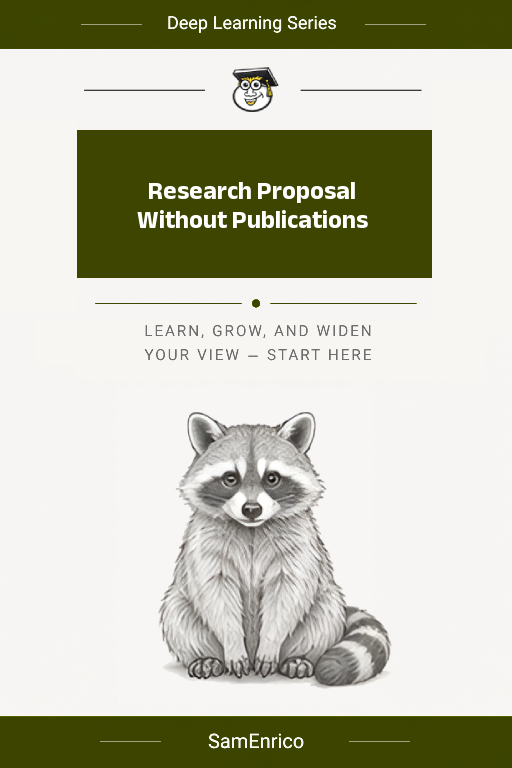
researchStudent's ShortcutProposals
Research Proposal Without Publications eBook
Write a compelling research proposal that demonstr
Write a compelling research proposal that demonstrates independent thinking and project readiness.
Formats
Free sample
Chapter 1: The Readiness Illusion--You have been told a lie about academic publishing.The lie goes like this: before anyone will trust you with funding, before any committee will admit you to a doctoral program, before any fellowship will support your research – you must have publications. A curriculum vitae with a "Publications" section that contains actual entries. Papers with your name on them, preferably as first author, preferably in reputable journals. Without this, the story goes, you are unproven. Untrustable.
Not ready.This lie has ruined more promising research careers than any other single misconception.Not because publications are bad. They are not. Publications are the currency of academic life, the metric by which careers are measured, the evidence that you have contributed something to the collective enterprise of knowledge production. But here is the truth that the lie obscures: publications are evidence of having finished something. They are retrospective.
They look backward at work already completed. A research proposal, by contrast, is prospective. It looks forward at work not yet begun. The skills that produce publications – persistence through review, responsiveness to feedback, the ability to close an argument – are not the same skills that produce a compelling proposal. And crucially, the absence of publications does not signal the absence of those proposal-relevant skills.This chapter will dismantle the readiness illusion – the mistaken belief that publications are the primary evidence of research readiness – and replace it with a more accurate, more useful, and more empowering framework.
By the end of this chapter, you will understand what reviewers are actually looking for when they read a proposal from an early-career researcher. You will learn to see your own experiences – course papers, theses, work projects, even failures – as evidence of readiness. And you will complete an exercise that transforms how you understand your own qualifications.The problem is not that you lack publications. The problem is that you have been taught to measure yourself against the wrong yardstick.The Reviewers Are Not Counting Your Publications Let us begin with evidence. I have interviewed dozens of proposal reviewers across the humanities, social sciences, and natural sciences.
I have analyzed the stated criteria of major funding agencies. And I have reviewed thousands of pages of reviewer feedback. The conclusion is unambiguous: reviewers of early-career proposals are not counting publications. They are scanning for something else entirely.Consider the stated criteria of major funding bodies. The NSF Graduate Research Fellowship Program lists its review criteria publicly: Intellectual Merit and Broader Impacts.
Nowhere does it mention publications. The SSRC's Dissertation Proposal Development Fellowship asks reviewers to assess "the intellectual significance of the research question" and "the feasibility of the proposed methodology." Not publications. The Fulbright U.S. Student Program evaluates "the quality and feasibility of the proposed project" and "the applicant's preparation and qualifications." The Wellcome Trust's Early-Career Awards assess "the candidate's potential to become an independent researcher" and "the scientific merit of the proposed research." Again, not publications.When I asked reviewers directly what they look for in proposals from unpublished applicants, their answers were remarkably consistent. A senior professor in political science told me: "I don't expect a first-year Ph D student to have publications.
If they do, I want to know what their contribution actually was. Was it their idea? Did they write the paper? Or did their advisor do the heavy lifting? A publication with a famous advisor can actually be harder to interpret than no publication at all." A sociologist who serves on a major fellowship committee said: "I scan the CV for evidence of research experience, not publications.
Coursework, conference presentations, research assistantships – those tell me more than a publication list that might just reflect being in the right lab at the right time."The logical reality is also compelling: if publications were required to get funding, no one would ever receive their first grant. The system would be circular. You need publications to get funding, but you need funding to produce publications. That circularity would prevent anyone from ever entering the research enterprise. The fact that early-career researchers do get funded – in large numbers – demonstrates that publications cannot be the real criterion.So what are reviewers actually looking for?The R3 Framework: What Reviewers Actually Want After analyzing hundreds of successful proposals from unpublished researchers, I have identified three criteria that consistently predict funding success.
I call this the R3 Framework, and it will guide everything in this book.Criterion One: Intellectual Ownership Reviewers want to know that you came up with the question. This sounds obvious, but it is surprisingly rare. Many proposals – especially those written by students working closely with advisors – sound like they were handed down from on high. The proposal describes a problem that the advisor studies, using methods the advisor uses, citing sources the advisor provided. There is no evidence that the applicant has made the question their own.Intellectual ownership is visible in the language of the proposal.
Proposals that demonstrate ownership use first-person singular ("I became interested in this question when...") rather than passive constructions ("It was determined that..."). They include an intellectual autobiography – a brief narrative explaining how the applicant arrived at this question through their own reading, experience, or curiosity. They show personal investment: the ability to explain why this question matters to this researcher, not just why it matters to the field.Consider two versions of the same opening sentence. Version A: "Research on voter turnout has established that young people vote at lower rates than older populations, but the mechanisms underlying this disparity remain undertheorized." Version B: "When I worked as a poll worker during the 2020 election, I watched young voters walk past our table without stopping. I started asking why.
This proposal investigates those whys." Both versions convey information. But only Version B demonstrates intellectual ownership. The reviewer knows that this question belongs to this applicant.Criterion Two: Methodological Competence Reviewers want to know that you can execute the methods you are proposing. But here is the crucial nuance: competence does not require prior publication. You do not need to have published a study using ethnographic methods to propose an ethnographic study.
You do need to demonstrate that you understand what ethnography entails, that you have some relevant experience (even if informal), and that you know what could go wrong.Evidence of methodological competence can take many forms. Coursework in relevant methods counts, especially if you can name specific skills acquired. A thesis or major paper using similar methods counts, even if it was never published. Work experience that involved data collection, analysis, or project management counts. Research assistantships count.
Even a pilot study conducted specifically for the proposal – no matter how small – provides powerful evidence.The key is specificity. "I have experience with qualitative methods" is weak. "I conducted fifteen semi-structured interviews for my undergraduate thesis, transcribed them verbatim, and analyzed them using thematic analysis" is strong. "I am familiar with regression analysis" is weak. "I completed two semesters of graduate-level statistics, including a final project that used multiple regression to predict voter turnout from demographic variables" is strong.Chapter 8 will provide a comprehensive framework for identifying and presenting preliminary evidence.
For now, the takeaway is this: you have more evidence of methodological competence than you think. You just need to…
This is the end of the free sample. Get the eBook to keep going. Buy now
About this book
Details
- Author
- Bankston Francesca
- Publisher
- SamEnrico
- Language
- English
- Genre
- research, Student's Shortcut, Proposals
- Released
- 2026-06-01
- Pages (approx.)
- 153
- Available as
- eBook, Audiobook

Read better in the ZLOADR app
Your eBooks on your phone or tablet. Sign in with your SamEnrico account and start reading.
More by Bankston Francesca
 Self Hypnosis for BruxismBankston Francesca$11.99
 Fibromyalgia Antidepressant GuideBankston Francesca$11.99
 AA Step One WorkbookBankston Francesca$11.99
 Athlete Pre Game NapBankston Francesca$11.99
 The Pet Loss TattooBankston Francesca$11.99
 Rent Increase StrategyBankston Francesca$11.99
 Imposter Syndrome For LawyersBankston Francesca$11.99
 Pancreas Kidney ComboBankston Francesca$11.99
 The Tsars and the Celts: Russia’s Forgotten Gaelic LegacyBankston Francesca$11.99
 How to Start a Meat (wholesale) Business (Beginners Guide)Bankston Francesca$11.99
 The Strategist's Guide to Permission MarketingBankston Francesca$11.99
 Scaling Education Businesses GloballyBankston Francesca$11.99
You may also like
 Scientific Research On TM GuideMartens Nathanial$11.99
 Research Proposal Methodology Section MasteryPauley Debroah$11.99
 Research Proposal Appendix CompilationRaines Tyisha$11.99
 Academic Researcher Distraction GuideFord Virgil$11.99
 TM Research and ScienceCovert Nicki$11.99
 Social Anxiety Research ReviewRoberge Cole$11.99
 Research Proposal Significance Section GuideBock Tory$12.99
 Research Proposal Reviewer PsychologyLugo Tawanda$11.99
 Research Proposal Research Questions DesignLara Robbi$11.99
 Research Proposal References and CitationsPatten Shanice$11.99
 Research Proposal Mixed Methods DesignCameron Omega$11.99
 Research Proposal Data Management PlanAnderson Roberto$12.99