
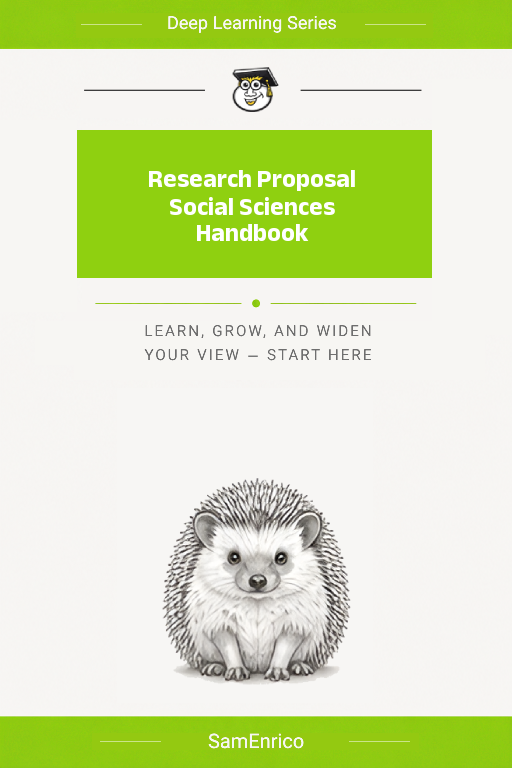
researchStudent's ShortcutSocial Research
Research Proposal Social Sciences Handbook
Design mixed methods proposals that balance qualit
Design mixed methods proposals that balance qualitative depth and quantitative breadth for social science audiences.
Formats
About this book
Free sample
Chapter 1: The Broken Promise--–- Every year, thousands of social science researchers sit down to write a research proposal. They have a compelling question. They have reviewed the literature. They have a genuine desire to contribute knowledge. And then they hit the same wall: the false choice between numbers and narratives.The professor says, "You need rigorous quantitative data." The advisor says, "But you're missing the human story." The grant reviewer writes back, "Interesting question, but your methods are one-dimensional." And so the doctoral student, the postdoc, or the early-career faculty member goes back to their office, deletes half of their proposal, and tries again.
This time, they add a few interview questions to their survey. Or they tack on a short questionnaire after their ethnographic study. They call it "mixed methods." The committee calls it "methodological afterthought."This book exists because that approach is broken.The promise of mixed methods was never supposed to be about adding a few qualitative quotes to a regression table or running descriptive statistics on a small interview sample. The promise was integration: a genuine, purposeful, and rigorous combination of qualitative depth and quantitative breadth that produces insights neither method could achieve alone. But somewhere between the textbooks and the proposal-writing desk, that promise was lost.
Researchers learned the vocabulary of mixed methods without learning its grammar. They learned to say "triangulation" and "sequential design" without understanding how to actually integrate data at the point of interface.This chapter begins the repair work.The Methodology Trap: Why Smart Researchers Stay in Their Lane Before we can build a better proposal, we have to understand why so many smart, well-intentioned researchers default to single-method studies even when their research questions demand mixing. The answer is not laziness or incompetence. The answer is fear, training, and institutional inertia.Consider the typical doctoral student in sociology, education, public health, or political science. They enter their program with a genuine research question: Why do some schools successfully reduce the achievement gap while others fail?
Or What explains the relationship between neighborhood poverty and health outcomes? Or How do frontline bureaucrats implement policies that seem…
This is the end of the free sample. Get the eBook to keep going. Buy now
Contents
- Chapter 1
- Chapter 2
- Chapter 3
- Chapter 4
- Chapter 5
- Chapter 6
- Chapter 7
- Chapter 8
- Chapter 9
- Chapter 10
- Chapter 11
- Chapter 12
Details
- Author
- Pinckney Johna
- Publisher
- SamEnrico
- Language
- English
- Genre
- research, Student's Shortcut, Social Research
- Released
- 2026-05-30
- Pages (approx.)
- 133
- Available as
- eBook, Audiobook

Read better in the ZLOADR app
Your eBooks on your phone or tablet. Sign in with your SamEnrico account and start reading.
More by Pinckney Johna
 Widow Social Isolation HelpPinckney Johna$11.99
 Reconstruction of Elder Abuse DeathsPinckney Johna$11.99
 Inaccessible Playground CrusaderPinckney Johna$11.99
 Imposter Visibility GuidePinckney Johna$11.99
 Memory Palace For Physics FormulasPinckney Johna$11.99
 Intention Setting Before ListeningPinckney Johna$11.99
 Pomodoro for LawyersPinckney Johna$11.99
 The Nightingale of Healing: Florence Nightingale's Medical RevolutionPinckney Johna$11.99
 Tangaroa's Wrath: The Birth of the First ReefPinckney Johna$11.99
 How to Produce Portable Water Filters and PurifiersPinckney Johna$11.99
 Mastering The Erector SpinaePinckney Johna$11.99
 How to Start a Comminution Plant for Effluent Treatment Business (Beginners Guide)Pinckney Johna$11.99
You may also like
 Scientific Research On TM GuideMartens Nathanial$11.99
 Research Proposal Methodology Section MasteryPauley Debroah$11.99
 Research Proposal Appendix CompilationRaines Tyisha$11.99
 Academic Researcher Distraction GuideFord Virgil$11.99
 TM Research and ScienceCovert Nicki$11.99
 Social Anxiety Research ReviewRoberge Cole$11.99
 Research Proposal Significance Section GuideBock Tory$12.99
 Research Proposal Reviewer PsychologyLugo Tawanda$11.99
 Research Proposal Research Questions DesignLara Robbi$11.99
 Research Proposal References and CitationsPatten Shanice$11.99
 Research Proposal Mixed Methods DesignCameron Omega$11.99
 Research Proposal Data Management PlanAnderson Roberto$12.99