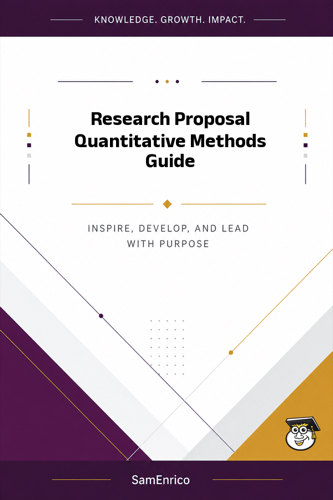
Research Proposal Quantitative Methods Guide
Design surveys, experiments, or secondary data ana
by Ames Madie
Design surveys, experiments, or secondary data analysis studies.
Formats
About this book
Free sample
Chapter 1: The Precision Paradox...--The most dangerous sentence in academic writing is not “I don’t know” or “My hypothesis was wrong.” It is this one, written with complete confidence by thousands of graduate students and early-career researchers every single year: “This study will explore the relationship between various factors affecting student performance.”By the time you finish reading this chapter, you will understand exactly why that sentence is a slow-acting poison for research proposals. You will also know how to replace it with something so clear, so specific, and so defensible that your committee—or your funder—will have no choice but to lean forward and pay attention.The 80% Problem Let us begin with a statistic that should either terrify you or liberate you, depending on your perspective. Approximately 80 percent of quantitative research proposals that are rejected—whether by a thesis committee, an institutional review board, or a funding agency—share a single root cause. It is not bad statistics. It is not an insufficient sample size.
It is not even a poorly designed survey or experiment.It is vagueness.Specifically, it is a problem statement that meanders, a research question that could apply to a thousand different studies, or a hypothesis that cannot be falsified because it says nothing concrete enough to be wrong. Committees do not reject vague proposals because they are cruel. They reject them because a vague proposal cannot be evaluated. If you do not know exactly what the researcher intends to measure, how they intend to measure it, and what they expect to find, you cannot assess whether their methods are appropriate. You cannot assess whether their sample size is adequate.
You cannot assess whether their analysis plan matches their question. The entire review process grinds to a halt before it even begins.This chapter exists to ensure that your proposal never dies this death.The Three Questions That Defend Your Proposal Before we dive into the mechanics of problem statements, research questions, and hypotheses, we need to establish a simple framework. Every defensible quantitative proposal answers three questions. If your proposal answers these three questions…
This is the end of the free sample. Get the eBook to keep going. Buy now
Contents
- Chapter 1
- Chapter 2
- Chapter 3
- Chapter 4
- Chapter 5
- Chapter 6
- Chapter 7
- Chapter 8
- Chapter 9
- Chapter 10
- Chapter 11
- Chapter 12
Details
- Author
- Ames Madie
- Publisher
- SamEnrico
- Language
- English
- Genre
- research, Student's Shortcut, Quantitative Research
- Released
- 2026-06-10
- Pages (approx.)
- 150
- Available as
- eBook, Audiobook

Read better in the ZLOADR app
Your eBooks on your phone or tablet. Sign in with your SamEnrico account and start reading.
More by Ames Madie
 Sector for CaregiversAmes Madie$11.99
 Stranger Xenophobia SocialAmes Madie$11.99
 PewDiePie BrofistAmes Madie$11.99
 MMA Calm in Chaos HypnosisAmes Madie$11.99
 Healthcare Worker Migration GuideAmes Madie$11.99
 Animal Control Officer StressAmes Madie$11.99
 Voices from the Abyss: The Lost Tapes of the Mary CelesteAmes Madie$11.99
 The Lyre and the Lance: Pericles' Last Stand in the Peloponnesian WarAmes Madie$11.99
 Ultimate Handbook Guide to Malang : (Indonesia) Travel GuideAmes Madie$11.99
 The Mineral Guide to BrushiteAmes Madie$11.99
 US LLC Credit Building TimelineAmes Madie$12.99
 Cooperative in Informal SettlementsAmes Madie$12.99