
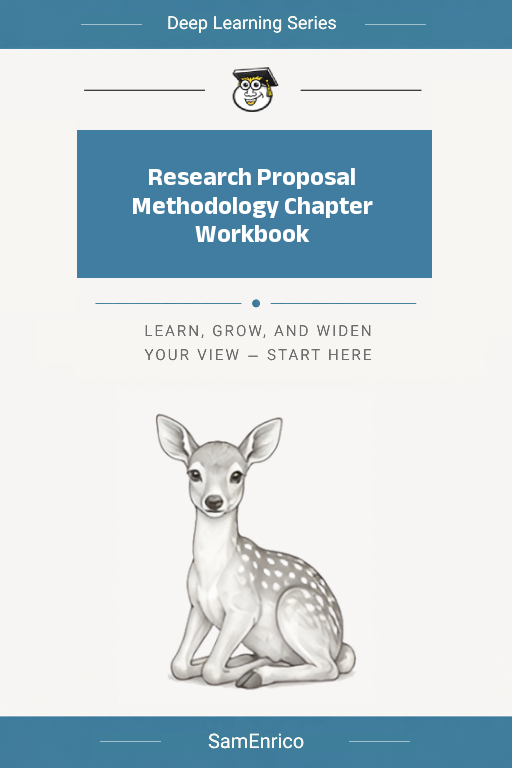
Research Proposal Methodology Chapter Workbook eBook
Design qualitative quantitative or mixed methods t
by Wesley Sean
Design qualitative quantitative or mixed methods that admissions committees find feasible and rigorous.
Formats
Free sample
Chapter 1: The Gatekeeper’s Secret--Every rejected research proposal has a moment of death. It is rarely the moment you expect. Most students assume committees reject proposals because the topic is uninteresting, the literature review is incomplete, or the research questions are not novel enough. These assumptions are almost always wrong. The actual cause of death, in nearly sixty percent of rejected proposals, is the methodology chapter – not because the methods themselves were necessarily flawed, but because the student failed to convince the committee that the methods could be executed successfully within the constraints of graduate study.This chapter reframes the methodology chapter from a bureaucratic formality into the single most strategic document in your application.
You will learn why committees reject proposals on methodological grounds, what the “feasibility plus rigor equation” means for your specific situation, and how this entire workbook is structured to guide you from panic to a completed, committee-ready chapter. By the end of this chapter, you will understand the hidden gatekeeping role of methodology – and you will be prepared to stop making the mistakes that sink ninety percent of first drafts before they are even read in full.The Hidden Gatekeeping Role of Methodology Admissions committees read dozens, sometimes hundreds, of proposals per cycle. They develop what might be called a “rejection reflex” – an ability to identify a failing proposal within the first two or three pages. Where do they look first? Not at your literature review.
Not at your theoretical framework. They flip directly to the methodology chapter, or they scan your research questions and then jump to methods. Why? Because a flawed methodology cannot be rescued by elegant writing or a comprehensive literature review. If you cannot credibly explain how you will answer your questions, nothing else matters.Committees are not looking for perfection.
They are looking for two specific signals: feasibility and rigor. A feasible design is one you can actually complete given your time, resources, access, and skill level. A rigorous design is one that produces credible, defensible answers to your research questions. The devastating truth is that a design can fail by missing either signal. A rigorous design that requires three years of fieldwork when you have six months will be rejected for infeasibility.
A feasible design that uses convenience sampling, unvalidated instruments, and no attention to validity threats will be rejected for lack of rigor.This creates what I call the “feasibility plus rigor equation.” Both conditions must be met simultaneously. Neither can compensate for the other. You cannot argue that your design is rigorous enough to justify an impossible timeline. You cannot argue that your design is so feasible that it excuses sloppy measurement or unaddressed bias. The committees have seen both arguments fail hundreds of times.
They are unmoved.What makes this especially painful is that most students never receive explicit training in how committees evaluate methodology chapters. Your coursework likely taught you research methods in the abstract – what a case study is, how a t-test works, the difference between purposive and random sampling. But coursework rarely teaches you how to present those methods in a proposal so that a skeptical committee says yes. That gap between knowing methods and proposing them convincingly is exactly what this workbook exists to close.The Three Silent Killers of Methodology Chapters Through analysis of hundreds of rejected proposals and interviews with admissions committee members across social sciences, education, health sciences, and business disciplines, three patterns emerge as the most common causes of methodology chapter rejection. I call them the silent killers because students rarely see them coming.The first silent killer is what I call “feasibility theater.” This occurs when a student describes a design that sounds rigorous but cannot possibly be executed.
The classic example is the student who proposes a randomized controlled trial with a hundred participants recruited from a population they do not have access to, analyzed with advanced statistics they have never studied, all within a four-month data collection window. The committee reads this and thinks one word: impossible. The student has performed feasibility theater – they have acted as if describing a rigorous design is enough, without checking whether that design can actually be done. Committees have zero tolerance for this. They would rather see a modest, feasible design than an ambitious, impossible one.The second silent killer is “rigor cosplay.” This is the opposite problem – a design that is perfectly feasible but makes no serious attempt at credibility.
The student plans to interview three friends, analyze their responses by summarizing what they said, and call it a phenomenological study. Or they plan to distribute a survey to whoever responds to a social media post, run no power analysis, use no validated instruments, and call it quantitative research. The committee sees this as rigor cosplay – wearing the costume of research methods without the substance. These proposals are rejected quickly and often without detailed feedback, because the committee does not believe the student understands what research actually requires.The third silent killer is “alignment amnesia.” This occurs when a student writes research questions that demand one methodological approach but then proposes a completely different approach. A student asks a causal question – “What is the effect of tutoring on test scores?” – but then proposes qualitative interviews.
A student asks a descriptive question – “What are the experiences of first-generation college students?” – but then proposes a closed-ended survey with no qualitative component. The committee reads these proposals with growing frustration, because the student has demonstrated that they do not understand the fundamental relationship between questions and methods. Alignment amnesia is particularly common because students often write their research questions first, then write their methodology chapter days or weeks later without ever checking whether the two still match.Each of these silent killers is avoidable. The rest of this workbook exists to help you avoid them. Chapter two will teach you the alignment check that prevents alignment amnesia.
Chapter three will teach you how to build feasibility arguments that end feasibility theater forever. Chapters four through six will teach you qualitative, quantitative, and mixed methods designs that committees actually trust – designs that are both feasible and rigorous. And the remaining chapters will walk you through sampling, instrumentation, analysis, validity, ethics, and the final assembly of your chapter.But before you move on, you need to understand where you currently stand. The remainder of this chapter introduces the structure of this workbook, the logic behind its sequence, and a diagnostic that will help you identify which silent killer poses the greatest threat to your current proposal draft.Why This Workbook Exists – And How It Differs from a Textbook You may have taken a research methods course that used a textbook by Creswell, or Yin, or Babbie, or Patton. Those are excellent books.
They are not this book. A textbook teaches you what research methods are. This workbook teaches you how to propose them to an admissions committee. The difference is crucial and often misunderstood.A textbook is organized by method type – here is qualitative research, here is quantitative research, here is mixed methods, here are ethical principles, here is sampling theory. That organization makes sense for learning concepts.
But it does not make sense for writing a proposal. When you sit down to write your methodology chapter, you…
This is the end of the free sample. Get the eBook to keep going. Buy now
About this book
Details
- Author
- Wesley Sean
- Publisher
- SamEnrico
- Language
- English
- Genre
- research, Student's Shortcut
- Released
- 2026-05-29
- Pages (approx.)
- 158
- Available as
- eBook, Audiobook

Read better in the ZLOADR app
Your eBooks on your phone or tablet. Sign in with your SamEnrico account and start reading.
More by Wesley Sean
 Pet Loss For FarmersWesley Sean$11.99
 Reverse Mortgage Cash Flow GuideWesley Sean$11.99
 Radiofrequency Skin Tightening HandbookWesley Sean$11.99
 Fireplace and Wood Smoke GuideWesley Sean$11.99
 Trigger Anticipation PlanningWesley Sean$11.99
 CBT For IBS WorkbookWesley Sean$11.99
 Advanced Materials CapitalWesley Sean$11.99
 Meeting Time Blocking RulesWesley Sean$11.99
 Anger In FriendshipWesley Sean$11.99
 The Unseen Empire: How a Single Store Changed the WorldWesley Sean$11.99
 Echoes of the Red Dawn: The Untold Cyber War That Reshaped ElectionsWesley Sean$11.99
 The Silent Revolution: How Rachel Carson Unlocked the Secrets of the SeaWesley Sean$11.99
You may also like
 Scientific Research On TM GuideMartens Nathanial$11.99
 Research Proposal Methodology Section MasteryPauley Debroah$11.99
 Research Proposal Appendix CompilationRaines Tyisha$11.99
 Academic Researcher Distraction GuideFord Virgil$11.99
 TM Research and ScienceCovert Nicki$11.99
 Social Anxiety Research ReviewRoberge Cole$11.99
 Research Proposal Significance Section GuideBock Tory$12.99
 Research Proposal Reviewer PsychologyLugo Tawanda$11.99
 Research Proposal Research Questions DesignLara Robbi$11.99
 Research Proposal References and CitationsPatten Shanice$11.99
 Research Proposal Mixed Methods DesignCameron Omega$11.99
 Research Proposal Data Management PlanAnderson Roberto$12.99