
researchStudent's ShortcutLongitudinal Research
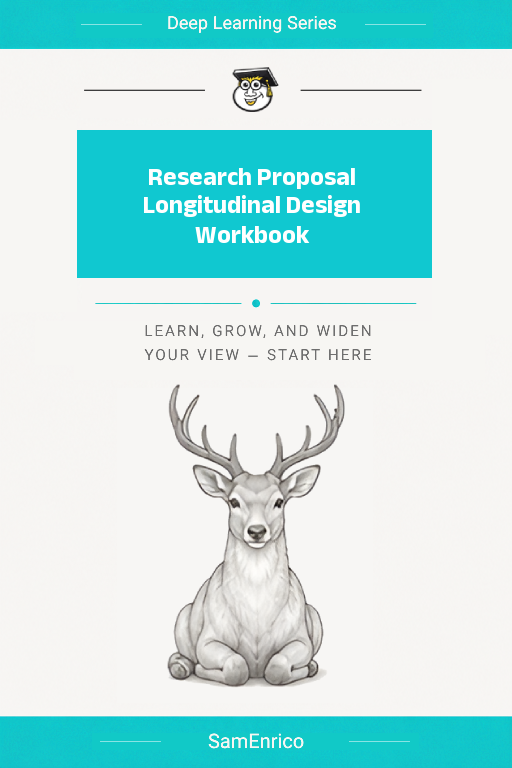
Research Proposal Longitudinal Design Workbook
Plan multi year studies including retention strate
Plan multi year studies including retention strategies, attrition analysis, and interim data checkpoints.
Formats
About this book
Free sample
Chapter 1: The Five-Year Trap--–- You have spent six months writing the grant. The review panel loved it. The funding came through. You recruited 500 people. Wave 1: 500 responses.
You are feeling good. Wave 2: 412 responses. Ouch. Wave 3: 331 responses. Panic begins to set in.
Wave 4: 189 responses. Your statistician uses the word "underpowered." Your advisor uses the word "disaster." Your funder uses a word that cannot be printed in this workbook.This story repeats itself thousands of times every year across universities, research institutes, and evaluation firms. The tragedy is not that participants drop out of longitudinal studies. The tragedy is that most researchers never saw it coming. They planned for perfect retention in an imperfect world.
They designed five-year studies without asking the one question that matters most: "Should this study even be longitudinal in the first place?"This chapter is not about how to keep people in your study. That comes later. This chapter is about whether you should start a longitudinal study at all. Because the single biggest predictor of attrition disaster is launching a multi-year study when a cross-sectional design, a repeated cross-sectional design, or a much shorter longitudinal window would have answered your question better, faster, and cheaper.Welcome to the Five-Year Trap.The Hidden Cost of Going Long Every longitudinal study begins with a seductive promise: watch change happen. See trajectories unfold.
Establish temporal order. Prove what causes what. These are real advantages. Cross-sectional studies measure prevalence at a single moment. They tell you that older adults have more chronic conditions than younger adults.
They cannot tell you whether aging causes chronic conditions or whether people with chronic conditions die younger. Longitudinal designs solve that problem by tracking the same individuals over time.But that solution comes at a staggering cost that most textbooks understate. A five-year panel study of 500 participants with three waves of data collection will cost approximately three to five times more than a cross-sectional study with the same sample size. That is just the financial cost. The human cost includes participant fatigue, staff burnout, and the ethical burden of maintaining relationships with people who…
This is the end of the free sample. Get the eBook to keep going. Buy now
Contents
- Chapter 1
- Chapter 2
- Chapter 3
- Chapter 4
- Chapter 5
- Chapter 6
- Chapter 7
- Chapter 8
- Chapter 9
- Chapter 10
- Chapter 11
- Chapter 12
Details
- Author
- Youngblood Cristine
- Publisher
- SamEnrico
- Language
- English
- Genre
- research, Student's Shortcut, Longitudinal Research
- Released
- 2026-05-30
- Pages (approx.)
- 134
- Available as
- eBook, Audiobook

Read better in the ZLOADR app
Your eBooks on your phone or tablet. Sign in with your SamEnrico account and start reading.
More by Youngblood Cristine
 The Prison Library EducationYoungblood Cristine$11.99
 Reconstruction of Staged SuicidesYoungblood Cristine$11.99
 Disabled Adult Child BenefitsYoungblood Cristine$11.99
 Widow Grief Timeline ChartYoungblood Cristine$11.99
 Peg System For Art HistoryYoungblood Cristine$11.99
 British Raj Rule IndiaYoungblood Cristine$11.99
 Pomodoro for Social WorkersYoungblood Cristine$11.99
 Dream Recall Enhancement MethodsYoungblood Cristine$11.99
 The Last Stand of Delhi: India's Forgotten War for FreedomYoungblood Cristine$11.99
 The Beast of the Belgian Congo: The True Story of a Colonial-Era Serial KillerYoungblood Cristine$11.99
 How to Produce Pot and Planter LinersYoungblood Cristine$11.99
 Mastering The Sternal Head of The Pectoralis MajorYoungblood Cristine$11.99
You may also like
 Scientific Research On TM GuideMartens Nathanial$11.99
 Research Proposal Methodology Section MasteryPauley Debroah$11.99
 Research Proposal Appendix CompilationRaines Tyisha$11.99
 Academic Researcher Distraction GuideFord Virgil$11.99
 TM Research and ScienceCovert Nicki$11.99
 Social Anxiety Research ReviewRoberge Cole$11.99
 Research Proposal Significance Section GuideBock Tory$12.99
 Research Proposal Reviewer PsychologyLugo Tawanda$11.99
 Research Proposal Research Questions DesignLara Robbi$11.99
 Research Proposal References and CitationsPatten Shanice$11.99
 Research Proposal Mixed Methods DesignCameron Omega$11.99
 Research Proposal Data Management PlanAnderson Roberto$12.99