
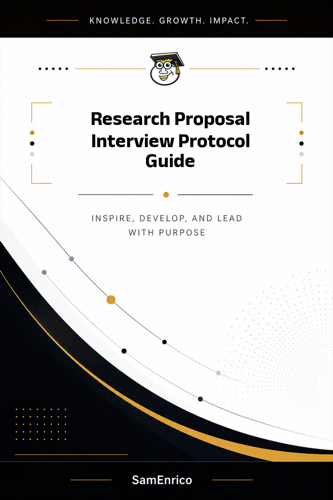
Research Proposal Interview Protocol Guide eBook
Develop semi structured interview guides with effe
Develop semi structured interview guides with effective probes.
Formats
Free sample
Chapter 1: The Interview Trap--Most novice researchers believe they already know how to ask questions. After all, they have been asking questions their entire lives—to teachers, to colleagues, to friends, to strangers. What could be so difficult about asking a few more questions, this time with a recorder running?Everything, as it turns out.The gap between casual conversation and rigorous qualitative interviewing is not a crack; it is a canyon. And every year, thousands of researchers—graduate students, UX professionals, market researchers, journalists, and program evaluators—throw themselves into that canyon, armed with nothing but a list of questions and a misplaced confidence in their own conversational abilities. They emerge on the other side with hundreds of pages of transcripts, rich with data that is often beautifully irrelevant, systematically biased, or both.This chapter is about why that happens and what to do about it.
It is not a gentle introduction. It is a wake-up call.The Most Expensive Mistake in Interviewing Let us begin with a story. A technology company had spent eighteen months developing a new feature for their flagship product. The feature was technically brilliant, elegantly engineered, and internally beloved. The product team was certain it would revolutionize how users interacted with their platform.Before launch, they conducted thirty interviews with power users.
The interview guide asked questions like: "How would this feature improve your workflow?" "What problems does this feature solve for you?" "How excited are you to use this feature?"Every single participant answered positively. They described improvements, identified problems, expressed excitement. The team launched with confidence. The feature failed catastrophically. Adoption was near zero.
Users complained that it solved problems they did not have and created new problems they had not anticipated.What happened? The interview guide was not designed to learn. It was designed to confirm. Every question contained an assumption: that the feature would improve workflows, that it did solve problems, that excitement was the appropriate emotional response. Participants, being polite humans who generally want to be helpful and not cause conflict, answered accordingly.
They gave the company exactly what it asked for: validation of its own assumptions, delivered in the form of data that looked real but was actually constructed by the questions themselves.This is the Interview Trap. And it has claimed more research budgets, more dissertations, and more product launches than any other single error in qualitative methodology.The Three Illusions That Fool Novice Interviewers Why do smart, well-intentioned researchers fall into the Interview Trap? Because they operate under three powerful illusions that crumble upon examination.Illusion One: "I Know How to Ask Questions"The first illusion is the assumption that question-asking is a natural skill rather than a trained craft. Humans are indeed born with the capacity to ask questions. The two-year-old who demands "Why?" a hundred times in an afternoon is a question-asking machine.
But that two-year-old is not conducting research, and neither are you when you rely on instinct.Casual conversation operates under different rules than research interviewing. In casual conversation, efficiency is valued; in research interviewing, depth is valued. In casual conversation, you seek common ground and agreement; in research interviewing, you seek specificity and often divergence. In casual conversation, leading questions are a normal way to show you are listening ("That sounds really frustrating, right?"); in research interviewing, leading questions are fatal errors that corrupt your data.The skills that make you a good conversationalist—smoothness, agreement, shared assumptions—often make you a terrible interviewer. Unlearning those instincts is the first step toward competence.Illusion Two: "A List of Questions Is a Protocol"The second illusion is that writing down a set of questions constitutes a research protocol.
It does not. A shopping list is a list of items; a recipe is a protocol. The difference is that a recipe tells you not only what ingredients to use but also how to combine them, when to adjust for conditions, what to do when something goes wrong, and how to know when you are finished.Most interview "protocols" are shopping lists. They contain ten to twenty questions, often in a numbered list, with no guidance on order, no branching logic, no probes, no time estimates, no contingency plans. The interviewer reads question one, receives an answer, reads question two, and so on, like a script.
This is not a semi-structured interview. It is a survey administered orally, which is the worst of both worlds: neither the standardization of a survey nor the flexibility of a qualitative interview.A true protocol is a strategic document. It distinguishes between main questions (non-negotiable coverage), follow-ups (optional depth), and probes (clarifying tools). It anticipates where participants might struggle and provides alternative phrasings. It budgets time across topics.
It includes exit strategies for when a participant is struggling or distressed. It is designed for a human conversation, not for a robot reading a list.Illusion Three: "Participants Will Tell Me the Truth"The third illusion is perhaps the most dangerous: the belief that participants are honest, self-aware, and willing to disclose. They are none of these things, reliably, and it is not because they are bad people. It is because humans are complex, memory is fallible, and social dynamics are powerful.Participants do not lie, exactly. They perform.
They perform the version of themselves that they want you to see—competent, rational, consistent, socially appropriate. They summarize when you need specifics. They rationalize when you need raw recall. They tell you what they believe you want to hear, because that is what polite humans do. And you, the interviewer, signal what you want to hear with every nod, every facial expression, every subtle choice of words.This is not a bug in the system that can be eliminated.
It is a feature of human interaction that must be designed for. The protocol that assumes direct questions yield direct answers is a protocol that will produce polished performances, not useful data.The Paradox of Structure If a shopping list of questions is a trap, and pure unstructured conversation is a different trap (unfocused, incomparable across participants, impossible to analyze systematically), then where is the middle ground?The answer is what this book calls the Paradox of Structure: the fundamental tension between asking every participant the same core questions (for comparability across interviews) and remaining flexible enough to follow unexpected, valuable tangents (for discovery). This paradox is not a problem to be solved once and forgotten. It is a dynamic to be managed in every interview, sometimes in every question.Consider two interviewers studying the same topic—say, how new managers learn to give performance feedback. Interviewer A follows a rigid script.
Every participant gets the same ten questions in the same order, asked in the same words. The data is highly comparable, which makes analysis straightforward. But Interviewer A learns nothing that was not already in the script. When a participant says something surprising—"I actually never give negative feedback; I just wait for them to quit"—Interviewer A has no room to explore. The script marches on, and the gold is buried.Interviewer B has no script at all.
She asks "Tell me about giving feedback" and lets the conversation wander wherever it goes. She might discover fascinating terrain—the…
This is the end of the free sample. Get the eBook to keep going. Buy now
About this book
Details
- Author
- Bethea Glennis
- Publisher
- SamEnrico
- Language
- English
- Genre
- research, Student's Shortcut, Interviewing
- Released
- 2026-06-09
- Pages (approx.)
- 129
- Available as
- eBook, Audiobook

Read better in the ZLOADR app
Your eBooks on your phone or tablet. Sign in with your SamEnrico account and start reading.
More by Bethea Glennis
 Rock Climbing Fear ReleaseBethea Glennis$11.99
 Exposure Ladder BuilderBethea Glennis$11.99
 Sector for NeurodivergentsBethea Glennis$11.99
 Substitutes and ComplementsBethea Glennis$11.99
 Wedding Planner Stress ManagementBethea Glennis$11.99
 Therapeutic Suggestion WritingBethea Glennis$11.99
 Shane Dawson ConspiracyBethea Glennis$11.99
 The Vanishing Act of the Great Pyramid’s Missing CornerstoneBethea Glennis$11.99
 The Sole Invaders: How a Sneaker Heist Rocked the NBABethea Glennis$11.99
 Cooperative Social Impact MetricsBethea Glennis$12.99
 US Business Credit Repair GuideBethea Glennis$12.99
 The Mineral Guide to BukovskyiteBethea Glennis$11.99