
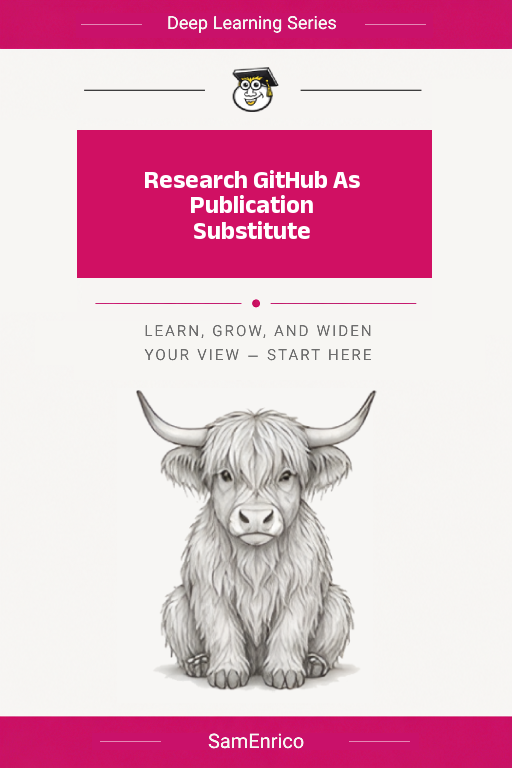
researchStudent's ShortcutOpen Science
Research GitHub As Publication Substitute eBook
Use code repositories data sets or research blogs
Use code repositories data sets or research blogs to demonstrate research productivity.
Formats
Free sample
Chapter 1: The Broken Pipeline...--–- In the winter of 2016, a quiet earthquake shook the foundations of academic science. A survey published in the journal Nature asked over 1,500 researchers a simple question: have you ever tried and failed to reproduce another scientist’s results? More than seventy percent said yes. More than half admitted they had failed to reproduce their own experiments. The headline, splashed across scientific social media and departmental coffee rooms alike, read: “More than 70% of researchers have tried and failed to reproduce another scientist’s experiments.” The implications were staggering.
If the majority of published findings could not be trusted, what was the point of publishing at all?For most working scientists, the news was not surprising. It was confirmation of a secret they had long kept. The postdoc who spent six months trying to replicate a key figure from a high-impact paper, only to discover that the original code was lost, the data was stored on a crashed hard drive, and the lead author had left academia entirely. The graduate student who found that the “statistically significant” result in a celebrated study vanished when they used the correct standard error calculation. The principal investigator who realized that their own beautiful results from five years ago could not be reproduced because the lab notebook was illegible and the analysis script was written in a hurry on a laptop that no longer booted.
The system was broken, and everyone knew it.But the crisis was not merely one of trust or replication. It was a crisis of incentives. The academic publishing industry, built on a subscription model that charges universities millions of dollars annually to access their own researchers’ work, had created a machine that rewarded novelty over rigor, speed over transparency, and positive results over null findings. A single paper in Nature or Science could make a career. A well-maintained, perfectly documented, fully reproducible Git Hub repository could not.
The currency of the realm was the PDF—that static, often unreadable, frequently uncitable snapshot of a moment in time. And the realm was growing poorer by the year.This book argues that the PDF has outlived its usefulness as the primary unit of academic productivity. It argues that Git Hub—the ubiquitous platform for version control and collaboration—is not merely a tool for software developers but a publication substitute for the twenty-first-century researcher. It argues that a well-structured repository, containing executable code, versioned datasets, a clear narrative README, and a persistent digital object identifier (DOI), carries as much scholarly weight as a traditional paper—and in many cases, considerably more. And it argues that the researchers who learn to treat their Git Hub profiles as living, citable publication records will be the ones who shape the future of open science.This is not a theoretical argument.
Across disciplines, from computational biology to digital humanities, from econometrics to experimental psychology, early adopters are already using Git Hub to demonstrate research productivity in ways that tenure committees are beginning to recognize. They are publishing “executable papers” that reproduce every figure with a single command. They are releasing versioned datasets that enable longitudinal studies and precise replication. They are writing research blogs hosted on Git Hub Pages that reach thousands of readers before the journal article ever appears. They are curating “Awesome Lists” that become de facto textbooks in their fields.
And they are doing all of this without waiting for permission from editors, reviewers, or publishers.But the transition is not easy. It requires new skills: writing a README that functions as an abstract, selecting a license that protects your rights while enabling reuse, structuring a repository so that others can navigate it without a map. It requires new metrics: commit frequency, issue resolution time, cyclomatic complexity, dependency freshness. It requires a new mindset: thinking of code and data not as supplements to a paper but as the primary outputs of research. And it requires a new kind of advocacy: convincing skeptical department chairs, promotion committees, and funding agencies that a Git Hub repository is not a “code dump” but a legitimate scholarly publication.This chapter, the first of twelve, lays the foundation for that transition.
It begins by diagnosing the three core failures of the traditional publishing system: the cost crisis, the reproducibility crisis, and the incentive crisis. It then introduces the open science movement as a response to these failures, tracing its roots to the success of open-source software communities. It poses the central question that animates the entire book: can a well-maintained repository hold the same academic weight as a PDF? Finally, it previews the structure of the book and offers a roadmap for readers from different backgrounds—whether you are a computational biologist comfortable with Python or a political scientist who has never opened a terminal.By the end of this chapter, you will understand why the traditional system is collapsing and why Git Hub offers a viable alternative. You will have reframed your Git Hub profile not as a “code dump” but as a living publication record.
And you will be ready to build the technical infrastructure—covered in the chapters that follow—that makes this reframing credible, citable, and convincing to the committees that matter.The Three Crises of Traditional Publishing To understand why Git Hub matters as a publication substitute, we must first understand what the traditional system has failed to do. Three interrelated crises define the current moment in academic publishing: the cost crisis, the reproducibility crisis, and the incentive crisis. Each crisis is severe on its own. Together, they have created a system that is unsustainable, untrustworthy, and fundamentally misaligned with the values of scientific inquiry.The Cost Crisis: Paying to Publish and Paying to Read The economics of academic publishing are perverse. Researchers conduct the research, often funded by public grants.
They write the papers, volunteer their time as peer reviewers, and frequently serve as editors. Then they or their institutions pay thousands of dollars to publish the paper in a subscription journal—or tens of thousands to make it open access. Finally, they pay again to access the papers their colleagues have published in other journals. A single institution might spend millions of dollars annually on journal subscriptions, with prices rising at rates far exceeding inflation.Consider the most extreme example. The journal Nature charges individual subscribers over 200peryearforonlineaccess.Itsopenaccessfeescanexceed200 per year for online access.
Its open access fees can exceed 200peryearforonlineaccess.Itsopenaccessfeescanexceed10,000 per article. The for-profit publisher Elsevier reported profit margins of nearly forty percent in 2022—higher than Apple, Google, or Microsoft. These profits are extracted from the labor of unpaid academics and the budgets of public universities. The system is not merely expensive; it is exploitative.The consequences are not distributed evenly. Wealthy institutions in wealthy countries can afford the subscriptions.
Researchers at smaller colleges, community colleges, or universities in the global south are locked out. A brilliant scientist in Nigeria or Nepal cannot read the latest findings in their field unless they have a personal connection at a well-funded institution or rely on pirated copies shared via email or platforms like Sci-Hub. The knowledge produced by public funding becomes a private good, accessible only…
This is the end of the free sample. Get the eBook to keep going. Buy now
About this book
Details
- Author
- Stearns Aliza
- Publisher
- SamEnrico
- Language
- English
- Genre
- research, Student's Shortcut, Open Science
- Released
- 2026-06-01
- Pages (approx.)
- 150
- Available as
- eBook, Audiobook

Read better in the ZLOADR app
Your eBooks on your phone or tablet. Sign in with your SamEnrico account and start reading.
More by Stearns Aliza
 House Dream SymbolismStearns Aliza$11.99House Dream SymbolismStearns Aliza$11.99
 Parent Legal Planning GuideStearns Aliza$11.99
 The Metta Meditation WorkbookStearns Aliza$11.99
 Retail Therapy Alternatives ListStearns Aliza$11.99
 The Wedding Budget StressStearns Aliza$11.99
 Building Relationship With Board MembersStearns Aliza$11.99
 Group Therapy ParticipationStearns Aliza$11.99
 Kashmiri Pandit ExodusStearns Aliza$11.99
 Anapanasati for Public SpeakingStearns Aliza$11.99
 The Unseen Genius: Banksy's Shadow WarStearns Aliza$11.99
 The Iron Road: How American Railroads Conquered the ContinentStearns Aliza$11.99
You may also like
 Scientific Research On TM GuideMartens Nathanial$11.99
 Research Proposal Methodology Section MasteryPauley Debroah$11.99
 Research Proposal Appendix CompilationRaines Tyisha$11.99
 Academic Researcher Distraction GuideFord Virgil$11.99
 TM Research and ScienceCovert Nicki$11.99
 Social Anxiety Research ReviewRoberge Cole$11.99
 Research Proposal Significance Section GuideBock Tory$12.99
 Research Proposal Reviewer PsychologyLugo Tawanda$11.99
 Research Proposal Research Questions DesignLara Robbi$11.99
 Research Proposal References and CitationsPatten Shanice$11.99
 Research Proposal Mixed Methods DesignCameron Omega$11.99
 Research Proposal Data Management PlanAnderson Roberto$12.99