
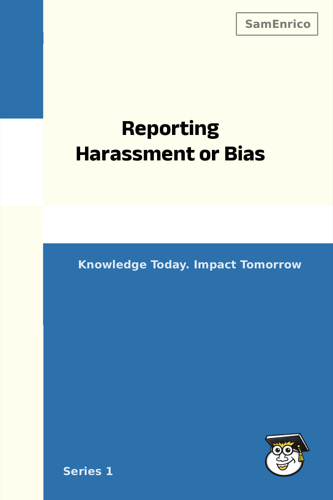
Non-FictionSelf-HelpWorkplace Harassment
Reporting Harassment or Bias eBook
Navigates reporting procedures while protecting yo
Navigates reporting procedures while protecting yourself.
Formats
Free sample
Chapter 1: The Naming Crucible--–- You are reading this because something happened. Or maybe because something has been happening for months, and you have finally reached the point where your stomach clenches every time you see a certain name in your inbox, every time you hear a certain voice in the hallway, every time you walk past a particular office door. You are not sure if it is "bad enough" to report. You are not sure if it is illegal, or just unethical, or merely annoying. You are not sure if you are being brave or paranoid, strategic or self-destructive.
That uncertainty is not a sign of weakness. It is a sign that you are thinking clearly enough to recognize the complexity of what you are facing. This chapter exists to resolve that uncertainty.The Question That Paralyzes Most Targets Before anyone ever files a report, before they write a single email or request a single meeting, they get stuck on one question. It is not "What should I say?" or "Who should I tell?" It is more fundamental, more paralyzing, and far more dangerous. The question is this: Is this actually harassment, or am I overreacting?This question has derailed more good-faith reports than any bad-faith denial ever could.
It keeps targets silent for weeks, months, sometimes years. It allows patterns to become entrenched, witnesses to scatter, and evidence to decay. And it rests on a false premise: that there is a simple, bright-line answer. There is not.The law is not a moral compass. It is a minimum standard.
Something can be deeply wrong, professionally destructive, and psychologically corrosive without being illegal. Conversely, something can be illegal without looking like the dramatic, single-event "quid pro quo" scenes from training videos. The gap between what hurts and what is legally actionable is where most people get lost.This chapter builds a map for that gap. It introduces a framework for categorizing what you have experienced—not to minimize it, not to exaggerate it, but to name it accurately so you can choose the right strategy. Because the single biggest mistake reporting targets make is using the wrong tool for the wrong problem.
Filing a legal complaint about bad management will destroy your credibility. Treating illegal harassment as a personality conflict will leave you unprotected. The difference between those two outcomes is not the severity of your pain. It is the accuracy of your diagnosis.The Four-Category Framework After analyzing hundreds of real-world cases, legal outcomes, and survivor accounts, a clear pattern emerges. Harmful workplace behavior falls into four distinct categories.
They overlap at the edges, but they require fundamentally different responses.Category One: Illegal Harassment This is what most people think of when they hear the word "harassment." Legally, it has two forms. The first is quid pro quo—Latin for "this for that." Someone with authority over your job conditions demands sexual or discriminatory compliance in exchange for keeping your position, getting a promotion, or avoiding some punishment. "Sleep with me or you are fired." "Laugh at my racist jokes or I will reassign you to the night shift." These cases are relatively rare but legally clear.The second form is hostile environment harassment. This is far more common and far more misunderstood. A hostile environment exists when unwelcome conduct based on a protected characteristic (race, sex, religion, national origin, age, disability, or genetic information) is so severe or pervasive that it alters the conditions of your employment and creates an abusive working environment.
Two critical points here. First, the conduct must be based on a protected characteristic. General bullying is not illegal harassment. A boss who screams at everyone equally is not creating a hostile environment based on race or sex. He is just a terrible manager.
Second, the conduct must be severe or pervasive. A single off-color joke is unlikely to meet this standard. A weekly pattern of degrading comments, unwanted touching, and sabotage almost certainly will.Category Two: Illegal Discrimination Discrimination is different from harassment, though they often travel together. Harassment is about the climate of the workplace. Discrimination is about decisions.
You are being discriminated against if you are treated differently than similarly situated colleagues because of a protected characteristic. This includes being passed over for promotion, receiving lower pay, being assigned worse shifts or offices, being excluded from important meetings, or being terminated under circumstances that suggest bias.Discrimination can be harder to spot because it often hides inside legitimate business decisions. Your boss promotes a less qualified man instead of you. Your manager assigns the desirable projects to younger colleagues. Your department head excludes you from strategy meetings while including everyone at your level.
Each of these could have a nondiscriminatory explanation. The question is whether the explanation is honest or a cover.Category Three: Bullying (Non-Protected)Bullying is real, it hurts, and in many workplaces it is entirely legal. This is the hardest truth in this chapter. Bullying refers to repeated, health-harming mistreatment that is not based on a protected characteristic. It includes verbal abuse, threatening conduct, humiliation, sabotage of work, and exclusion.
It is malicious and damaging. But if your boss targets you because she dislikes your personality, not because of your race or religion, federal law does not protect you. Some states have anti-bullying laws for public employees, but for most private-sector workers, bullying is a matter of company policy, not legal right.This does not mean you should tolerate it. It means your strategy changes. You cannot file an EEOC charge for bullying.
You can file a complaint with HR, but your leverage is different. You are asking the company to enforce its own values, not comply with federal law. That is a weaker position, but not a hopeless one.Category Four: Bad Management Bad management is the catch-all for everything else. A boss who takes credit for your work. A supervisor who withholds information you need to do your job.
A manager who plays favorites, changes rules arbitrarily, or communicates through passive-aggressive emails. These behaviors are frustrating, demoralizing, and sometimes career-limiting. They are also almost never illegal.The line between bad management and bullying is often subjective. The line between bullying and harassment depends entirely on whether the behavior targets a protected characteristic. A manager who yells at everyone is a bad manager.
A manager who yells only at women is potentially a harasser. The same behavior, different category, different strategy.The Case Studies That Make It Real Theory is useful. Stories are unforgettable. Consider three scenarios.Scenario A: The Pattern of Exclusion Maria is the only Latina in her twelve-person department. Her manager, David, has never made a single explicitly racist comment.
But he consistently assigns the high-visibility projects to white colleagues. He "forgets" to invite Maria to client meetings. When she speaks in team meetings, he looks at his phone. When she sends email suggestions, he responds with one-word answers or not at all. Meanwhile, her white peers receive detailed feedback and public praise.
Maria has documented this pattern for six months.Where does this fall? David has not asked for sex. He has not used slurs. But his behavior is based on race and sex…
This is the end of the free sample. Get the eBook to keep going. Buy now
About this book
Details
- Author
- Derrick Robbie
- Publisher
- SamEnrico
- Language
- English
- Genre
- Non-Fiction, Self-Help, Workplace Harassment
- Released
- 2026-06-09
- Pages (approx.)
- 134
- Available as
- eBook, Audiobook

Read better in the ZLOADR app
Your eBooks on your phone or tablet. Sign in with your SamEnrico account and start reading.
More by Derrick Robbie
 IBS And Antibiotic History GuideDerrick Robbie$11.99
 The Willingness vs WillfulnessDerrick Robbie$11.99
 Berta Caceres Honduran StruggleDerrick Robbie$11.99
 The Step Zero Acceptance GuideDerrick Robbie$11.99
 Resting Metabolic Rate TestDerrick Robbie$11.99Resting Metabolic Rate TestDerrick Robbie$11.99
 Environment Design for HabitsDerrick Robbie$11.99
 Home Alcohol Detox RisksDerrick Robbie$11.99
 The Invisible Hand: The Whistleblower Who Cracked the Panama PapersDerrick Robbie$11.99
 Hannibal's Ghosts: The DNA of Genius in the Second Punic WarDerrick Robbie$11.99
 Service Providers Guide to Physical TherapyDerrick Robbie$11.99
 How to Produce Train CasesDerrick Robbie$11.99
You may also like
 Hong Kong Handover 1997Dunn Johnnie$11.99
 Zumba For Postnatal Recovery CourseNeal Christian$11.99
 Zumba for BeginnersLadner Nikia$11.99
 YouTube Comment Mining GuideHumes Pandora$12.99
 Worry Box MeditationCarlin Rudy$11.99
 Workplace Stress MeditationNguyen Lynn$11.99
 Workplace Stress and Sleep RepairHawley Ivory$11.99
 Workplace Perfectionism CureDelaney Jeffry$11.99
 Workplace Injustice Anger GuideWallen Isabelle$11.99
 Work Addiction and Burnout LinkGreenwood Ester$11.99
 Women in Yoga and WellnessBeattie Galina$11.99
 Women in Stand Up ComedyChun Evangeline$11.99