
Non-FictionCrisis ManagementRemote Work
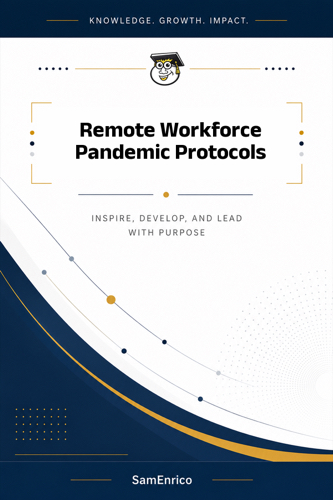
Remote Workforce Pandemic Protocols eBook
Shift your entire team to secure remote operations
by Hand Valorie
Shift your entire team to secure remote operations in under 48 hours without losing productivity.
Formats
Free sample
Chapter 1: The 2 PM Email--The email arrived at 2:17 PM on a Tuesday. The subject line read: “Immediate Action Required – Building Closure.” Seventeen minutes later, the CEO’s assistant had booked a crisis call for 3:00 PM. By 3:45 PM, the head of IT was on the phone with their VPN vendor, begging to raise the concurrent user cap from 500 to 2,000. By 5:30 PM, the head of HR had printed out 847 emergency remote work agreements and realized they had no way to get them signed. By 8:00 PM, the first employee had messaged their manager: “My home internet is down.
What do I do?” By 10:00 PM, the CEO had gone to bed without sending the company-wide email. By 6:00 AM the next morning, the building was still closed. By 9:00 AM, 30% of the staff couldn’t log in. By 11:00 AM, the CEO wished they had sent that email at 10:00 PM.This is not a hypothetical scenario. It is a composite drawn from interviews with seventeen leaders who lived through emergency remote pivots between 2020 and 2025.
Their stories share a single, haunting commonality: the twenty-four hours between “we might need to go remote” and “we are going remote” cost them more productivity, more security, and more morale than the following six weeks combined. Hesitation, in an emergency remote transition, is not a risk management strategy. It is the risk.This book exists because that 2:00 PM email is coming for your organization. It might be a pandemic. It might be a flood that takes out the ground floor of your building.
It might be a ransomware attack that locks every office computer. It might be a transit strike that leaves 60% of your workforce unable to commute. It might be a government mandate issued at 5:00 PM on a Friday. The trigger does not matter. What matters is that when that email arrives, you will have exactly forty-eight hours to move your entire team to secure remote operations without losing productivity, without suffering a breach, and without watching your culture crumble into a thousand Slack messages sent at midnight.This chapter is not a warm-up.
It is the difference between those who pivoted well and those who pivoted poorly. In the pages that follow, you will learn why hesitation is the single greatest predictor of failure, how to distinguish between a planned remote transition and an emergency remote pivot, and the exact framework you need to make the “go remote” decision before your building actually closes. By the end of this chapter, you will have a Trigger Matrix that removes ambiguity from the decision, a 48-Hour Leadership Triage Checklist that tells you what to do in what order, and a crystal-clear understanding of why the first company-wide email you send matters more than the next fifty combined.The Trigger Problem Let us start with an uncomfortable truth. Most leaders are terrible at making decisions under time pressure. This is not an insult.
It is a well-documented cognitive phenomenon. When humans face high-stakes decisions with incomplete information and a ticking clock, we default to one of two dysfunctional patterns: premature closure (making a decision too quickly with insufficient analysis) or analysis paralysis (waiting for more information that will never arrive in time).Emergency remote transitions trigger both patterns simultaneously. The stakes feel high because they are high. The information is incomplete because it always is in a crisis. And the clock is ticking because every hour you wait is an hour your team spends wondering what is happening, checking their phones, and not working.
The result is a uniquely toxic leadership dynamic: leaders who wait for perfect information, then make a rushed decision based on incomplete data, then execute that decision poorly because they ran out of time.Consider the case of a regional healthcare network we will call Coastal Health. In early 2020, when the first pandemic lockdowns were announced, the CEO convened a task force. They met for three hours. They debated the reliability of VPN connections. They argued about whether home internet would be sufficient for telemedicine platforms.
They discussed the legal implications of sending patient data home. At the end of three hours, they decided to “wait and see” for forty-eight hours. Forty-eight hours later, the state government mandated remote work for all non-essential healthcare staff. Coastal Health had zero hours of preparation time. They spent the next two weeks in chaos: VPN crashes, employees without laptops, and a near-miss data breach when a physician saved patient records to their personal Google Drive.
The CEO later admitted, “We knew on Tuesday what we needed to do. We waited until Thursday because we were scared. The waiting cost us everything.”This pattern is so common that it has a name in crisis management literature: the “wait and see” trap. The trap operates on a seductive logic. If we wait, we might get more information.
If we wait, the crisis might resolve itself. If we wait, we can make a better decision. The problem is that in an emergency remote transition, the opposite is true. The crisis will not resolve itself. More information will arrive, but most of it will be about how bad things are getting, not about how to fix them.
And every hour you wait erodes the one resource you cannot recover: time to execute.The Trigger Matrix To escape the “wait and see” trap, you need a decision framework that removes ambiguity and automates the “go remote” call. This framework is called the Trigger Matrix. It is a simple, objective set of thresholds that, once crossed, activate the remote protocol without further debate. The Trigger Matrix does not ask you to decide. It tells you that the decision has already been made by the conditions you agreed to in advance.The Trigger Matrix consists of five independent triggers.
If any one of these triggers is met, you initiate the 48-hour remote pivot. You do not wait for a second trigger. You do not call a meeting to discuss whether the trigger really counts. You execute.Trigger One: Building or Infrastructure Failure If your primary workspace becomes physically inaccessible for twelve hours or more, activate the pivot. This includes flood, fire, power outage, internet outage, or any other infrastructure failure that prevents 50% or more of your staff from working in the office.
Note the threshold: twelve hours. A two-hour power outage is an inconvenience. A twelve-hour power outage is a transition event. The distinction matters because many leaders wait for “permanent” closure before acting. By then, it is too late.Trigger Two: Commute Disruption If 20% or more of your staff report that they cannot commute to the office due to transit strikes, road closures, weather events, or public health restrictions, activate the pivot.
This trigger is often overlooked because leaders assume that 20% is “manageable.” It is not. When 20% of your staff cannot get to work, the remaining 80% are working with incomplete teams, picking up slack, and burning out. More importantly, the 20% who cannot commute are the canary in the coal mine. Commute disruptions rarely improve. They worsen.Trigger Three: Government Mandate If any government authority (local, state, or federal) issues a directive that recommends or requires remote work for organizations like yours, activate the pivot.
Do not wait for enforcement. Do not wait for clarification. Do not wait for the “final” version of the mandate.…
This is the end of the free sample. Get the eBook to keep going. Buy now
About this book
Details
- Author
- Hand Valorie
- Publisher
- SamEnrico
- Language
- English
- Genre
- Non-Fiction, Crisis Management, Remote Work
- Released
- 2026-06-11
- Pages (approx.)
- 155
- Available as
- eBook, Audiobook

Read better in the ZLOADR app
Your eBooks on your phone or tablet. Sign in with your SamEnrico account and start reading.
More by Hand Valorie
 Loving Kindness for Yoga InstructorsHand Valorie$11.99
 The Last Group Home GirlHand Valorie$11.99
 Tallow and Lard GuideHand Valorie$11.99
 Monthly Goal SystemHand Valorie$11.99
 Recovering from StumbleHand Valorie$11.99
 Nobel Laureates in VaccinologyHand Valorie$11.99
 Grief and Guilt After SpouseHand Valorie$11.99
 The Duel of the Dukes: How Two Rival Aristocrats Built Europe’s First Professional Football ClubsHand Valorie$11.99
 Beatrix Farrand: The Garden That Defined America's Gilded AgeHand Valorie$11.99
 How to Produce Marine RadarHand Valorie$11.99
 Service Providers Guide to Tour GuidesHand Valorie$11.99
 A Collector's Handbook to the Morris HlHand Valorie$11.99
You may also like
 Hong Kong Handover 1997Dunn Johnnie$11.99
 Zumba For Postnatal Recovery CourseNeal Christian$11.99
 Zumba for BeginnersLadner Nikia$11.99
 YouTube Comment Mining GuideHumes Pandora$12.99
 Worry Box MeditationCarlin Rudy$11.99
 Workplace Stress MeditationNguyen Lynn$11.99
 Workplace Stress and Sleep RepairHawley Ivory$11.99
 Workplace Perfectionism CureDelaney Jeffry$11.99
 Workplace Injustice Anger GuideWallen Isabelle$11.99
 Work Addiction and Burnout LinkGreenwood Ester$11.99
 Women in Yoga and WellnessBeattie Galina$11.99
 Women in Stand Up ComedyChun Evangeline$11.99